Archive | February, 2026

Faith Sees in Anticipation

28 Feb

Tom, a recovering alcoholic, faced another challenge: to quit smoking. He confessed to many failed attempts. I asked what was the worst part. He said the first four days were torture for his family; he was like a bear with a sore head and impossible to live with. I wanted to climb Mount Whitney and proposed we take four days to do it so that he could “bear” it out in a remote location. As a pilot, Tom suggested a scouting flight over the 14,505-foot peak before we set foot on the trail.The view was an awe inspiring contrast of snow-capped sentinels and the parched Mojave Desert until the musing was shattered. At 16,000 feet, the wind attacked. The aircraft bucked violently, the wind torqued the plane so violently that the passenger door wrenched open, and I found myself staring down at Lone Pine. From that altitude the layout looked remarkably like a cemetery.

In that moment when I thought I was going to die, I discovered a calm. It is this tension—facing death—that defines genuine faith. True faith is not the panic during the storm, but the calm trusting confidence in God. 

Previously we saw how Habakkuk reoriented himself by focusing on the character of God amidst a violent storm. https://progressingpeople.wordpress.com/2026/02/26/faith-enables-perseverance/

Here he takes the next step:  “I will stand at my watch and station myself on the ramparts; I will look to see what he will say to me and what answer I am to give to this complaint” (Habakkuk 2:1). 

God responds with a vivid contrast: “The arrogant person stands tall in his own eyes, confident in his strength, his intellect, his position. But something inside him is twisted. His inner life is misaligned. His confidence rests on himself, and that foundation is unstable.

In contrast, the righteous person lives differently. He does not rely on pride, power, or appearances. He lives by trust—steady, enduring trust—in God. His life is sustained not by self-assertion, but by faithfulness.” (2:1-4)

The contrast is sharp. One life is powered by self-reliance; the other is sustained by trust. The proud person may look secure, but his foundation is unstable. The righteous person may look vulnerable, but his foundation is firm. It is about what you lean on when the world shakes.

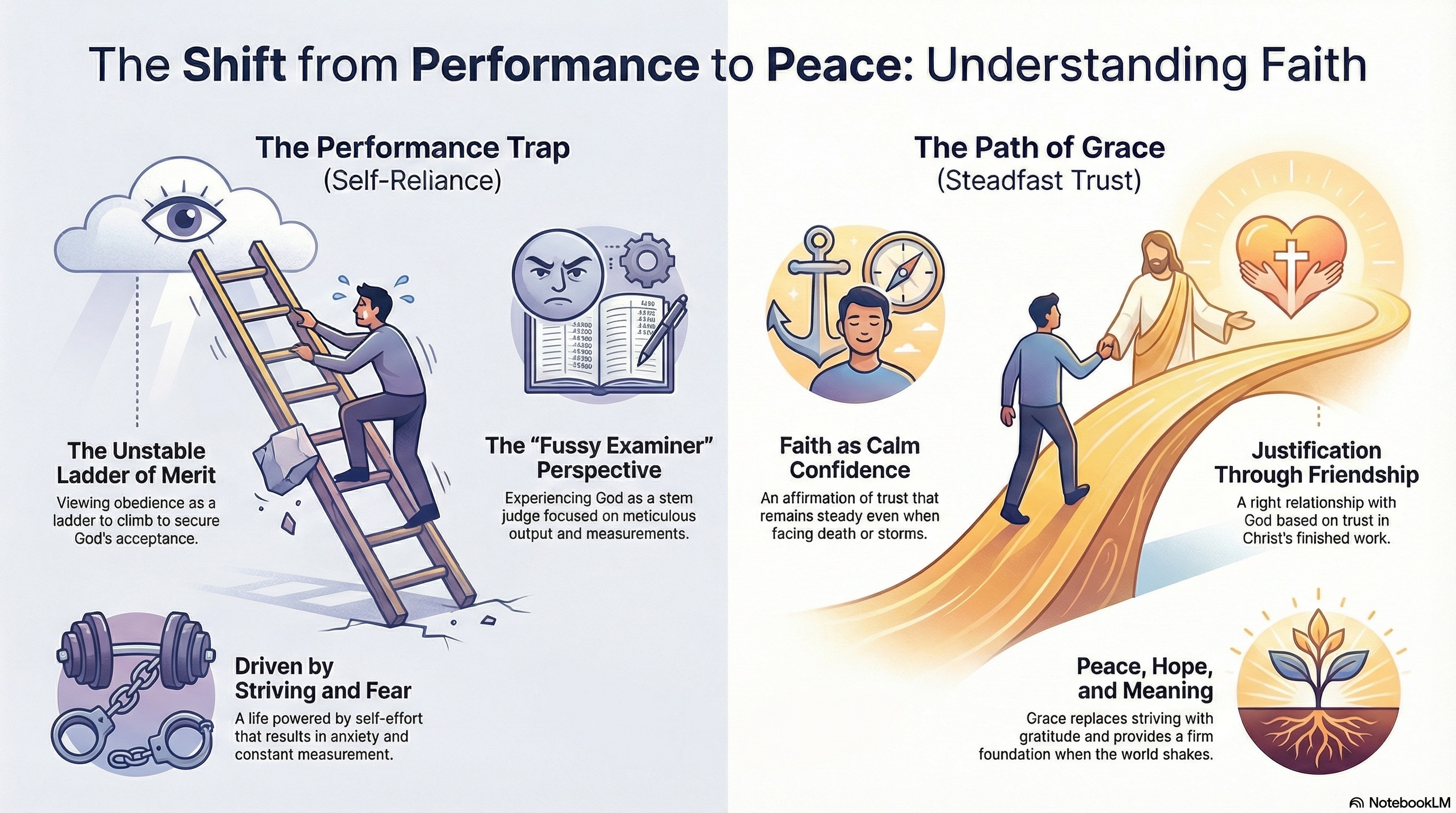
God resolved the crisis in a single sentence: “The righteous shall live by his faith.” That is the essence of the Christian message. The trajectory of “the just” can be explored: it began as covenant loyalty—a desire to walk faithfully with God—was replaced by increasingly detailed interpretations of keeping the Law. Over time righteousness was measured by precision that required breath taking analysis rather than trust. The commandments multiplied in straining to apply them. In such an atmosphere, God was experienced less as a gracious companion, a Deliverer and more as an Examiner, fussy and stern. Against this drift, God’s words stand clear: life does not flow from meticulous self-effort, but from steadfast trust.

What began as a heartfelt desire to please God morphed into self-righteousness. It became a system of performance, defined by being meticulous to a bewildering extent. A person’s standing before God was measured by output. Obedience was no longer a response to love, but a ladder used to secure acceptance. God upended this climb. Being “just” was not about the height reached on the ladder of performance, but about the gracious bestowal of Friendship.

To be justified is to stand in a right relationship with God—to be friends with God. “Justified by faith” describes a grace-based relationship that rests not on performance or accumulated merit, but on trust in Christ’s finished work. Obedience is a response to love, not a test to pass. 

Love Struck or Duty Bound

Performance-based relationships keep us measuring, striving, fearing. 

Grace-based relationships replace anxiety with assurance and striving with gratitude.

Whenever this truth—that we are justified by faith alone—is rediscovered, it acts like a match to dry wood.

Martin Luther in the 16th century was trapped in a system of religious performance and indulgences. When he realized that Habakkuk’s and Paul’s words offered a way out through trust, he renounced the system. That change of perspective started the Reformation.

John Wesley was shaken by his fear of death during a violent transatlantic crossing, in contrast to Amish emigrants singing joyfully. Later, while listening to a reading of Luther’s preface to Romans, he found his heart “strangely warmed.” He moved from trying to be a Christian to trusting the Christ who had already done the work.

This “strangely warmed heart” was instrumental in the Great Awakening in the USA. It was characterized by the realization that God was not a distant judge to be appeased, but a present reality to be encountered by anyone standing on the watchtower of faith.

Martyn Lloyd-Jones of Westminster Chapel insisted that justification by faith and the benefits in Romans 5:1–11—peace, access, hope, and meaning, even in suffering—are the heart of Christian experience. And they are the result of Jesus our Lord being delivered over to death for our sins and raised to  life for our justification. (Rom 4:31) 

By abandoning the ladder of self-effort, the focus moves from the climber to the Creator. We long for peace and hope; for that we need access to God. We long for an explanation of suffering; for that we need perspective. These longings belong to our existence as moral beings.

To be justified is to stand in a right relationship with God—to be friends with God. “Justified by faith” describes a grace-based relationship that rests not on accumulated merit, but on trust in Christ’s finished work. 

Performance-based relationships keep us measuring, striving, fearing. Grace-based relationships replace anxiety with assurance and striving with gratitude.

Next time: Faith is not a Leap into Dark.
Faith Enables Perseverance

26 Feb

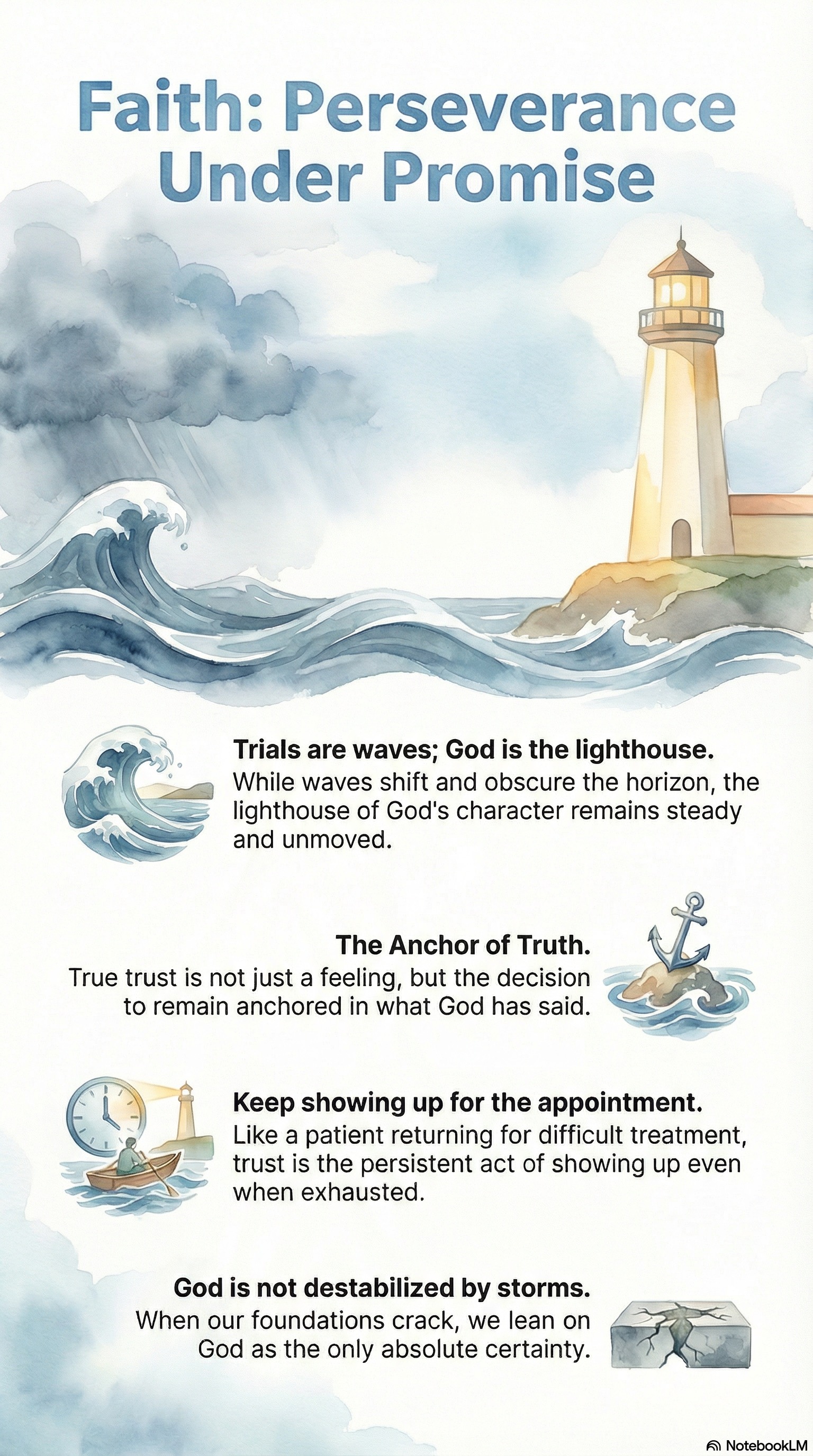
Imagine yourself in a small ship on a violent sea. Thunder splits the sky, and waves rise like mountains, dropping you into valleys so deep that the world disappears. In the trough of the wave, you see nothing but walls of shifting water; the horizon is gone, and the shore is a memory.

Then, a Word breaks through the roar of the storm, like a shaft of illumination from a lighthouse:

“For the earth will be filled with the knowledge of the glory of the Lord, as the waters cover the sea.” — Habakkuk 2:14

When you are in the trough, the light vanishes. You are surrounded by the spray and the dark. But as you crest the wave, you see it gain—steady, and unwavering. 

“But the Lord is in his holy temple; let all the earth keep silence before him.” — Habakkuk 2:20

The lighthouse never shifted; it did not flicker or fail. Only your position changed. These promises are beams of light from a distant, permanent shore.

Those who know God trust Him. When the foundation of our world begins to crack, we don’t lean on our circumstances; we lean on our deepest-held certainty: God as the only absolute. God is not destabilized by what destabilizes you.

Persevering Faith

I saw this lighthouse-faith in my friend Julia. She faced a rare and deadly metastasis of melanoma; what had begun on her skin had migrated to her lungs. There was no known treatment at the time. The prognosis was six months of life remaining.

Her physician proposed an aggressive, unproven course of action. There were no guarantees, only severe side effects and a slim margin of hope. In a profound act of surrender, Julia had faith in him and entrusted her life to his hands.

The path was brutal: thirteen chemotherapy cocktails, administered three weeks apart. Each infusion left her depleted for an entire week. Her skin burned a vivid red against her blonde hair. She had every reason to quit. As each appointment approached, the dread intensified. But she kept returning. Today, the cancer is defeated. She lives now with gratitude sharpened by the edge of survival.

The Anatomy of Trust

Julia’s faith was not merely what she professed with her lips; her faith was that she kept showing up. To abandon the treatment would have been to abandon confidence in the promise.

Habakkuk wrestled with this question: Can God be trusted in a collapsing world? In his day, national life was unstable and international powers were predatory. We live shaky lives in a shaking world that grows more shaky by the day.

Habakkuk anchored himself not in his circumstances, but in God’s character. He affirmed that God is Holy, God is the Rock, and God is enthroned. The lighthouse stands outside the storm; it is not subject to the tides.

Trust is not the repetition of a creed. It is the act of returning for the next appointment. It is enduring the side effects of a life of faith. It is standing in silence before the Lord when the waves rise high enough to obscure the light.

Faith is perseverance under promise.


Coming Next: From the Trough to the Tower

In the midst of the storm, we look for the Lighthouse to survive the next wave. But what happens when we step out of the ship and onto the solid ground of the Rampart?

Next, we’ll explore God’s word to Habakkuk – the just live their faith.—a posture of anticipation that sparked the Reformation, warmed the heart of John Wesley, and fueled the Great Awakening, and is the key to a full Christian experience. Don’t just endure the storm; learn how to watch for the dawn.

Navigating the Darkness: From Anxiety to Peace

21 Feb

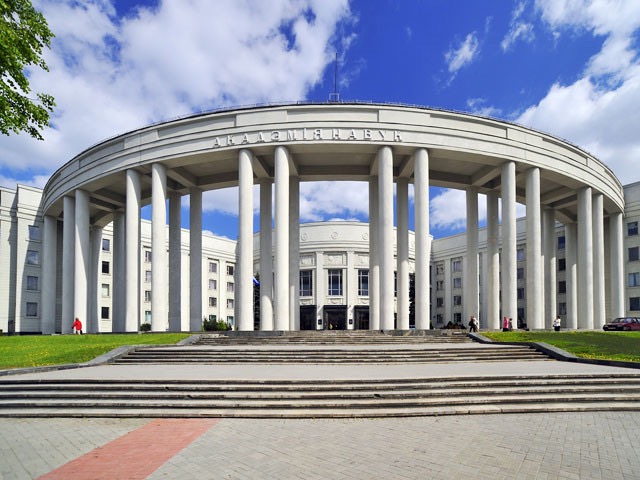
I once had the terrifying experience of getting lost in Minsk, Belorussia.. With rising panic, I tried to retrace my steps, but nothing registered. No one spoke English and people shrugged then ignored me when I asked for help, the signs were all in Cyrillic, the phone booths were stripped of equipment, bare wires protruding and smelling of urine. I felt doomed until, in entirely the wrong direction according to my perceptions, I saw the monument outside the metro station where I disembarked every morning on my way to teaching at The International Leadership Academy. The recognition of that landmark was the critical turning point that allowed me to reorient myself.Habakkuk 1:12–17 presents a crisis that every pilgrim eventually faces. It isn’t just that God is silent; it’s that His actions feel hostile—even evil. Habakkuk looks at the brutal Babylonians and anguishes over the mystery. “Why do You stand idly by while the wicked swallow up those more righteous than they?”

Pilgrims are disoriented by the mysterious ways of God, impacting their mindset and the trajectory of their lives. Pull out of the flow of alarmed thought, and switch your bewildered focus from the circumstances to God.

Habakkuk 1:12–17 presents a crisis that every pilgrim eventually faces. It isn’t just that God is silent; it’s that His actions feel hostile—even evil. Habakkuk looks at the brutal Babylonians and anguishes over the mystery. “Why do You stand idly by while the wicked swallow up those more righteous than they?” 

Pilgrims are disoriented by the mysterious ways of God, impacting their mindset and the trajectory of their lives. Pull out of the flow of alarmed thought, and switch your bewildered focus from the circumstances to God.

Stop! Look for a Landmark!

Notice Habakkuk’s  focus on God as Holy. “Lord, are you not from everlasting?  My God, my Holy One, you will never die.”

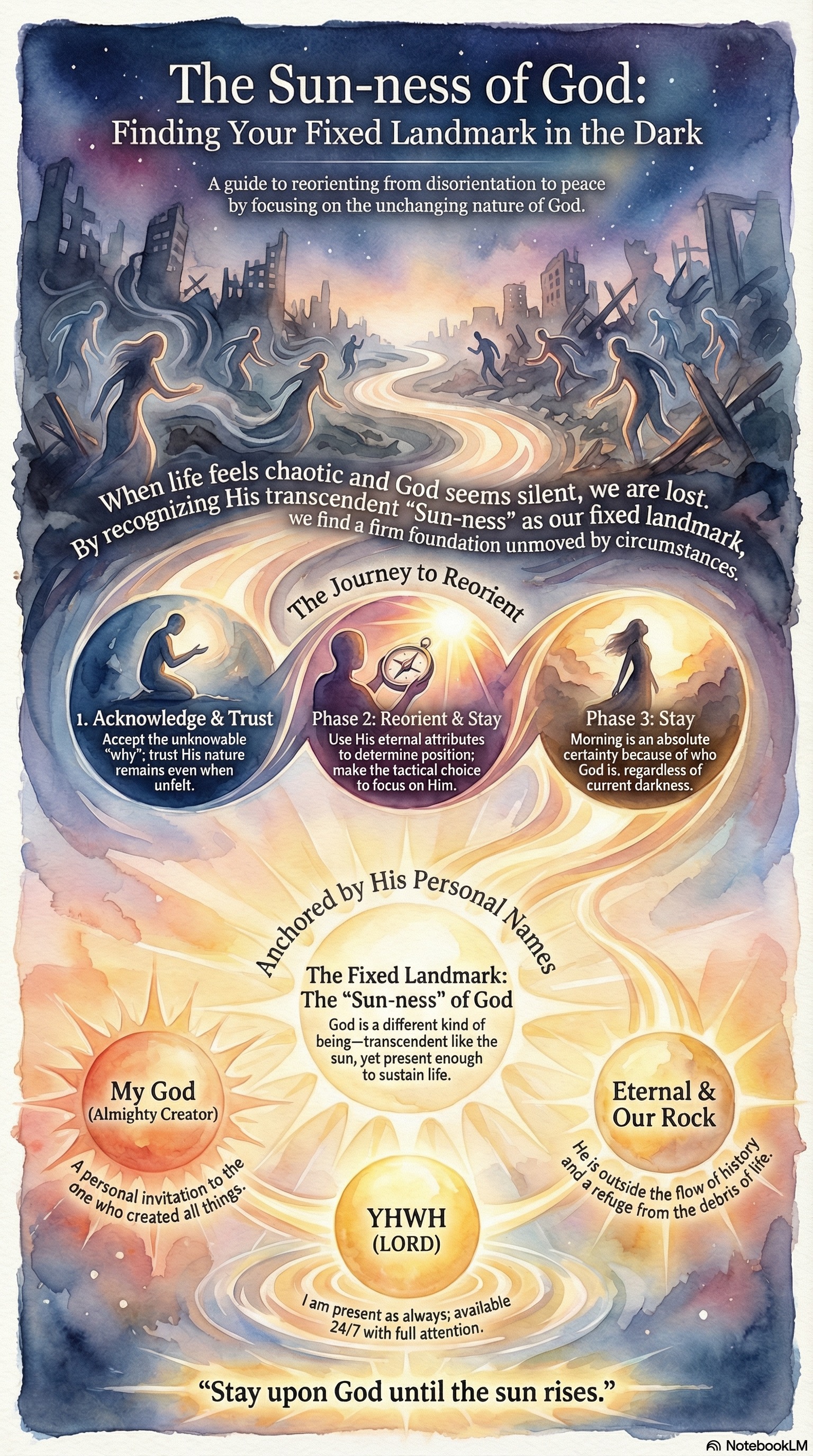
The “Sun-ness” of God: Holy means Distinct

To reorient, we must understand God as our landmark, specifically His holiness. Think of the difference between a drawing of the sun and the actual sun. You can look at a sketch, touch the paper, and understand its shape. But you cannot “touch” the sun; its heat, power, and brilliance would vaporise you long before you made contact.

Holiness is God’s “sun-ness.” He is not just a better version of us; He is a different kind of being entirely. However, this “otherness” does not mean He is inaccessible. Like the sun, God is too great to be controlled, but He is also too present to be ignored. The sun is 93 million miles away, yet its “sun-ness” is exactly what allows it to reach across the vacuum of space to sustain life. His transcendence (being above us) is precisely what makes His immanence (being with us) possible.

When you are lost  you must find a landmark that is fixed. Because God is “Holy”—the “Sun-ness” outside of our creation—He is the only truly fixed point. When Habakkuk stood on his watchtower, he didn’t look at the Babylonian army to find his peace; he looked at the “Sun-ness” of God.

To use this landmark:

  • Acknowledge: Accept that you cannot understand the “why” of every event. God begins where our data collection ends.
  • Trust: Even when you can’t feel the heat, the “Sun-ness” of God remains.
  • Reorient: Use His attributes to determine your position. If God is eternal, this crisis is temporary.

Distinct not Distant – The Personal Name: YHWH

“O LORD,” says Habakkuk. That is the personal name that God revealed to Moses when he tried to dodge going to tell Pharaoh, an absolute despot with no accountability, to let  “my people go.”  LORD (YHWH) describes His activity: “I am present as always,” available 24/7 with full attention. Unlike a human gatekeeper who might deny access, God’s attention is always full because His holiness tells us He is different.

Affirm these personal landmarks:

  • He is “LORD”. (YHWH) 
  • He is “MY God”: A personal pronoun; respond to the personal invitation.
  • He is”my GOD“: The Hebrew word means “Almighty Creator”.
  • He is “Eternal”: He is outside the ebb and flow of history.
  • He is “Our Rock”: A firm foundation – a refuge outside of the debris flow.

The Voice That Sustains the Weary

Isaiah 50 addresses the darkness from the perspective of the Servant—the voice that sustains the weary. This is not the rehearsed art of an orator; it is a voice that carries weight because the speaker is literally nailed to a cross in the darkness.

 During the unnatural night of the crucifixion, Jesus cries out in anguish: “My God, my God, why have you forsaken me?”  Yet, after that cry of abandonment eventually comes the calm, trusting voice of faith: “Into Your hands I commend my spirit.”

Jesus acts as the bridge between the “Sun-ness” of God and our human frailty. Just as the atmosphere allows us to experience the sun’s light without being consumed by its raw heat, He is the “radiance of God’s glory”—the brilliance of the sun brought down to eye level. He absorbed the darkness so that we might walk in the light.

When you find yourself in the “pitch-black room” of a personal crisis, the natural instinct is to scramble for a flashlight—to fix the problem, find an answer, or force a resolution. But Isaiah offers a different strategy for the pilgrim: Stay.

Staying Upon YHWH – Leaning against a Rock

Staying is not a sign of defeat; it is a tactical choice of focus. It is the refusal to let the chaos of the immediate “alarmed thoughts” drown out the reality of the fixed landmarks. By orienting yourself toward the “Sun-ness” of God, you recognize that while you are currently in the shadow, the Sun itself has not moved, dimmed, or changed.

You are leaning against a Rock that is higher than the debris flow. You are listening to a Voice that has already navigated the deepest darkness and emerged with a calm, commendatory faith.

If you are walking in darkness, stay upon God until the sun rises. For the pilgrim, the morning is not just a possibility; because of who God is, it is an absolute certainty, the one and only sure thing in a changing world.

The Babylonians still invade. Jerusalem was sacked. Captivity lasted seventy years.

But Habakkuk, as we shall see, was not sighing anymore, after seeing, he began singing. 

Stay tuned!

Navigating Life When Faith Doesn’t Make Sense

17 Feb

Pilgrim in Process: When Faith Sighs

Navigating the Salt Basins and High Sierra Peaks

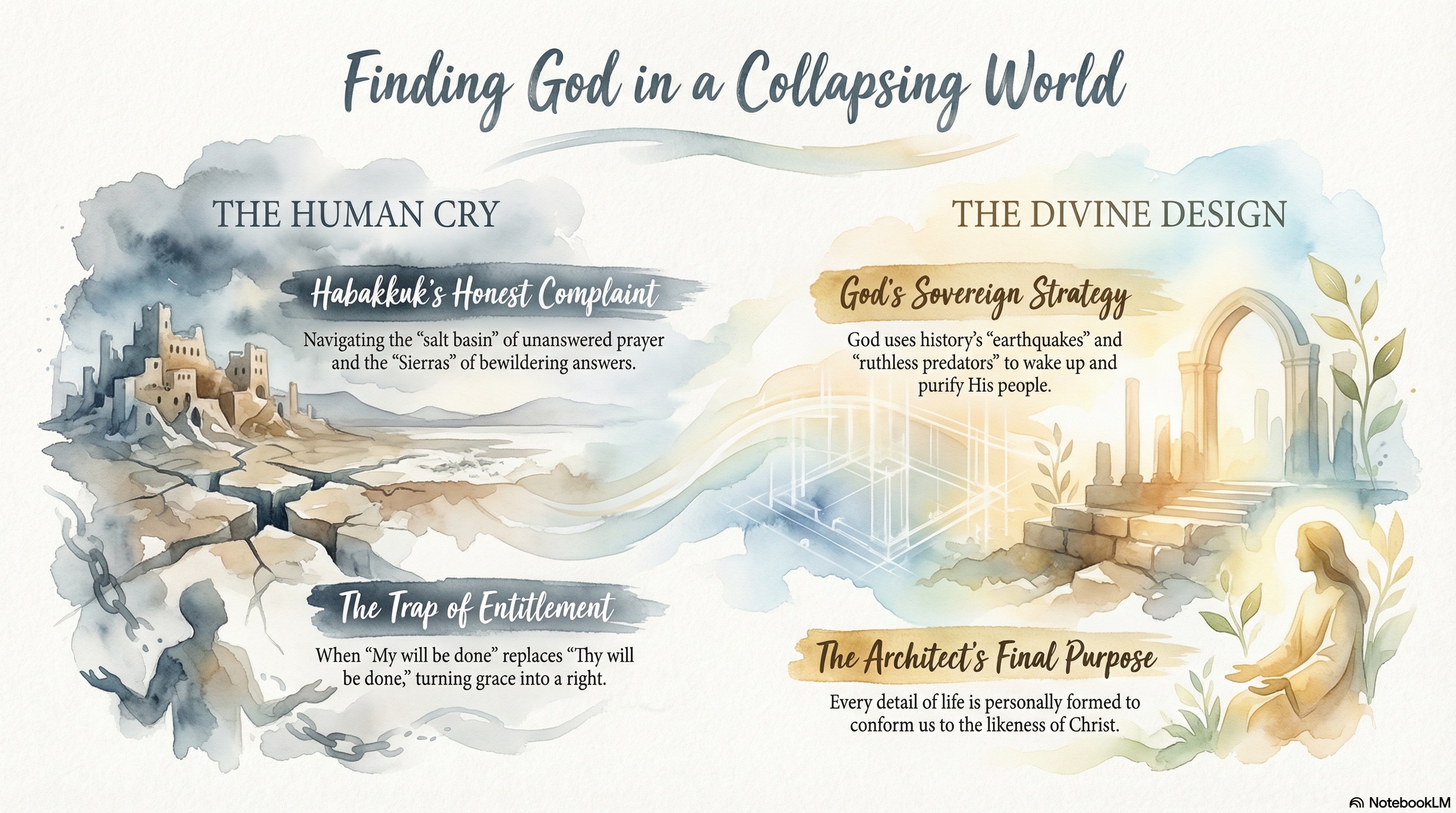
The pioneers who trekked across the salt basin in Utah and crossed the Sierras faced obstacles that killed some and turned others back. For the spiritual pilgrim, the journey involves similar barriers: the salt basin represents unanswered prayer, while the Sierras represent answers to prayer. It may seem counterintuitive, but answers to prayer can often become our greatest obstacles. Every prayer is answered—whether granted, refused, or delayed—but it is the “bewildering answers” that are completely unacceptable to us that cause us to stumble.

1. The Human Cry

Habakkuk’s ancient frustration feels remarkably modern. He looked at a world where destruction and violence were constant, strife abounded, and the law seemed paralyzed. His cry was raw and honest: “How long, Lord, must I call for help, but you do not listen? Or cry out to you, ‘Violence!’ but you do not save?”. Habakkuk was not posing abstract theological riddles; his world was literally crumbling. The nation was decaying from within, and a ruthless predator was approaching from without.

Practical Application: Don’t be afraid to bring your “sighs” to God. Habakkuk’s example shows that faith often begins with an honest complaint about the injustice and wrongdoing we see in our own lives and the world.

2. The Shocking Answer

When God finally answered Habakkuk, it was a “geopolitical earthquake”. God told him to be “utterly amazed” because He was doing something unbelievable: He was raising up the Babylonians. God described them as a “ruthless and impetuous people,” a “feared and dreaded” nation that promoted their own honor and worshiped their own strength as their god. Habakkuk had to wrestle with the reality that God was personally behind the rise of a ruthless enemy marching toward Jerusalem.

Personal Touch: It is a staggering thought that God’s answer to our cry for help might be to send a “Babylonian”—a difficult circumstance or a person that acts as a “wake-up call” when we have grown “dull of hearing”.

3. The Entitlement Trap

Why do we stumble over these shocking answers? Often, it is because we fall into a trap of entitlement. Just as a teenager might turn a one-time relaxed curfew into a “right” or a “bargaining chip,” we often turn God’s grace into a personal merit that we feel we have earned. This logic thrives whenever “My will be done” replaces “Thy will be done”. When this happens, we begin to view God as a “Supermarket” where blessings are expected on demand—an ornament to our lives rather than the sovereign Lord.

Practical Application: Take a moment to audit your prayers. Are you treating God as a Sovereign Lord to be trusted, or as a “Supermarket” where you are shopping for conveniences? Entitlement produces anger when refused; faith produces trust.

4. The Grand Design

Scripture reveals that history is not a chain of random events, but a Grand Design arranged toward redemption. In the “fullness of time,” God used centuries of preparation—Greek language, Roman roads and order, philosophical curiosity, spiritual desire awakened—to weave His redemptive plan.

If God carefully directs the rise of empires, His purpose reaches into the details of our personal lives to conform us to the likeness of Christ.

  • God is the Architect; you are the campus.
  • The “bulldozers, sawdust, and nail guns” of life are not signs of destruction, but the Architect’s tools serving an eternal purpose.
  • These trials become the “steel framework” of your life—a bulwark against life’s storms.

As a Pilgrim in Process, we must learn that prayer matures from making demands to seeking intimacy. The goal is not to bend God to our will, but to know Him, trust Him, and rest in His purposes.

Does the idea of God as an “Architect” change how you view the “bulldozers” currently at work in your own life? Which are you facing right now: a silent “salt basin” or a “Sierra peak” answer that feels like an obstacle?

Let’s Talk

I would love this to become a conversation. Please share your anecdotes, questions and insights in the comments.

Points to Ponder

In the context of your “Pilgrim in Process” journey, do you find that your current “sighs” are born out of a frustration that God isn’t following your blueprint, or a desire to understand His?

Does the idea of God as an “Architect” change how you view the “bulldozers” currently at work in your own life? I’d love to hear your thoughts on how you navigate those “salt basins” of unanswered prayer.

The Pilgrim’s Trajectory of Faith

14 Feb

 Habakkuk- a Modern 3000 Year Old Pilgrim

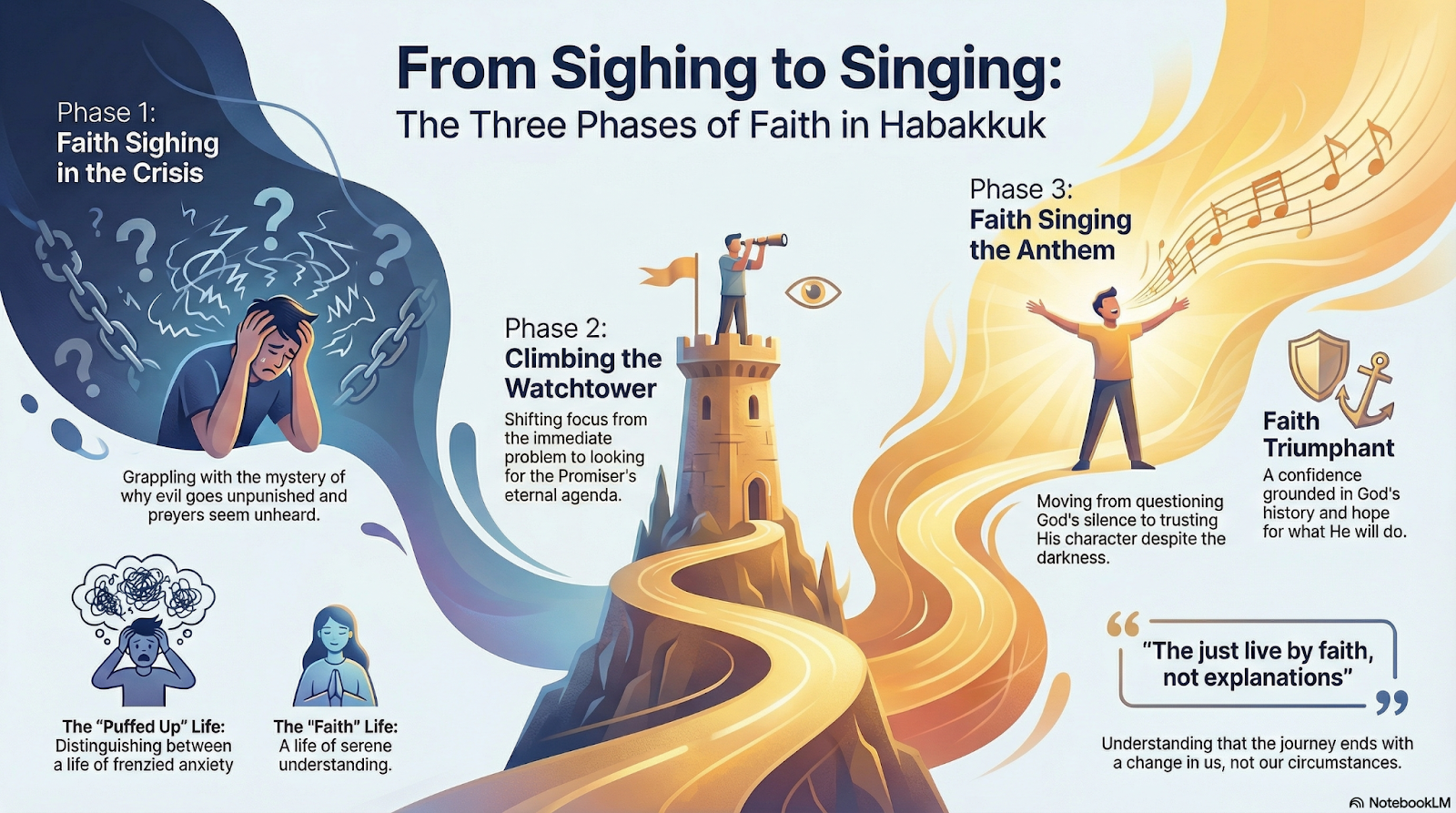
Faith Sighing in the Valley of Silence

The agonizing question: Where is God when the world burns? 

The Math Doesn’t Add Up:

– the confusing reality where evil goes unpunished;

– The unthinkable answer –  a brutal marauding army, raised up by God Himself.

 Pilgrims often find  their faith under fire, sighing in agonizing confusion.

 Faith Seeing from the Rampart

The Pilgrim trusts God and watches  and waits expectantly:

– Pilgrims avoid The “Puffed Up” restless approach, the impatient demand for an immediate answer.

– Pilgrims don’t live by what they can see right now; they live by who they know

Faith is faithfulness – it is a verb, not a noun. This is not passive sitting; it is active, as demonstrated in the Grand Finale.

Faith Singing in the Grand Finale

The journey ends not with a change in circumstances, but a change in the Pilgrim:

– The Pilgrim moves from questioning God’s silence to trusting His character. 

– This is faith triumphant—grounded in the history of what God has done, and confident in what He will do. 

The Pilgrim  no longer sighs at the mystery; even when suffering the ravages of a ruthless enemy. He sings in a rising crescendo:

I will still be joyful and glad,
    because the Lord God is my savior.

The Sovereign Lord gives me strength.
    He makes me sure-footed as a deer
    and keeps me safe on the mountains.  (Habakkuk 3:18-19)

This very modern 3000 year old book will be explored in six coming posts. Stay tuned.

For Pilgrims, Destination Becomes Destiny

9 Feb

For Pilgrims, Destination Becomes Destiny

Overlooking the North Rim of the Grand Canyon, the setting sun casting shadows in shades of cobalt and indigo, accentuating the crags and crevices with a fleeting, golden splendor, I heard an exhilarated cry: “We made it!”

A group had just arrived from the South Rim—a grueling, 11-hour trek across the heart of the canyon. I was instantly hooked. My gracious wife agreed to drive to our South Rim reservation, and I would hike the canyon.

Comparing routes on a map, the decision seemed like a no-brainer – the North Kaibab Trail was four miles shorter than the Bright Angel Trail. Looking back, it wasn’t a “no-brainer” — it was a case of “no brain.”

The Descent and the Warning

The descent to Phantom Ranch was magical, even mystical — the 14-mile drop of 6,000 feet was sheer delight – awe and wonder every step of the way. However, I was met with a sobering sign. In foot-high letters, it warned hikers not to take the Kaibab ascent lightly. My internal translation: “Don’t be an idiot. This might kill you.” 

The plan was pre-arranged ans I was committed. I set off and the song in my heart soon became a groan. Those final seven miles took seven grueling hours.

I crested the rim as a different person, and the canyon was no longer just a postcard; it was an experience etched into my psyche.

From Place to Purpose

A pilgrim has a destination in mind, but along the way, a transformation occurs. The destination becomes a destiny — the deeper purpose a person grows into through calling, formation, and faithful response. It is a shift from “getting there” to “becoming the kind of person who belongs there.”

What exactly is our destination? For the pilgrim, the destination is to know the will of God. – “Do not be conformed to this world, but be transformed by the renewal of your mind, that by testing you may discern what is the will of God, what is good and acceptable and perfect.” 

1 The Incidental Will of God

We naturally crave to know God’s will for our daily decisions. These are “incidental”. A passenger once asked a boat captain how he navigated a treacherous harbor entrance so unerringly.

“You see those three lights?” the captain replied. “I align my ship up until all three are in a single row. That alignment shows me the safe channel.”

Navigating the tricky waters of the journey requires alignment. Think of these Three Harbor Lights as your markers:

  • Circumstances: A true harbor light isn’t a door we kick down; it’s a path that clears as we walk in obedience.
  • Scripture: is the fixed light that never shifts. If a “circumstance” seems to lead toward something God prohibits, the lights are out of alignment. We don’t need a new sign when we already have a clear command.
  • Wise Counsel: In the heat of the journey, we often have “trail blindness” —  choosing a shorter route because it looks faster on a map. Wise counsel provides the perspective of those who have walked these miles before us.

2 The Primary Will of God

Our ultimate destination is Heaven. However, the pilgrimage is about more than just a future arrival; it is about character formation en route. We seek to know God now so that Heaven, being face to face with God, is current enjoyment.

Paul prays for a “complete knowledge of His will. “The word for “know” used here—epignosis—is a composite word made up of the intensifier epi (think “epic”) joined to the verb “to know.” It is an intense, experiential, epic knowledge. It is the difference between reading a map of the Grand Canyon and hiking the Canyon for yourself. .

When we know God as Guide, Encourager, and Mentor, we aren’t just waiting for a distant reward. We are being forged in real-time, changed into the image of Christ — not through a legalistic keeping of rules, but through a delightful relationship. As the Psalmist says, “The Lord makes firm the steps of the one who delights in him; though he may stumble, he will not fall, for the Lord upholds him with his hand” (Psalm 37:23-24).

This internal delight isn’t meant to be lived in a vacuum, in a quiet corner of spiritual isolation. On the contrary, when we truly delight in Him, it creates a spiritual centrifugal force. The closer we get to the center — the more we rotate around the heart of God — the more powerfully we are propelled outward into the lives of others, propelled by the centrifugal force of God’s love into the thick of daily life. Like Ambassadors, we represent the King wherever our incidental lives are lived — from the stress of the workplace to the long silence of a hospital ward. We don’t just point the way to a distant country; we bring the life of that country into the room with us. Your experiential encounter with God isn’t just for your benefit; a pilgrim is an Ambassador representing God. It is in this sense that the destination — becoming like Him — becomes your destiny.

The Profound Gift of Presence

Jesus promised that He would give the Holy Spirit to be with us in His stead; it is as simple as receiving the gift He pledged.

When offered a piece of essential, life-saving advice, you receive it simply, by saying ““Thank you.” The same is true here. All that is required of you is to remember His promise and respond with gratitude. Jesus said, “if we know how to give good gifts to our children, how much more will the Father give the Holy Spirit to those who ask Him?

Don’t overcomplicate it, remember the promise, and say, “Thank you.” Say it so often that gratitude becomes your routine response to life. Say thank You for all the joy, say thank You for all the sorrow. 

And in saying it, know the gift is yours.

The Pilgrim as Farmer

4 Feb

Bridge over Colorado River at Phantom Ranch

Planting Seeds While Passing Through

We often think of the spiritual life as a pilgrimage—a steady, linear walk toward a distant horizon. But in 2 Timothy 2:6, the Apostle Paul startles with an arresting contrast: – the pilgrim is a farmer.

At first glance, these identities seem at odds. A pilgrim is always moving; a farmer is rooted in the soil.If you just looked at the surface, you’d say, “You can’t be both!” But by investigating that paradox, an essential perspective comes into view: – we are called to work hard in our neighborhood(Farmer) while never forgetting that we don’t belong to it (Pilgrim).


Cultivating the “In-Between”

The Pilgrim has his eyes fixed, laser-like, on the destination. But he is not so heavenly minded as to be of no earthly use.

  • Whether it’s our careers, our families, our character, or our community, we are called to plow, plant, and weed with intentionality.
  • Farming is cultivation of the art of waiting. The pilgrim knows the road is long; the farmer knows the growth is slow. Together, they create a soul that isn’t discouraged by a lack of immediate results.

Eating What You Plant

God promises a harvest in this life: “The hardworking farmer ought to be the first to receive a share of the crops.”

This is the secret to spiritual endurance. As you plant seeds of kindness, patience, and truth in the lives of others, you are the first one nourished by them. The “crop” we cultivate on our journey—peace and joy—is exactly what fuels us to keep walking the difficult Pilgrim way with joy.

Patient Endurance

Farmers work for a harvest they cannot see yet. Pilgrims walk toward a home they haven’t yet reached. The present harvest sustains and energizes the Pilgrim.

I once walked from the North Rim to the South rim of the Grand Canyon. I had a pint of water and the advice was to take a gallon. I was badly dehydrating, my mouth dry and my tongue swelling. I was alarmed by my situation. To my relief a ranger appeared and offered me his bottle of water laced with gatorade. It invigorated me in indescribable ways. I set out with renewed energy and gratitude, all my symptoms swallowed up. I was enabled to finish, and to finish strong.

The Lessons:

Grow something beautiful in the soil of today while you keep your eyes on the destination of tomorrow.

Be refreshed by the Ranger, the Holy Spirit,   “Let anyone who is thirsty come to me and drink. Whoever believes in me, as Scripture has said, rivers of living water will flow from within them.” By this he meant the Spirit, whom those who believed in him were later to receive. (John 7:37-39 NIV)