Tag Archives: prayer

Navigating Life When Faith Doesn’t Make Sense

17 Feb

Pilgrim in Process: When Faith Sighs

Navigating the Salt Basins and High Sierra Peaks

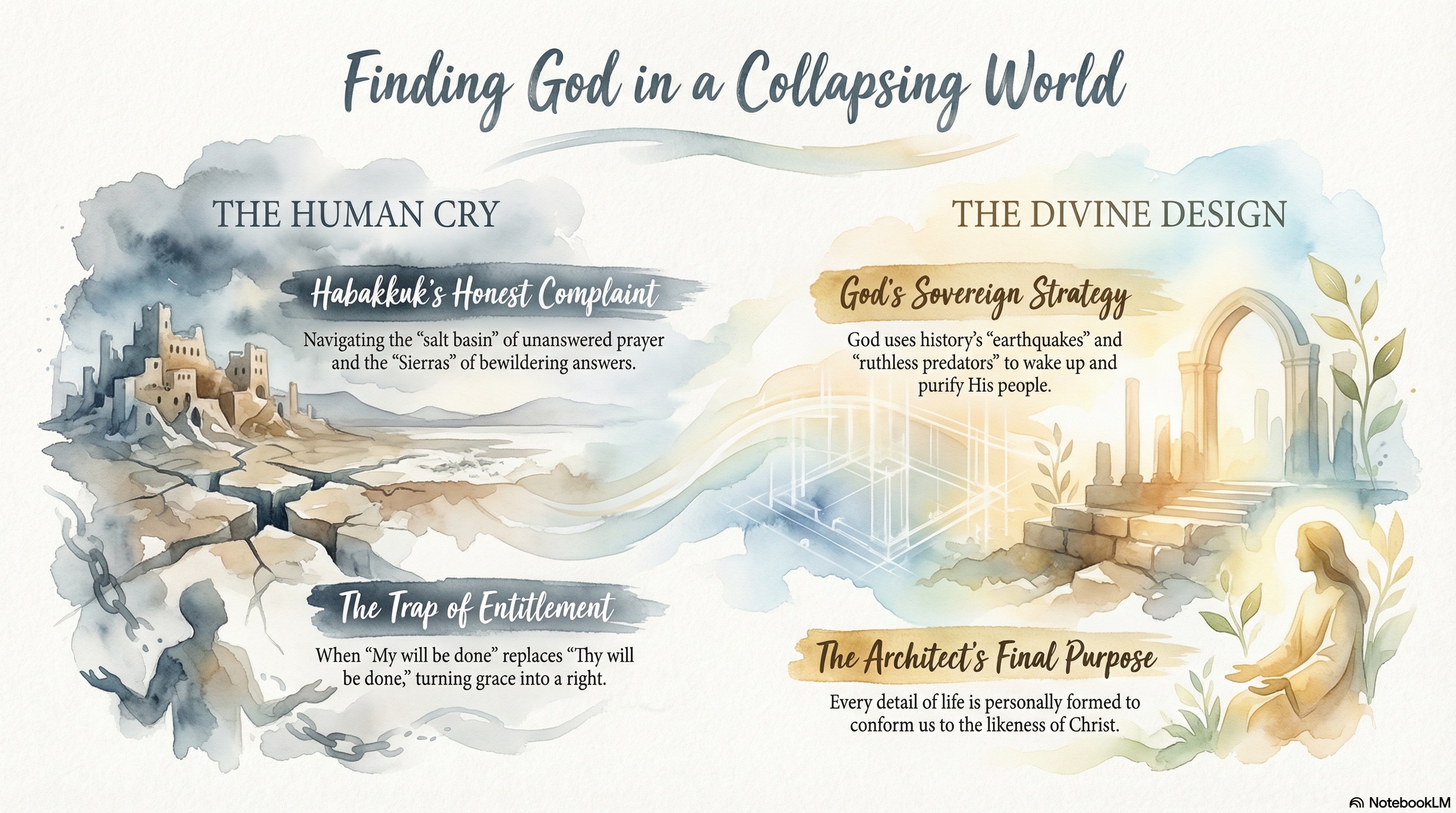
The pioneers who trekked across the salt basin in Utah and crossed the Sierras faced obstacles that killed some and turned others back. For the spiritual pilgrim, the journey involves similar barriers: the salt basin represents unanswered prayer, while the Sierras represent answers to prayer. It may seem counterintuitive, but answers to prayer can often become our greatest obstacles. Every prayer is answered—whether granted, refused, or delayed—but it is the “bewildering answers” that are completely unacceptable to us that cause us to stumble.

1. The Human Cry

Habakkuk’s ancient frustration feels remarkably modern. He looked at a world where destruction and violence were constant, strife abounded, and the law seemed paralyzed. His cry was raw and honest: “How long, Lord, must I call for help, but you do not listen? Or cry out to you, ‘Violence!’ but you do not save?”. Habakkuk was not posing abstract theological riddles; his world was literally crumbling. The nation was decaying from within, and a ruthless predator was approaching from without.

Practical Application: Don’t be afraid to bring your “sighs” to God. Habakkuk’s example shows that faith often begins with an honest complaint about the injustice and wrongdoing we see in our own lives and the world.

2. The Shocking Answer

When God finally answered Habakkuk, it was a “geopolitical earthquake”. God told him to be “utterly amazed” because He was doing something unbelievable: He was raising up the Babylonians. God described them as a “ruthless and impetuous people,” a “feared and dreaded” nation that promoted their own honor and worshiped their own strength as their god. Habakkuk had to wrestle with the reality that God was personally behind the rise of a ruthless enemy marching toward Jerusalem.

Personal Touch: It is a staggering thought that God’s answer to our cry for help might be to send a “Babylonian”—a difficult circumstance or a person that acts as a “wake-up call” when we have grown “dull of hearing”.

3. The Entitlement Trap

Why do we stumble over these shocking answers? Often, it is because we fall into a trap of entitlement. Just as a teenager might turn a one-time relaxed curfew into a “right” or a “bargaining chip,” we often turn God’s grace into a personal merit that we feel we have earned. This logic thrives whenever “My will be done” replaces “Thy will be done”. When this happens, we begin to view God as a “Supermarket” where blessings are expected on demand—an ornament to our lives rather than the sovereign Lord.

Practical Application: Take a moment to audit your prayers. Are you treating God as a Sovereign Lord to be trusted, or as a “Supermarket” where you are shopping for conveniences? Entitlement produces anger when refused; faith produces trust.

4. The Grand Design

Scripture reveals that history is not a chain of random events, but a Grand Design arranged toward redemption. In the “fullness of time,” God used centuries of preparation—Greek language, Roman roads and order, philosophical curiosity, spiritual desire awakened—to weave His redemptive plan.

If God carefully directs the rise of empires, His purpose reaches into the details of our personal lives to conform us to the likeness of Christ.

  • God is the Architect; you are the campus.
  • The “bulldozers, sawdust, and nail guns” of life are not signs of destruction, but the Architect’s tools serving an eternal purpose.
  • These trials become the “steel framework” of your life—a bulwark against life’s storms.

As a Pilgrim in Process, we must learn that prayer matures from making demands to seeking intimacy. The goal is not to bend God to our will, but to know Him, trust Him, and rest in His purposes.

Does the idea of God as an “Architect” change how you view the “bulldozers” currently at work in your own life? Which are you facing right now: a silent “salt basin” or a “Sierra peak” answer that feels like an obstacle?

Let’s Talk

I would love this to become a conversation. Please share your anecdotes, questions and insights in the comments.

Points to Ponder

In the context of your “Pilgrim in Process” journey, do you find that your current “sighs” are born out of a frustration that God isn’t following your blueprint, or a desire to understand His?

Does the idea of God as an “Architect” change how you view the “bulldozers” currently at work in your own life? I’d love to hear your thoughts on how you navigate those “salt basins” of unanswered prayer.


Choose Contentment Over Un-Happy-Mess

5 Feb

I find that I have no control over my feelings – I have no idea where they come from, am bewildered by their intensity and dismayed by the turmoil they can promote. Like prowling predators, say a grizzly bear in my attic, emerging to ambush me when I least expect it.

Choice

What I have learned though, is that I can choose what to do with them.

I can focus on them, nurture them and wallow in them. That makes them determinative of my mood, and that in turn controls my reactions to life in general spilling over into behavior. They are in control, they are the landscape in which I live, I am trapped as a victim.

Or I can choose to take control. I do this by examining them and deciding if they are valid. By that I mean, if they are a reflection of unrealistic expectations, harsh self-judgement, embarrassment, shame, or  …   ?They invite me to remain mired in them, trapped by them, controlled by them, but I can evaluate them and decide that they belong in the rearview mirror, not filling the windshield of my life. By weighing them up I can decide they are not worth entertaining.

Acceptance

By acknowledging them, examining them and recognizing them I find I am able to sigh deeply, and then view them as helpful because they have given me insight and I can take what I learned about myself and then walk into the future with a new confidence and maturity. Happiness is in this sense a choice. I cannot control how and when the emotions arise, but I can choose to change my point of view about them. Then something significant occurs –  that elusive thing called happiness is no longer all consuming. (Generally happiness is realized in retrospect, I experience it when I reflect afterwards on a happy event or interaction.) 

A Human Becoming – not a Human Being

The remarkable thing is that I then experience contentment. Contented with who I am, joyful that I am a human becoming who learns from the past; expects more misery in future learning experiences, but know it is part of the rounding out of my personality. Also, it enables me to be sensitive to the moods of those around me. Contentment is a learned state of joyful acceptance, happiness is a yo-yo of conflicting misery. Contentment promotes wholeness, replacing woundedness.

Perspective is essential to every problem: it resituates us and reveals the way ahead,

Instead

How do I escape the quicksand of all encompassing sorrow or anxiety or sadness? A train heading to a washed out bridge needs the switch thrown that will change its track to a safe siding called Contentment. “Stop it!” as a command adds to the stress because like an endless looping video it will not cease. Paul writes in Philippians 4 “Do not worry about anything.” As a blunt command it is cruel, because I then add the worry that I cannot stop worrying to the worry intensifying its terror. He finishes the thought, “Instead .. by prayer, with thanksgiving, make your request known.” Do something else instead. “Instead” is the switch that changes the track of the train.

Prayer with Thanksgiving

Prayer captures the practice that focuses on the worship God. So, I immediately set the problem to one side and engage fully in contemplating God.

He is our Creator: “Try to realize what this means—the Lord is God! He made us—we are his people, the sheep of his pasture. Go through his open gates with great thanksgiving; enter his courts with praise. Give thanks to him and bless his name.  For the Lord is always good. He is always loving and kind, and his faithfulness goes on and on to each succeeding generation.” (ps 100:3-5)

He is our Savior: “…. as I worship, giving thanks to you for all your loving-kindness and your faithfulness, for your promises are backed by all the honor of your name. When I pray, you answer me and encourage me by giving me the strength I need.” Psalm 138:3

He is a Redeemer: “For you know what was paid to set you free from the worthless manner of life …. It was not something that can be destroyed, such as silver or gold;  it was the costly sacrifice of Christ, who was like a lamb without defect or flaw.” 1 Peter 1:18-19. ” “But the LORD says, Do not cling to events of the past

  or dwell on what happened long ago.
19 Watch for the new thing I am going to do.

 It is happening already—you can see it now!
I will make a road through the wilderness
    and give you streams of water there.” Isaiah 43:18-19

He is our Companion. In Psalm 23 replace the personal pronouns with my name. “The Lord is Anton’s shepherd. Anton shall not want.” And so on. Be astonished by this! “He prepares a banquet for Anton,
    He welcomes Anton as an honored guest
    and fills Anton’s cup to the brim.”

Let the astonished delight be expressed in thanks giving.

Request, not Demand

Now make a request, not a demand. Only now, and not before prayer and thanksgiving, do I make a request. It is a request, not a panic stricken screaming demand. And in the light of the prayer, my request may be more like desire for a closer walk with the Shepherd rather than an outright deliverance from the situation; a yearning to let the peace that floods my being with contentment be mirrored in the situation as a testimony to His Living Presence, or asking for wisdom in the fulness of the Holy Spirit. So it it becomes a dynamic process that is like the heavy flywheel of an engine, it keeps momentum going even when the engine is idling.

Practice Makes Contentment

Paul says, and I affirm, it is a state of consciousness that is learned through practice. Just as a skill is obtained through an apprenticeship, so must we practice this dynamic of “Instead”. Every time some emotion disturbs you, determine that you will immediately set the circumstance aside, contemplate God with thanksgiving, and request His Shepherding. Ultimately it will become your reflex action, but only if you take the first faltering steps and make progress through continued practice.