
Tag Archives: god

Beatitude = Profound Contentment

9 Jun

Inflation

This is not monopoly money. It is a genuine 100-billion-dollar banknote issued by the Reserve Bank of Zimbabwe in 2008.

At the height of the country’s hyperinflation, this staggering sum was just enough to buy a loaf of bread and a pint of milk …. provided you ran to the store. If you waited too long, the currency would devalue so rapidly that you would leave with bread, the milk priced far out of reach.

The modern use of the word “bless” has undergone its own hyperinflation. 

  • After a sneeze: “Achoo!” — “Bless you.”
  • When someone makes a tiny mistake: “Aw, bless him, he tried.”
  • Condescension: “Well, bless your heart.”
  • Responding to mild inconvenience: “Bless you, that sounds exhausting.”
  • Thanking someone for something trivial: “Bless you for bringing napkins.”
  • Celebrity acceptance speeches: “God has really blessed me with this award.”
  • Athletes after winning: “Feeling blessed.”
  • Prosperity language: “We’re blessed with a new SUV.”
  • Hashtags: “#blessed” attached to luxury vacations or gym selfies.
  • End of a letter, instead of sincerely: “Blessings to you and yours.”
  • Clichés: “Have a blessed day.” 
  • Humorous idioms: “Bless this mess” on home décor signs.
  • CondesenscIon: “Bless your little heart.”
  • Pity mixed with affection: “Bless him, he doesn’t understand.”
  • Irony: “Oh, bless…” meaning “you poor fool.”

When a word is used to mean everything, it ultimately means nothing.

Gold 

Gold on the other hand, increases in value The idea of blessing involves the bestowment of divine favor and the conferring of divine benefits. It means enjoying everything that God bestows on those He adopts into His family, including all the benefits of belonging to His royal family. A modern rendering of this idea would be an exclamation: “Oh, the supreme bliss of…!”. (The verb is absent in the original Greek, so it is acceptable grammatically, to read them as exclamations.)

Fools Gold

What!?

Whoever heard of the poor in spirit, the meek, or the persecuted as partakers of supreme bliss?. Our culture is the exact opposite: “Kick, bite, scratch, revile” and “look after #1”. 

For them, these exclamations are found in stained glass windows, where an obscure saint with a mournful face has a weird, otherworldly spotlight on his head. 

Platinum

The nature of this bliss is supreme because it is independent of prosperity and outward circumstance. It has to do with character and the Kingdom that is within—the rule of God over your anger, selfishness, greed, and hatred. It is the growth of character into Christlikeness, experiencing the love and life of Christ, who even in agony maintained communion with His Father. This bliss is not food and drink, but righteousness, peace, and joy in the Holy Spirit.

The Hebrew Foundation: Ashrei

Jesus was steeped in the Psalms and very likely had Psalm 1 in mind. It opens with “Blessed! (here the verb is missing and it is probably an exclamation). “Blessed!  This  man!” it is not expressing a religious wish or a prayer for a blessing to be bestowed. It is not a wishful thought, it is a treadmill in a gymn. The Hebrew word is ashrei, an objective declaration of a state of being. “Blessed! This is what rightly ordered, flourishing human life looks like: His delight is in the law of the Lord, meditating on it day and night. He comes through this relentless practice to resemble a tree planted by streams of water, yielding fruit in due season, with leaves that do not wither.

The Greek Translation: Makarioi

The Hebrew scriptures were translated into Greek, they chose the word makarioi to capture ashrei. They bypassed terms that merely mean “praised” or “well-spoken of” or “happy”. In ancient Greek culture, Makarios described a distinct state of deep well-being and fullness of life. It was the word used to describe the gods, who were untouched by ordinary human misery or the shifting winds of circumstance. 

An Unshakable Joy

Because this bliss is supreme, no one and not a single thing can rob us of it. Worldly happiness promotes concern, trouble, and dissatisfaction based on greed and envy. The Beatitudes are not only independent of circumstances, the hardest circumstances actually fuel the bright flame of bliss. We see this in the martyrs, like Perpetua who exclaimed that her execution was her “coronation”. A village of Anabaptist  believers were roped around a stake, waiting for the licking flames to execute them, when a man galloped up and shouted “Wait! I too am one of them!” Then he leapt into the ring of fire.

Here and Now

Furthermore, this bliss is present. There is no sense of “suffer now and be rewarded later”; it is here and now that we enjoy it. These are not spiritual smelling salts for dying saints, but a kick in the pants to exhibit the life of Christ in fellowship with Him in everyday, trying circumstances.

EMT OR HEART SURGEON

Ultimately, this defines the word “Christian”. A Christian is one who is full of bliss. How is this possible? All my natural instincts run contrary to this. It is critical to grasp that Jesus is not prescribing these things as if through sheer will we could live up to them. He is describing people who are in a relationship with Him. He is not performing an angioplasty to clear clogged arteries, He is offering a heart transplant. 

From this new heart a butterfly begins to emerge. Then it spreads its wings and experiences true freedom; freedom from the angst that defines our age.

The Presence of God

The contemporary world measures a “blessed life” almost exclusively by visible, external metrics:

  • Comfort and physical health;
  • Wealth and material success;
  • Influence and social admiration.

Jesus shifts the focus from circumstance to functional alignment. He defines this well-being by how an entity relates to its design:

  • A compass needle is functional when it points north;
  • A train operates correctly when it remains on the tracks;
  • A branch flourishes when it remains joined to the vine.

We flourish when we are rightly aligned with our Creator.

Biblical blessedness is not the absence of suffering; it is the presence of God.

Series: Introduction to Profound Contentment

1 Hologram https://progressingpeople.wordpress.com/2026/05/21/the-beatitudes-becoming-the-hologram/ Becoming the Hologram

2 Illusion https://progressingpeople.blog/2026/06/02/beatitude-profound-contentment/

Beatitude = Profound Contentment

2 Jun

Happiness – an Illusion?

“CNN wishes its many viewers a “Happy Christmas.

Billions of greeting cards are bought each year. The senders fondly express an impossibility: “We wish you a happy New Year” (or birthday, or anniversary). Significant in these greetings is the word “wish”. Happiness will always remain on the wish list; a dream, if not impossible, then certainly so fleeting as to be insignificant. No one can actually grant the wish. 

Consider the parallel of defining the Loch Ness Monster. There are fuzzy pictures and dubious sightings. These indicate that something may exist, but there is strong doubt as to whether it exists merely in beery imagination or in actuality.

When folk describe happiness, it is invariably connected with an emotional state. It is the feeling that arises from:

  • not being haunted by the past,
  • not being worried about financial or bodily security in the present,
  • not being fearful about the future.

But emotions are as fickle and changeable as politicians on campaign. They arise from some unknown inner recess of the psyche and disappear as quickly as a paycheck. Happiness is therefore as shy and elusive as the Loch Ness Monster.

One sure way of achieving an emotional high on a permanent basis would be by purchasing a time-share in the local cemetery. People who are permanently euphoric are generally found in asylums. Yet when reading or talking about happiness, a distinction between “happiness” and “true happiness” soon creeps into the discussion. This illustrates the problem very nicely: how do we distinguish between the two?

And what shall we say about people who live with vicious memories of past atrocities, stare death in the face daily, and have no security because they are refugees, yet still appear to be supremely happy?

The answer is that happiness, the number one quest of the human race, is a chasing after the wind. Billions of dollars are spent annually pursuing what is largely an illusion. Advertisements picture people made happy by the products on display. Like the great migration of gnus across the African plain, people follow the notion that happiness can be had if only they were slimmer, more tanned, drove a fancier car, smoked a different brand, or had more money in the bank. Quacks promising health and wealth flourish no less than their snake-oil forefathers in the Wild West.

How strange then that most people equate the word “happy” with “Blessed”, the word used to introduce each Beatitude.

The reality remains that happiness is as inaccessible as Mars and just as barren.

Next up:  If happiness is little more than a passing emotional weather pattern, then the Beatitudes are either cruel mockery or they are speaking about something entirely different. Jesus calls the poor in spirit, the mourning, the persecuted, and the meek “Blessed.” Whatever He meant, it plainly had nothing to do with the modern pursuit of happiness. The next question therefore becomes unavoidable: what did the word actually mean?

Full disclosure: I use AI as IA (Intelligent Assistant). And no, I am not dyslexic. All the words and ideas are mine alone. I prompt it to smooth the flow, check the logic and check for redundancy. I also use AI for infographics.

The Beatitudes Derivation: each statement begins with Blessed are…”, derived from the Latin word for blessed, beatus. “Favoured by God; enjoying divine grace.

Next up: Blessed! A Word Recaptured! I examine the profound biblical origins of the word “blessed,” The modern use of ‘bless’ has been hyper-inflated, like money in hyper inflation, stripping the word of its original value.

Series :      

1 https://progressingpeople.wordpress.com/2026/05/21/the-beatitudes-becoming-the-hologram/  Becoming the Hologram

EARTHQUAKE!

4 Apr

lasting peace and spiritual revival.

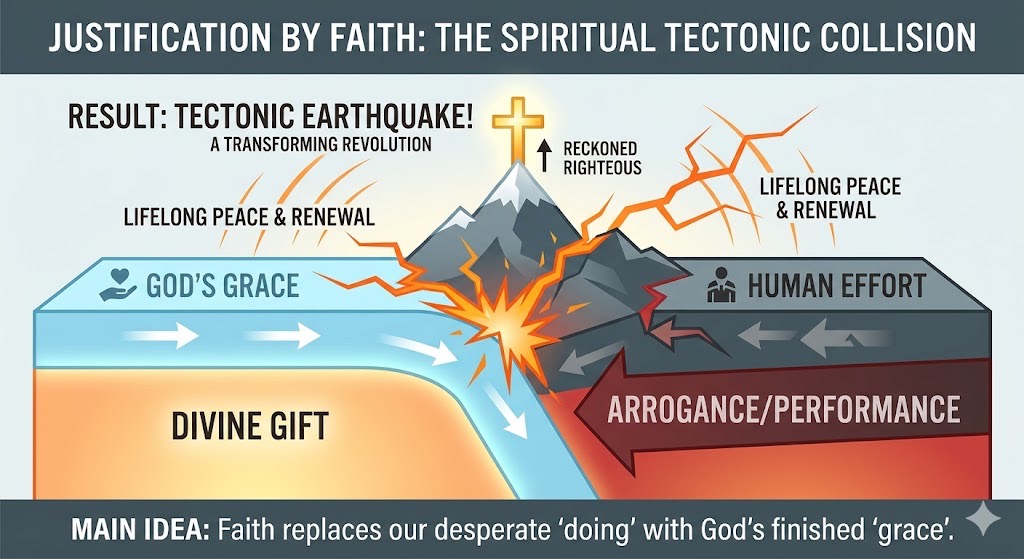
Mount Everest continues to rise about ¼ inch (5 mm) a year due to a massive, ongoing “tectonic smashup” between two tectonic plates: the Indian Plate and the Eurasian Plate. The region is prone toJustification by faith is more than a doctrine; it is a seismic event. It is the moment human effort is swallowed up by divine grace. continuing earthquakes. https://www.youtube.com/watch?v=z4WLHIUU2uU&t=7s

Justification by faith is a tectonic smashup between the grace of God and human arrogance. This contrast is clearly surfaced in the difficulties in prayer: unanswered as well as  answers not to my agenda. (Habakkuk:1-2:5) Human arrogance demands God do what an arrogant human desires. (The many who testify they tested God and he failed them highlight the matter.) Specifically 2:4 “Look at that man, bloated by self-importance— full of himself but soul-empty. But the person in right standing before God  through loyal and steady believing  is fully alive, really alive.” (The Message) 

Paul and the Shock Within Judaism

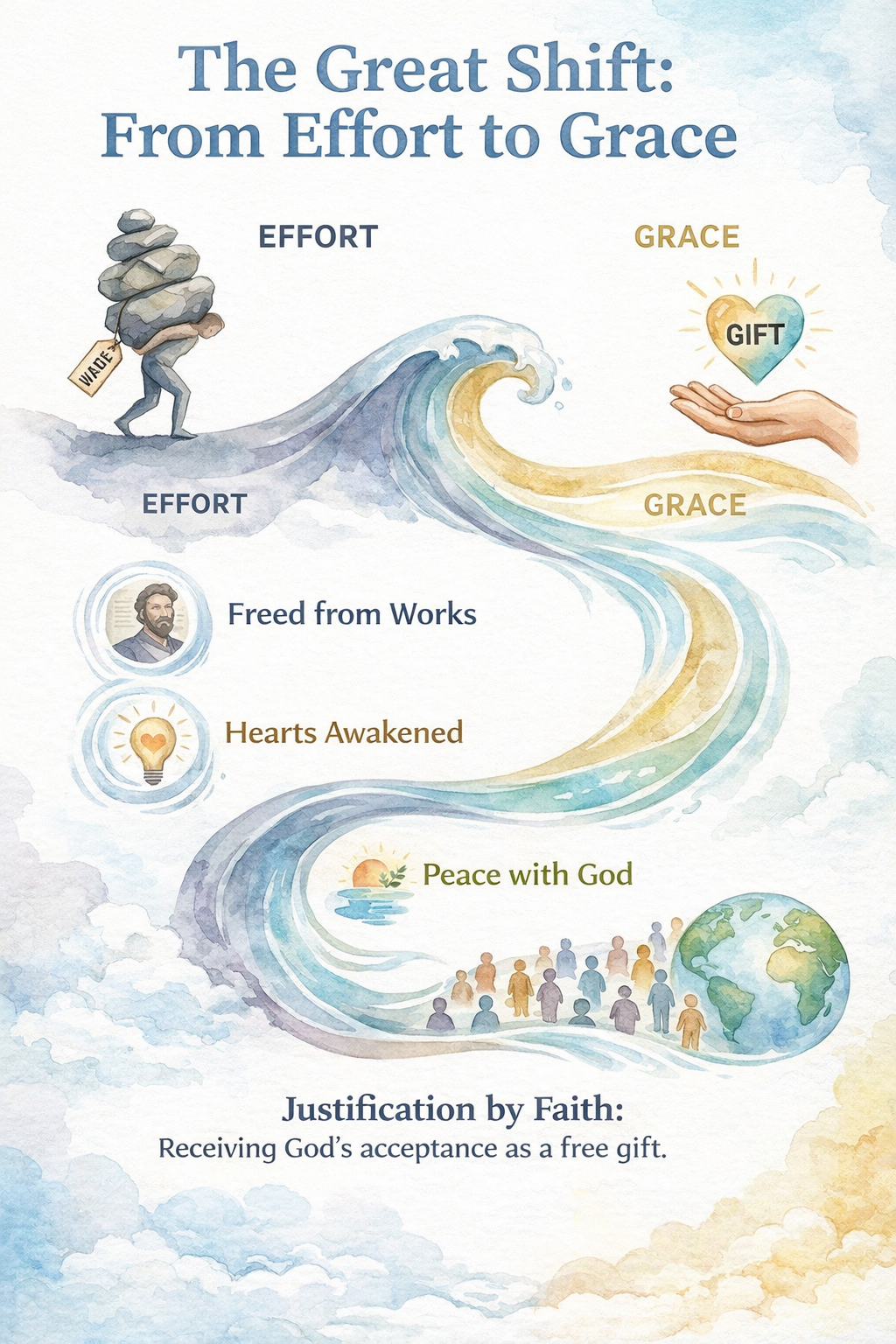
Paul was a Pharisee of the Pharisees, indicating a brand of fussy obedience that was all enveloping. Friendship with God cannot be earned. It is offered as a gift to be accepted. The obverse side to this coin is a pernicious human perception that God requires performance for acceptance. Here is an historical trajectory of the performance model: The Torah, the five books attributed to Moses, were analyzed to contain 613 commandments. The Talmud (which came after Paul) demonstrates where this led: a  63-volume “instruction manual” that explains the 613 details in depth. It is like the tax code of the USA” The “page count” of the U.S. tax code is a moving target because it depends entirely on whether you are looking at the literal laws passed by Congress or the massive library of regulations required to actually follow those laws.As of 2026, here is the breakdown of the length of the tax code:If you only count the actual Internal Revenue Code (Title 26 of the U.S. Code) as published by the government, it is approximately 6,800 to 7,000 pages. 

Paul recognized that it was impossible to be scrupulous enough. His discovery that God declared a person righteous, or justified, based on faith in the doing and dying of Jesus in his place, was a tectonic shift with continuing impact.  Harking back to the revelation made to Habakkuk, he found that accepting the gift of God, offered freely, was pivotal in friendship with God. Mount Everest, after all, is still rising! 

Luther and the Shock Within the Church

More than a thousand years later, the same idea shook Europe.

The medieval church had developed a complex system of penance, sacramental participation, and religious effort. Many believers lived with deep anxiety about whether they had done enough to satisfy God’s perfection. All who were sincere in seeking God lived with quiet anxiety: had they done enough to satisfy God’s perfection?

Martin Luther certainly tried. Reflecting on his years as a monk, he wrote, “If ever a monk got to heaven by monkery, I should have been that monk.” 

Despite his scrupulous observance, he  was wracked by doubt. He thought a pilgrimage to The Holy City would resolve his crisis of faith. Luther ascended the 28 marble steps (which tradition says were the steps Jesus climbed to face Pontius Pilate) on his knees. On each individual step, he stopped to recite the “Our Father” (Pater Noster) and, according to some accounts, kissed the steps where he believed he saw stains of Christ’s blood.  Instead of feeling the spiritual peace or “certainty” he expected, he reportedly stood up and thought (or whispered), “Who knows if it is true?” Maybe God requires a 100 steps, and/or a Pater Noster and a Hail Mary on each step? How do we satisfy perfection?

While teaching the Epistle to the Romans, Luther came to understand that righteousness before God was not something earned but something given through faith. This realization became the shock that led to the Protestant Reformation. The chain from Habakkuk to Paul gained another link, 

The discovery of “justification by faith” brought profound personal relief to Luther and soon spread across Europe. This shift was a geopolitical seismic event: when the established Church in Rome collided with these simplified Biblical truths, the resulting “shockwaves” permanently fractured the monolithic religious landscape, forcing a complete reordering of the map of Europe.

Wesley and the Shock of Methodism
Two centuries later, the same truth again changed a life—with far-reaching consequences.

John Wesley devoted himself to rigorous discipline and the pursuit of holiness. Yet he lacked assurance about his standing with God. That insecurity was exposed during his 1735 voyage to Georgia.

Mid-Atlantic, a storm so violent struck, that even the experienced sailors were terrified.. Waves crashed over the deck, sails tore apart, and passengers panicked, certain they would die. Wesley, though a devout Anglican priest, found himself afraid—without the calm confidence he thought he possessed.

In stark contrast, a group of Moravians calmly sang hymns through the chaos. When Wesley later asked if they had been afraid, their answer was simple: they were not—even their children faced death without fear.

The moment unsettled him deeply. Wesley realized he had religion, but not assurance. His faith was disciplined and sincere, yet lacked the settled trust he saw in them.

The storm did not convert him, but it destabilized him in the best way. It forced a question he could no longer avoid: did he truly trust God, or merely practice religion?

On May 24, 1738, while listening to Luther’s commentary on Romans, Wesley felt his “heart strangely warmed.” He came to trust in Christ alone for salvation.

That shift transformed his preaching. Its impact spread rapidly, helping spark a national awakening. Some historians even suggest it played a role in England avoiding a revolution like France’s.

The Shock in America
The same doctrine ignited the First Great Awakening in eighteenth-century America.

Preachers like George Whitefield and Jonathan Edwards confronted a comfortable assumption: that being right with God came through birth, baptism, or respectable behavior. For many, religion had become little more than inherited custom. Justification, they insisted, comes by faith alone—not by family background, moral effort, or outward religion. A person is made right with God only through a personal, inward trust in Jesus Christ.

Whitefield called people to the “new birth,” pressing for inner transformation rather than external reform. Edwards argued that true religion consists of “holy affections”—a heart genuinely reshaped by love for God. Faith, in their preaching, was not mere agreement, but deep reliance.

This shifted Christianity from cultural assumption to personal encounter. It unsettled the self-assured, yet opened the door to all: anyone could be reconciled to God through faith.

Removing the Bottleneck
The Awakening didn’t just change the message—it changed how it spread.

Before the revivals, preaching was largely confined to ordained clergy, creating a natural bottleneck. Growth was slow, limited by how many ministers could be trained and installed.

But if faith is personal, then testimony becomes universal. Those who experienced new life began to speak of it. The result was explosive: the rise of lay preaching.

Methodists and Circuit Riders
John Wesley’s decision to authorize lay preachers multiplied the movement overnight. Circuit riders carried the message across vast distances—on horseback, in fields, homes, and frontier settlements—spreading Methodism far beyond the reach of traditional structures.

The Baptist Grassroots Model
The Baptists, with their emphasis on local leadership and personal testimony, were already positioned for this shift. Lay preaching fit naturally. Ordinary people with a clear conversion and a gift for speaking could lead, enabling rapid growth across the South and West.

Lay preaching didn’t just support the revival—it fueled it. The message created transformed people; lay preaching turned them into messengers. Together, they reshaped the American religious landscape.

The Personal Shock

The impact of justification by faith is not only historical; it is deeply personal.

In the Epistle to the Romans, Paul writes: “Therefore, since we have been justified by faith, we have peace with God through our Lord Jesus Christ.”

The passage continues through Romans 5:1–12, describing the remarkable results of justification: peace with God, access to God, hope, and glory in suffering, and the assurance of reconciliation, all made real in the power of the Holy Spirit.

For countless individuals throughout history, these words have brought profound relief. The fear of never being good enough is replaced with the confidence that acceptance with God rests on Christ’s work rather than human effort. 

A Message That Continues to Change Lives

From the revelation to Habakkuk, Paul’s proclamation in the first century, Luther’s rediscovery in the Reformation, to Wesley’s awakening of heart, the doctrine of justification by faith has repeatedly brought renewal.

It reminds us that the foundation of the Christian life is not human achievement but divine grace.

And whenever that message is rediscovered, it has the power to transform both history and the human heart.

What’s In It For Me?

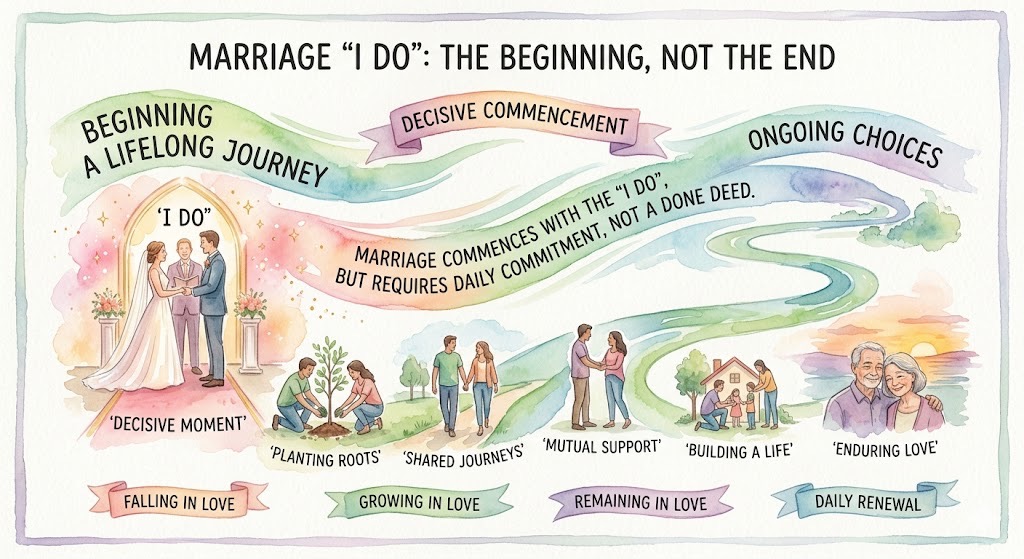
“Revived” medically speaking, is a miracle – a dead body is brought back to life. That, in a spiritual sense, is what happens when someone trusts in Christ. Baptism mirrors this miracle. We are baptized or initiated into His death and Resurrection.  It can be compared to a marriage ceremony where the parties say“I do”. “I do” must not be construed as “I did it!” -as if the ceremony was the conclusion.  it IS a done deed, but with the promise to keep up at it, loving, honoring, tending, 

And that is a description of revival. It begins when you say “I do” to Jesus. That “first love” needs constant renewal, or revival. Each time we feel distant, the way back is to say “I do” in response to God’s question

Say “I do” now! Maybe for the first time. Maybe for the hundredth time. It is a process of falling in love, growing in love and staying in love.

Faith Enables Perseverance

26 Feb

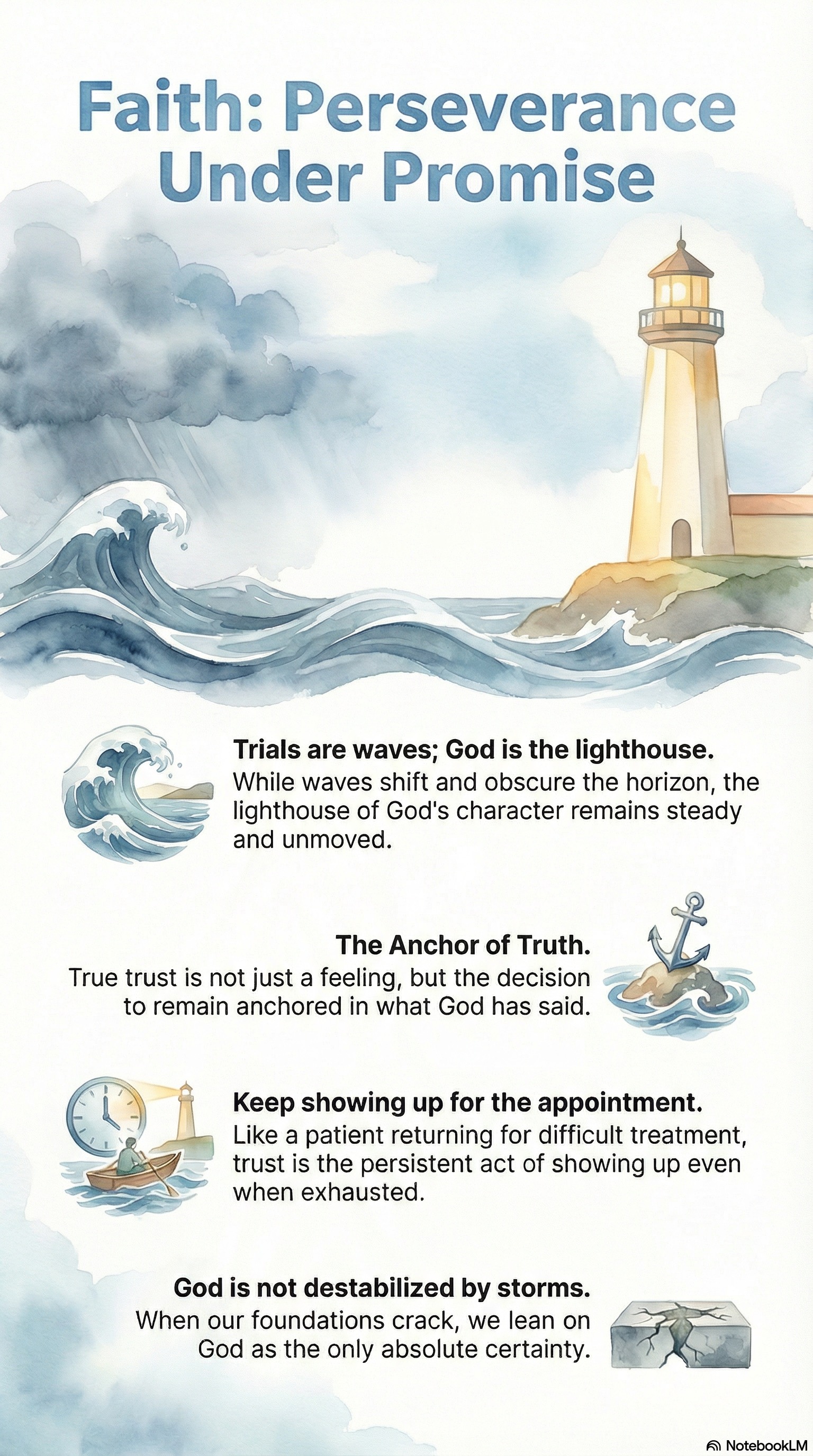
Imagine yourself in a small ship on a violent sea. Thunder splits the sky, and waves rise like mountains, dropping you into valleys so deep that the world disappears. In the trough of the wave, you see nothing but walls of shifting water; the horizon is gone, and the shore is a memory.

Then, a Word breaks through the roar of the storm, like a shaft of illumination from a lighthouse:

“For the earth will be filled with the knowledge of the glory of the Lord, as the waters cover the sea.” — Habakkuk 2:14

When you are in the trough, the light vanishes. You are surrounded by the spray and the dark. But as you crest the wave, you see it gain—steady, and unwavering. 

“But the Lord is in his holy temple; let all the earth keep silence before him.” — Habakkuk 2:20

The lighthouse never shifted; it did not flicker or fail. Only your position changed. These promises are beams of light from a distant, permanent shore.

Those who know God trust Him. When the foundation of our world begins to crack, we don’t lean on our circumstances; we lean on our deepest-held certainty: God as the only absolute. God is not destabilized by what destabilizes you.

Persevering Faith

I saw this lighthouse-faith in my friend Julia. She faced a rare and deadly metastasis of melanoma; what had begun on her skin had migrated to her lungs. There was no known treatment at the time. The prognosis was six months of life remaining.

Her physician proposed an aggressive, unproven course of action. There were no guarantees, only severe side effects and a slim margin of hope. In a profound act of surrender, Julia had faith in him and entrusted her life to his hands.

The path was brutal: thirteen chemotherapy cocktails, administered three weeks apart. Each infusion left her depleted for an entire week. Her skin burned a vivid red against her blonde hair. She had every reason to quit. As each appointment approached, the dread intensified. But she kept returning. Today, the cancer is defeated. She lives now with gratitude sharpened by the edge of survival.

The Anatomy of Trust

Julia’s faith was not merely what she professed with her lips; her faith was that she kept showing up. To abandon the treatment would have been to abandon confidence in the promise.

Habakkuk wrestled with this question: Can God be trusted in a collapsing world? In his day, national life was unstable and international powers were predatory. We live shaky lives in a shaking world that grows more shaky by the day.

Habakkuk anchored himself not in his circumstances, but in God’s character. He affirmed that God is Holy, God is the Rock, and God is enthroned. The lighthouse stands outside the storm; it is not subject to the tides.

Trust is not the repetition of a creed. It is the act of returning for the next appointment. It is enduring the side effects of a life of faith. It is standing in silence before the Lord when the waves rise high enough to obscure the light.

Faith is perseverance under promise.


Coming Next: From the Trough to the Tower

In the midst of the storm, we look for the Lighthouse to survive the next wave. But what happens when we step out of the ship and onto the solid ground of the Rampart?

Next, we’ll explore God’s word to Habakkuk – the just live their faith.—a posture of anticipation that sparked the Reformation, warmed the heart of John Wesley, and fueled the Great Awakening, and is the key to a full Christian experience. Don’t just endure the storm; learn how to watch for the dawn.

Navigating the Darkness: From Anxiety to Peace

21 Feb

I once had the terrifying experience of getting lost in Minsk, Belorussia.. With rising panic, I tried to retrace my steps, but nothing registered. No one spoke English and people shrugged then ignored me when I asked for help, the signs were all in Cyrillic, the phone booths were stripped of equipment, bare wires protruding and smelling of urine. I felt doomed until, in entirely the wrong direction according to my perceptions, I saw the monument outside the metro station where I disembarked every morning on my way to teaching at The International Leadership Academy. The recognition of that landmark was the critical turning point that allowed me to reorient myself.Habakkuk 1:12–17 presents a crisis that every pilgrim eventually faces. It isn’t just that God is silent; it’s that His actions feel hostile—even evil. Habakkuk looks at the brutal Babylonians and anguishes over the mystery. “Why do You stand idly by while the wicked swallow up those more righteous than they?”

Pilgrims are disoriented by the mysterious ways of God, impacting their mindset and the trajectory of their lives. Pull out of the flow of alarmed thought, and switch your bewildered focus from the circumstances to God.

Habakkuk 1:12–17 presents a crisis that every pilgrim eventually faces. It isn’t just that God is silent; it’s that His actions feel hostile—even evil. Habakkuk looks at the brutal Babylonians and anguishes over the mystery. “Why do You stand idly by while the wicked swallow up those more righteous than they?” 

Pilgrims are disoriented by the mysterious ways of God, impacting their mindset and the trajectory of their lives. Pull out of the flow of alarmed thought, and switch your bewildered focus from the circumstances to God.

Stop! Look for a Landmark!

Notice Habakkuk’s  focus on God as Holy. “Lord, are you not from everlasting?  My God, my Holy One, you will never die.”

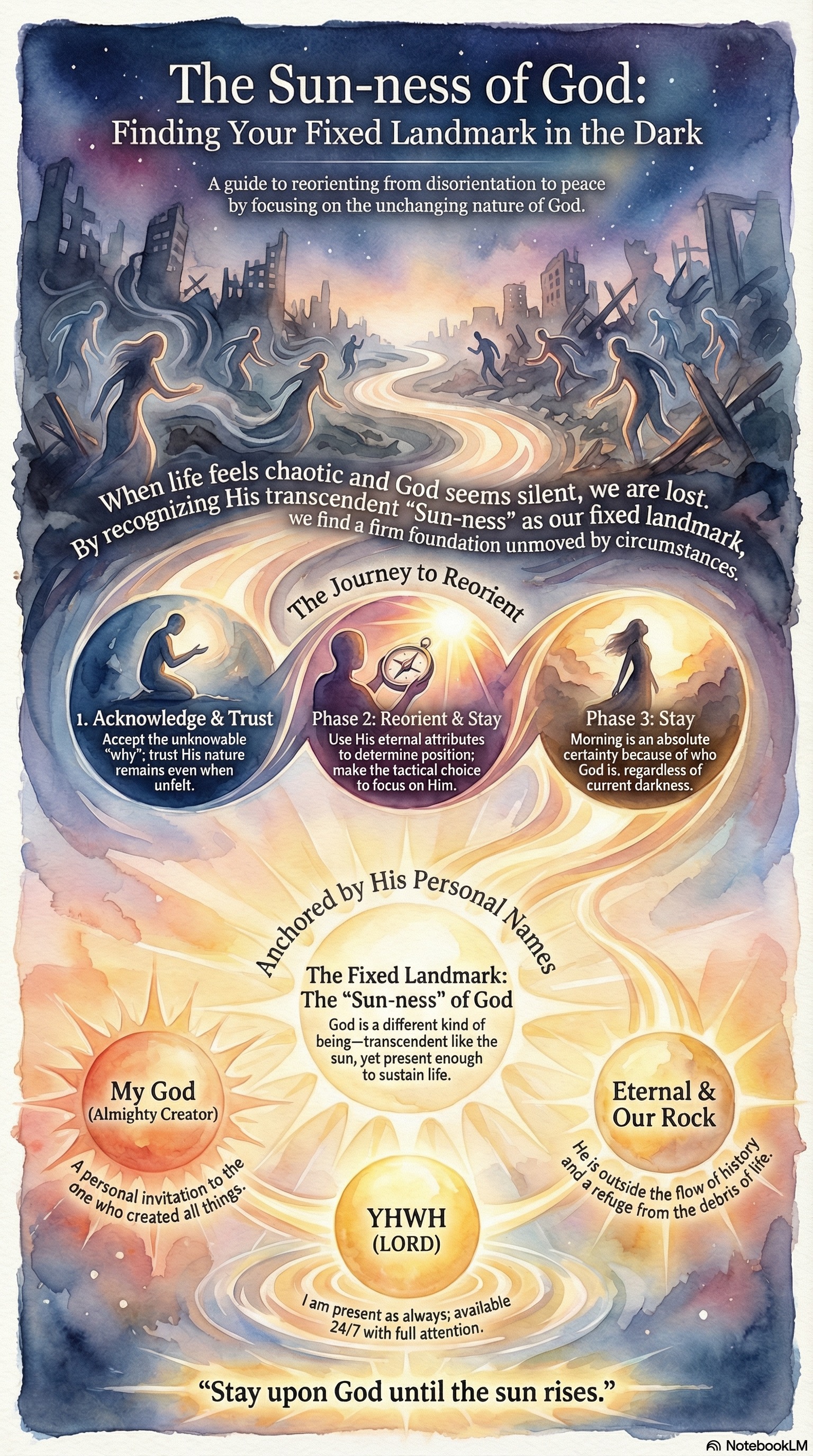
The “Sun-ness” of God: Holy means Distinct

To reorient, we must understand God as our landmark, specifically His holiness. Think of the difference between a drawing of the sun and the actual sun. You can look at a sketch, touch the paper, and understand its shape. But you cannot “touch” the sun; its heat, power, and brilliance would vaporise you long before you made contact.

Holiness is God’s “sun-ness.” He is not just a better version of us; He is a different kind of being entirely. However, this “otherness” does not mean He is inaccessible. Like the sun, God is too great to be controlled, but He is also too present to be ignored. The sun is 93 million miles away, yet its “sun-ness” is exactly what allows it to reach across the vacuum of space to sustain life. His transcendence (being above us) is precisely what makes His immanence (being with us) possible.

When you are lost  you must find a landmark that is fixed. Because God is “Holy”—the “Sun-ness” outside of our creation—He is the only truly fixed point. When Habakkuk stood on his watchtower, he didn’t look at the Babylonian army to find his peace; he looked at the “Sun-ness” of God.

To use this landmark:

  • Acknowledge: Accept that you cannot understand the “why” of every event. God begins where our data collection ends.
  • Trust: Even when you can’t feel the heat, the “Sun-ness” of God remains.
  • Reorient: Use His attributes to determine your position. If God is eternal, this crisis is temporary.

Distinct not Distant – The Personal Name: YHWH

“O LORD,” says Habakkuk. That is the personal name that God revealed to Moses when he tried to dodge going to tell Pharaoh, an absolute despot with no accountability, to let  “my people go.”  LORD (YHWH) describes His activity: “I am present as always,” available 24/7 with full attention. Unlike a human gatekeeper who might deny access, God’s attention is always full because His holiness tells us He is different.

Affirm these personal landmarks:

  • He is “LORD”. (YHWH) 
  • He is “MY God”: A personal pronoun; respond to the personal invitation.
  • He is”my GOD“: The Hebrew word means “Almighty Creator”.
  • He is “Eternal”: He is outside the ebb and flow of history.
  • He is “Our Rock”: A firm foundation – a refuge outside of the debris flow.

The Voice That Sustains the Weary

Isaiah 50 addresses the darkness from the perspective of the Servant—the voice that sustains the weary. This is not the rehearsed art of an orator; it is a voice that carries weight because the speaker is literally nailed to a cross in the darkness.

 During the unnatural night of the crucifixion, Jesus cries out in anguish: “My God, my God, why have you forsaken me?”  Yet, after that cry of abandonment eventually comes the calm, trusting voice of faith: “Into Your hands I commend my spirit.”

Jesus acts as the bridge between the “Sun-ness” of God and our human frailty. Just as the atmosphere allows us to experience the sun’s light without being consumed by its raw heat, He is the “radiance of God’s glory”—the brilliance of the sun brought down to eye level. He absorbed the darkness so that we might walk in the light.

When you find yourself in the “pitch-black room” of a personal crisis, the natural instinct is to scramble for a flashlight—to fix the problem, find an answer, or force a resolution. But Isaiah offers a different strategy for the pilgrim: Stay.

Staying Upon YHWH – Leaning against a Rock

Staying is not a sign of defeat; it is a tactical choice of focus. It is the refusal to let the chaos of the immediate “alarmed thoughts” drown out the reality of the fixed landmarks. By orienting yourself toward the “Sun-ness” of God, you recognize that while you are currently in the shadow, the Sun itself has not moved, dimmed, or changed.

You are leaning against a Rock that is higher than the debris flow. You are listening to a Voice that has already navigated the deepest darkness and emerged with a calm, commendatory faith.

If you are walking in darkness, stay upon God until the sun rises. For the pilgrim, the morning is not just a possibility; because of who God is, it is an absolute certainty, the one and only sure thing in a changing world.

The Babylonians still invade. Jerusalem was sacked. Captivity lasted seventy years.

But Habakkuk, as we shall see, was not sighing anymore, after seeing, he began singing. 

Stay tuned!

Navigating Life When Faith Doesn’t Make Sense

17 Feb

Pilgrim in Process: When Faith Sighs

Navigating the Salt Basins and High Sierra Peaks

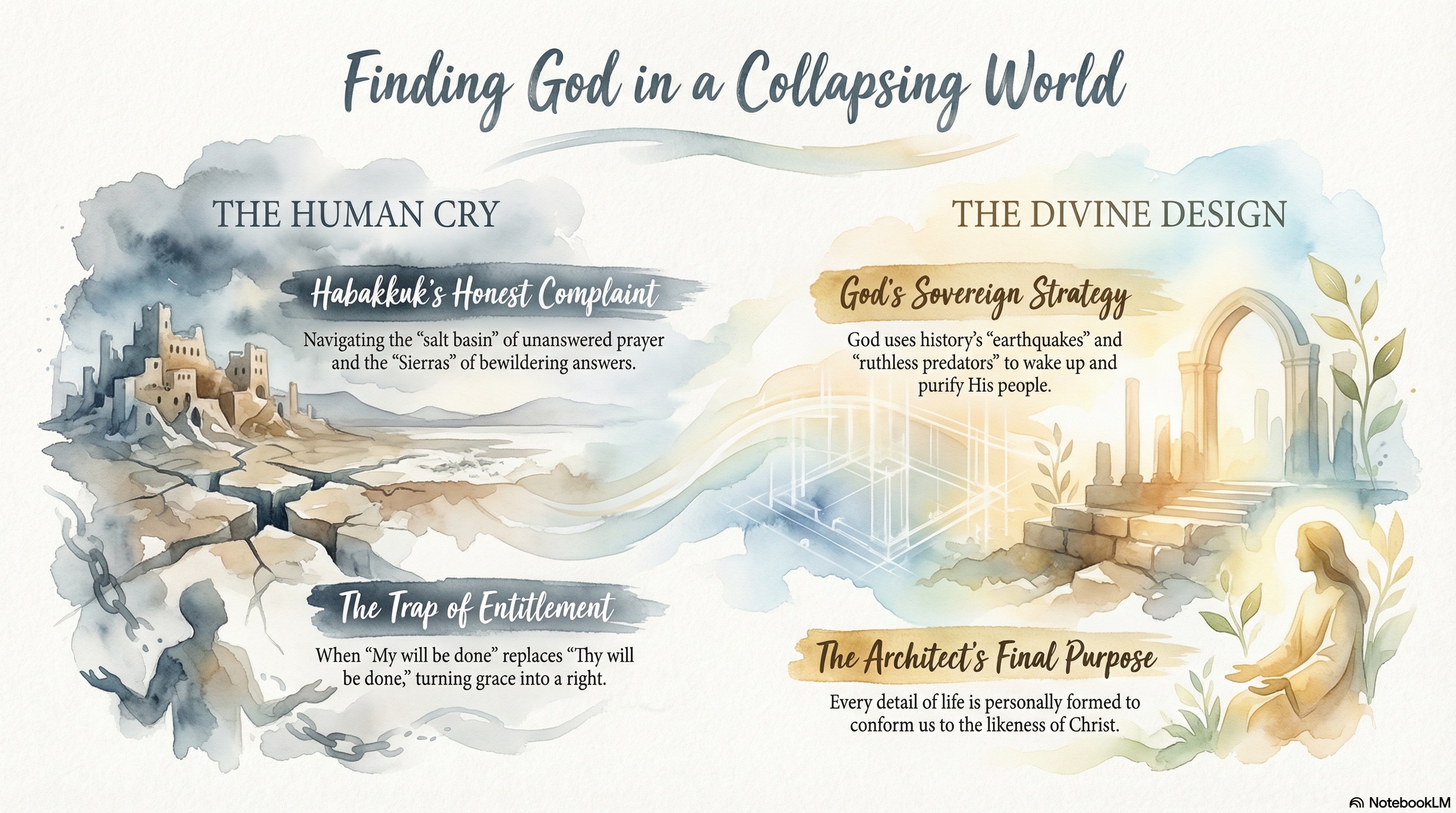
The pioneers who trekked across the salt basin in Utah and crossed the Sierras faced obstacles that killed some and turned others back. For the spiritual pilgrim, the journey involves similar barriers: the salt basin represents unanswered prayer, while the Sierras represent answers to prayer. It may seem counterintuitive, but answers to prayer can often become our greatest obstacles. Every prayer is answered—whether granted, refused, or delayed—but it is the “bewildering answers” that are completely unacceptable to us that cause us to stumble.

1. The Human Cry

Habakkuk’s ancient frustration feels remarkably modern. He looked at a world where destruction and violence were constant, strife abounded, and the law seemed paralyzed. His cry was raw and honest: “How long, Lord, must I call for help, but you do not listen? Or cry out to you, ‘Violence!’ but you do not save?”. Habakkuk was not posing abstract theological riddles; his world was literally crumbling. The nation was decaying from within, and a ruthless predator was approaching from without.

Practical Application: Don’t be afraid to bring your “sighs” to God. Habakkuk’s example shows that faith often begins with an honest complaint about the injustice and wrongdoing we see in our own lives and the world.

2. The Shocking Answer

When God finally answered Habakkuk, it was a “geopolitical earthquake”. God told him to be “utterly amazed” because He was doing something unbelievable: He was raising up the Babylonians. God described them as a “ruthless and impetuous people,” a “feared and dreaded” nation that promoted their own honor and worshiped their own strength as their god. Habakkuk had to wrestle with the reality that God was personally behind the rise of a ruthless enemy marching toward Jerusalem.

Personal Touch: It is a staggering thought that God’s answer to our cry for help might be to send a “Babylonian”—a difficult circumstance or a person that acts as a “wake-up call” when we have grown “dull of hearing”.

3. The Entitlement Trap

Why do we stumble over these shocking answers? Often, it is because we fall into a trap of entitlement. Just as a teenager might turn a one-time relaxed curfew into a “right” or a “bargaining chip,” we often turn God’s grace into a personal merit that we feel we have earned. This logic thrives whenever “My will be done” replaces “Thy will be done”. When this happens, we begin to view God as a “Supermarket” where blessings are expected on demand—an ornament to our lives rather than the sovereign Lord.

Practical Application: Take a moment to audit your prayers. Are you treating God as a Sovereign Lord to be trusted, or as a “Supermarket” where you are shopping for conveniences? Entitlement produces anger when refused; faith produces trust.

4. The Grand Design

Scripture reveals that history is not a chain of random events, but a Grand Design arranged toward redemption. In the “fullness of time,” God used centuries of preparation—Greek language, Roman roads and order, philosophical curiosity, spiritual desire awakened—to weave His redemptive plan.

If God carefully directs the rise of empires, His purpose reaches into the details of our personal lives to conform us to the likeness of Christ.

  • God is the Architect; you are the campus.
  • The “bulldozers, sawdust, and nail guns” of life are not signs of destruction, but the Architect’s tools serving an eternal purpose.
  • These trials become the “steel framework” of your life—a bulwark against life’s storms.

As a Pilgrim in Process, we must learn that prayer matures from making demands to seeking intimacy. The goal is not to bend God to our will, but to know Him, trust Him, and rest in His purposes.

Does the idea of God as an “Architect” change how you view the “bulldozers” currently at work in your own life? Which are you facing right now: a silent “salt basin” or a “Sierra peak” answer that feels like an obstacle?

Let’s Talk

I would love this to become a conversation. Please share your anecdotes, questions and insights in the comments.

Points to Ponder

In the context of your “Pilgrim in Process” journey, do you find that your current “sighs” are born out of a frustration that God isn’t following your blueprint, or a desire to understand His?

Does the idea of God as an “Architect” change how you view the “bulldozers” currently at work in your own life? I’d love to hear your thoughts on how you navigate those “salt basins” of unanswered prayer.

For Pilgrims, Destination Becomes Destiny

9 Feb

For Pilgrims, Destination Becomes Destiny

Overlooking the North Rim of the Grand Canyon, the setting sun casting shadows in shades of cobalt and indigo, accentuating the crags and crevices with a fleeting, golden splendor, I heard an exhilarated cry: “We made it!”

A group had just arrived from the South Rim—a grueling, 11-hour trek across the heart of the canyon. I was instantly hooked. My gracious wife agreed to drive to our South Rim reservation, and I would hike the canyon.

Comparing routes on a map, the decision seemed like a no-brainer – the North Kaibab Trail was four miles shorter than the Bright Angel Trail. Looking back, it wasn’t a “no-brainer” — it was a case of “no brain.”

The Descent and the Warning

The descent to Phantom Ranch was magical, even mystical — the 14-mile drop of 6,000 feet was sheer delight – awe and wonder every step of the way. However, I was met with a sobering sign. In foot-high letters, it warned hikers not to take the Kaibab ascent lightly. My internal translation: “Don’t be an idiot. This might kill you.” 

The plan was pre-arranged ans I was committed. I set off and the song in my heart soon became a groan. Those final seven miles took seven grueling hours.

I crested the rim as a different person, and the canyon was no longer just a postcard; it was an experience etched into my psyche.

From Place to Purpose

A pilgrim has a destination in mind, but along the way, a transformation occurs. The destination becomes a destiny — the deeper purpose a person grows into through calling, formation, and faithful response. It is a shift from “getting there” to “becoming the kind of person who belongs there.”

What exactly is our destination? For the pilgrim, the destination is to know the will of God. – “Do not be conformed to this world, but be transformed by the renewal of your mind, that by testing you may discern what is the will of God, what is good and acceptable and perfect.” 

1 The Incidental Will of God

We naturally crave to know God’s will for our daily decisions. These are “incidental”. A passenger once asked a boat captain how he navigated a treacherous harbor entrance so unerringly.

“You see those three lights?” the captain replied. “I align my ship up until all three are in a single row. That alignment shows me the safe channel.”

Navigating the tricky waters of the journey requires alignment. Think of these Three Harbor Lights as your markers:

  • Circumstances: A true harbor light isn’t a door we kick down; it’s a path that clears as we walk in obedience.
  • Scripture: is the fixed light that never shifts. If a “circumstance” seems to lead toward something God prohibits, the lights are out of alignment. We don’t need a new sign when we already have a clear command.
  • Wise Counsel: In the heat of the journey, we often have “trail blindness” —  choosing a shorter route because it looks faster on a map. Wise counsel provides the perspective of those who have walked these miles before us.

2 The Primary Will of God

Our ultimate destination is Heaven. However, the pilgrimage is about more than just a future arrival; it is about character formation en route. We seek to know God now so that Heaven, being face to face with God, is current enjoyment.

Paul prays for a “complete knowledge of His will. “The word for “know” used here—epignosis—is a composite word made up of the intensifier epi (think “epic”) joined to the verb “to know.” It is an intense, experiential, epic knowledge. It is the difference between reading a map of the Grand Canyon and hiking the Canyon for yourself. .

When we know God as Guide, Encourager, and Mentor, we aren’t just waiting for a distant reward. We are being forged in real-time, changed into the image of Christ — not through a legalistic keeping of rules, but through a delightful relationship. As the Psalmist says, “The Lord makes firm the steps of the one who delights in him; though he may stumble, he will not fall, for the Lord upholds him with his hand” (Psalm 37:23-24).

This internal delight isn’t meant to be lived in a vacuum, in a quiet corner of spiritual isolation. On the contrary, when we truly delight in Him, it creates a spiritual centrifugal force. The closer we get to the center — the more we rotate around the heart of God — the more powerfully we are propelled outward into the lives of others, propelled by the centrifugal force of God’s love into the thick of daily life. Like Ambassadors, we represent the King wherever our incidental lives are lived — from the stress of the workplace to the long silence of a hospital ward. We don’t just point the way to a distant country; we bring the life of that country into the room with us. Your experiential encounter with God isn’t just for your benefit; a pilgrim is an Ambassador representing God. It is in this sense that the destination — becoming like Him — becomes your destiny.

The Profound Gift of Presence

Jesus promised that He would give the Holy Spirit to be with us in His stead; it is as simple as receiving the gift He pledged.

When offered a piece of essential, life-saving advice, you receive it simply, by saying ““Thank you.” The same is true here. All that is required of you is to remember His promise and respond with gratitude. Jesus said, “if we know how to give good gifts to our children, how much more will the Father give the Holy Spirit to those who ask Him?

Don’t overcomplicate it, remember the promise, and say, “Thank you.” Say it so often that gratitude becomes your routine response to life. Say thank You for all the joy, say thank You for all the sorrow. 

And in saying it, know the gift is yours.

The Pilgrim Progresses as an Athlete

22 Jan

The Pilgrim progresses with the disciplined mindset of a soldier

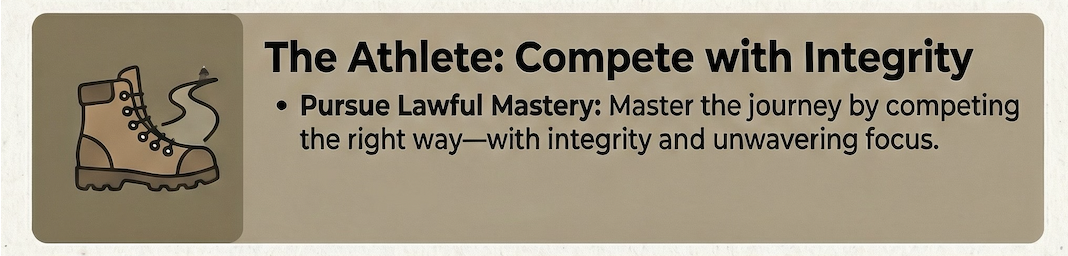
The Pilgrim masters the rules to travel with integrity and laser like focus

In the 1980 Boston Marathon, Rosie Ruiz crossed the finish line in record-breaking time. She was crowned the victor, draped in the traditional laurel wreath, and celebrated as a marvel of endurance. But the celebration was hollow. Within days, the truth emerged: Ruiz hadn’t run the race. She had slipped out of the crowd undetected by the marshals, and taken a subway to the final stretch, re-entering the course just in time to claim a prize for miles she never covered.

She had the title, but she lacked the integrity. By flouting the rules she demonstrated her lack of character.

The Pilgrim Progresses as an Athlete

Paul’s letter to Timothy warns us against this “subway spirituality.” He reminds us that the life of a pilgrim is not a scramble for status, but an athletic endeavor in which character counts. As Paul writes: “Follow the Lord’s rules for doing his work, just as an athlete either follows the rules or is disqualified and wins no prize” (2 Timothy 2:5, TLB).

To be a Pilgrim in Process is to realize that the shortcut is a lie. True victory is found in the three pillars of the athlete’s integrity.

Follow the Rules

The Two Trails: Why Discipline is a “Four-Wheel Drive” Experience

In the Kingdom, the “rules” aren’t a heavy slog under a whip; they are the practice of keeping in step with the Holy Spirit.

I recently took a father-son’s trip to Costa Rica to hike the trail to the Rio Celeste. Most folks take the busy tourist trail to see the

I recently took a father-son’s trip to Costa Rica to hike the trail to the Rio Celeste. Most folks take the busy tourist trail to see the famous blue waterfall, One views it from a platform and swimming is forbidden, A local tipped off my son about a trailhead a few miles down the road where you could actually swim.

That trail didn’t have a single soul on it. It started as a pleasant meander and then plunged—about 430 feet down a rocky, gnarlymess of a path. My two sons, worried about an octogenarian navigating those rocks, hovered over me like guardian angels. I eventually took a spill, gashing my knee and leaving a bit of skin as a “donation” to an obliging rock.”Dad, you want to turn back?” my younger son asked.

“Not on your nelly,” I told him. “I want to swim in that water.”

We made it down and had the joy of that cool blue water, but the ascent was where character was developed. My younger son took my hand to help me up. At first, it was just a regular hand-hold. Then, he insisted on locking our hold by grabbing one another by the wrist—a double-grip that ensured even if one of us weakened, the connection was solid. I joked that I finally had “four-wheel drive.”

Positive Mastery

The pilgrim faces sections of the trail similar that. Some rules are “negative”—watch your step, find a secure hold, move with caution. But the mastery Paul talks about is positive. Keeping in step with the Holy Spirit provides an exhilaration in the middle of the difficulty. He is the “heft” in the steep places and the “stability” on the slippery ones.

The disciplines of a happy communion with God—being instant in prayer, meditating on scripture, and serving my neighbor—aren’t heavy weights we carry. They are the energy for the ascent, providing lasting joy.

When we try to bypass the disciplines of faith, we arrive at life’s “finish lines” as cheats rather than genuine champions. We practice these disciplines because they are the only way to ensure that the person who reaches the summit is the person the Lord intended us to be—changed, and reflecting His image.

As the Spirit of the Lord works within us, providing that “four-wheel drive” power, we become more and more like Him. We aren’t just reaching a destination; we are being transformed from “glory to glory.”

“And all of us have had that veil removed so that we can be mirrors that brightly reflect the glory of the Lord. And as the Spirit of the Lord works within us, we become more and more like him and reflect his glory even more.” (2 Corinthians 3:18, The Living Bible)

Lawful Mastery: The Work of the Unseen Miles

There is a massive difference between just being active and achieving mastery. Paul speaks of the athlete competing “lawfully.” If you look at a marathon runner, you’ll see that mastery isn’t found on the day of the race under the roar of the crowd. It’s forged months earlier in the cold, gray silence of a 5:00 AM training run. It’s found in the discipline of a sensible diet and a regimen prescribed by those who know the way.

Mastery means honoring the “laws of growth” long before the prize is even in sight. It takes honesty to admit where your form is failing, and the humility to accept the guidance of “Coach Jesus.” It requires the patience to increase your mileage by inches rather than miles, doing the relentless hidden work that happens when no one is watching.

In the spiritual life, we often want the crown of maturity without the drudgery of the training ground. But the trail doesn’t lie. You cannot bypass the laws of growth and expect to finish the distance. True mastery is just a long string of honest, quiet choices made when it’s just you and God. It’s taking the “rules of the race” and living them out in the parts of your life that no one else ever sees. This is an internal attitude. It’s the recognition that our stature is built in those “unseen miles”—the moments of cultivated intimacy where we listen with the heart, instantly recognizing what displeases Him and correcting it right then and there.

No Shortcuts

The pursuit of comfort is the ultimate shortcut, and it is the enemy of integrity. A tourist seeks the easiest path, but a pilgrim embraces the grade. Taking a shortcut is really just an admission that you don’t believe the journey itself is worth the effort. Like that subway ride in Boston, a shortcut might get your body to the coordinates of the finish line, but it cannot give you the character God desires or the “glory” Paul speaks of.

You might reach the destination, but you won’t be the person the Lord intended for the summit. Mastery is the only way to ensure that when you finally stand at the end of the trail, you have the heart and the legs to be there.


The Fireside Reflection

Are you looking for a subway to the summit, or are you mastering the basics? The prize for the shortcut is always hollow and you can fool the crowd for a while, applause is meaningless. It is God’s approval that matters.


Next time: The Pilgrim as Farmer

Pilgrims in Process

19 Jan

Are You a Tourist or a Pilgrim?

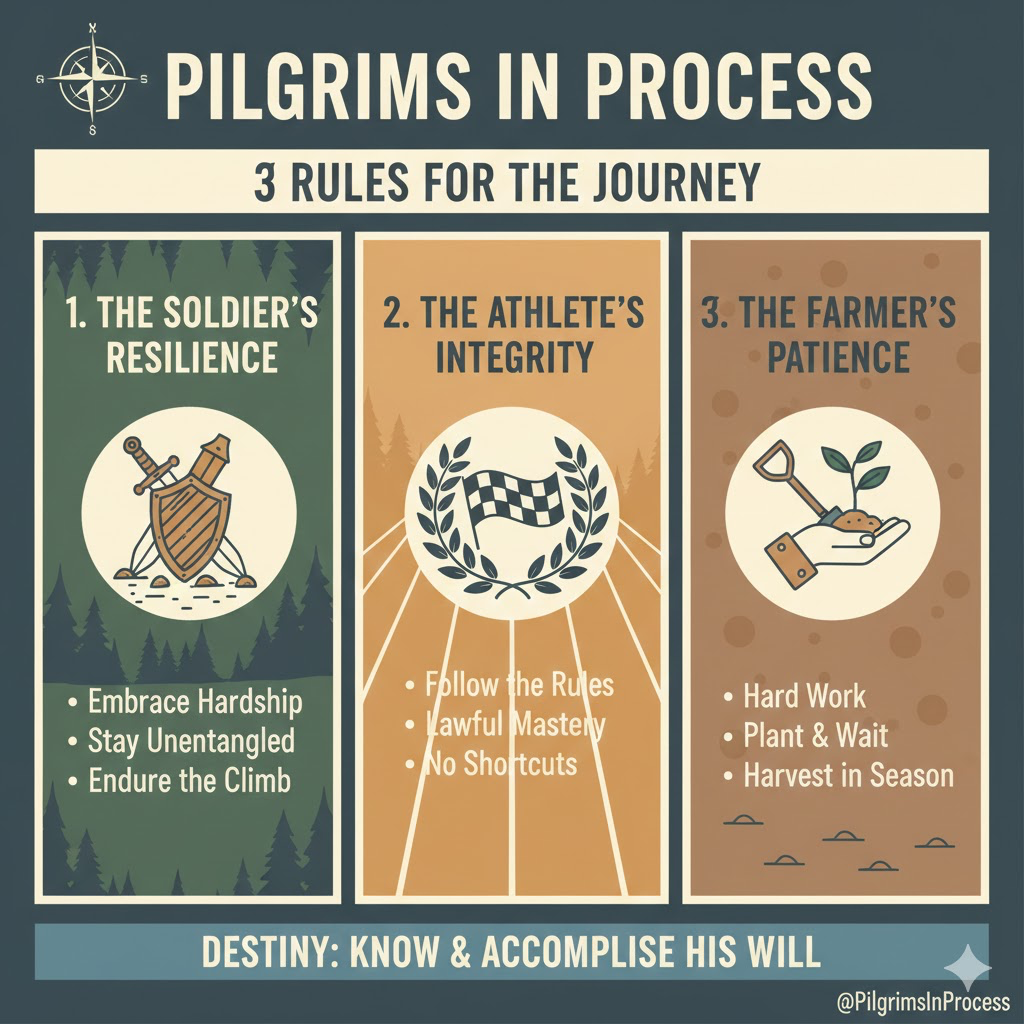
3 Rules for a Meaningful Journey

Your life is a process, either as a tourist vacantly gaping at attractions, or wandering bewildered through a foreign grocery store; or, as a determined pilgrim living with intentionality. Life is not a simple path from A to B. It is a winding, rocky ascent through fog and friction—a path defined not by the miles covered, but by the fortitude forged in the climb. To be a “Pilgrim in Process”—one genuinely committed to this path—requires more than forward movement; it demands an intentional internal posture.

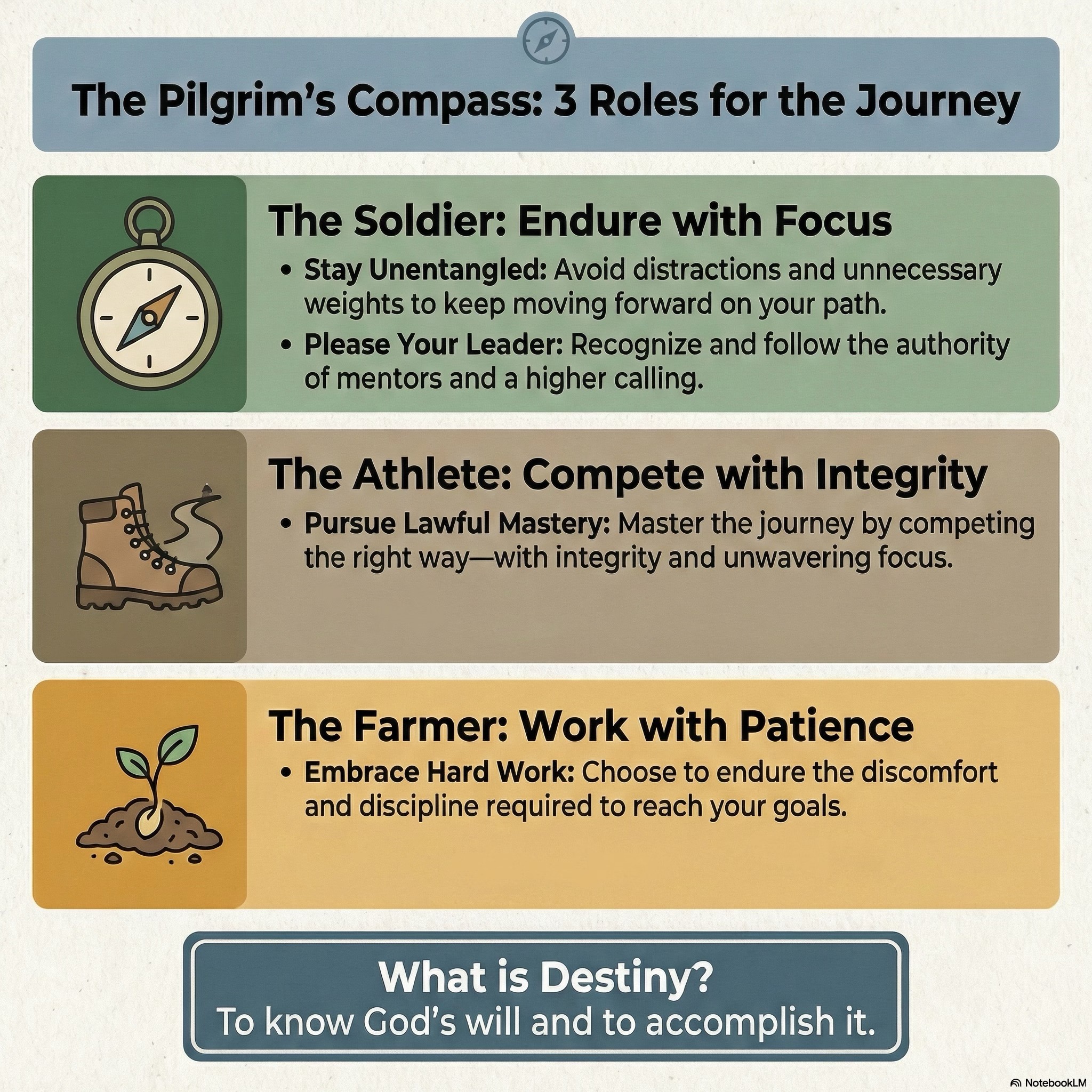
In 2 Timothy 2:3-7 Paul admonishes his protege: “Take your share of suffering as a good soldier of Jesus Christ, just as I do; and as Christ’s soldier, do not let yourself become tied up in worldly affairs, for then you cannot satisfy the one who has enlisted you in his army. Follow the Lord’s rules for doing his work, just as an athlete either follows the rules or is disqualified and wins no prize. Work hard like a farmer who gets paid well if he raises a large crop.Think over these three illustrations, and may the Lord help you to understand how they apply to you.” (Living Bible)

Let’s look at the metaphor of the soldier in this blog. (Paul gives us three distinct pictures of the pilgrim life: the Soldier, the Athlete, and the Farmer. While we will dive deep into the Athlete’s integrity and the Farmer’s patience in my next two posts, today we begin with the foundation: the resilience of the Soldier.”)

1. Embrace the Soldier’s Suffering

Pilgrim/Soldiers make the choice: discipline over the siren song of comfort. In a culture that worships ease, and equates happiness with wealth and power, a pilgrim understands that growth only happens at the edge of our capacity. We are not tourists on this path, ready to retreat at the first sign of trouble. We are, as the source notes remind us, “soldiers in a spiritual sense,” committed to the mission no matter the terrain. “This means accepting that a fixation on comfort acts as a barrier to progress—it encourages a slow slide into complacency and leaves our character fragile when the terrain inevitably turns rough.”

This willingness to ‘suffer’ through the rigors of discipline is not a call for self-punishment; it is the fundamental price of admission for achieving your destiny. And therefore it is not burdensome, but joyful. But this resilience is the engine, not the compass. It must be paired with a singular focus, which brings us to the second rule.

2. Stay Intentionally Unentangled

The second rule is to carry only what is essential for the journey. A tourist collects souvenirs; a pilgrim sheds weight. A pilgrim’s progress is immediately halted by the gravity of unnecessary burdens. Getting ‘entangled’ in the world’s distractions—the petty dramas, the fleeting pursuits, or even the ‘lawful’ but non-essential activities—will anchor you in place.

Progress requires doing things the “lawful way”—not just in a legal sense, but with a profound integrity and a disciplined focus that honors the mission. This is the art of strategic renunciation. By letting go of what doesn’t serve the journey, you gain the freedom and momentum to move with purpose. This singular focus clears the path, but a clear path is useless without a map.

3. Understand Your Place in the Ranks

The third rule is to recognize and respect the structure of the journey. Tourists wander where they please; pilgrims understand their part in the caravan. A true pilgrim is not like a sheep wandering aimlessly but is part of a larger body with a defined order. This means acknowledging the role of the “man of authority”—the leaders, mentors, or the “Undershepherd” who provides guidance—and even answering to a higher calling that serves as an internal compass.

“Stop measuring your life by the ease of the terrain or the miles you’ve logged. Measure it by the resolve you’ve built and the community you’ve kept. The fog will lift and the rocks will give way, but the fortitude you forge in the climb is yours forever. Keep walking. You are a Pilgrim in Process, and the path is exactly where you are meant to be.”

This is not a call for blind obedience, but for strategic alignment and teachability. Humility isn’t a weakness; it’s a strategic tool for accelerated learning. It allows you to absorb wisdom from those ahead, preventing costly errors and positioning you to contribute and, eventually, to lead. One must first know how to follow before one can ever hope to guide others.

Conclusion: The True Meaning of Destiny

“At the end of the day, we have to realize that these three postures—the Soldier, the Athlete, and the Farmer—aren’t just a checklist to complete. They are a trinity of principles that create the rhythm of the walk itself.

The Soldier’s Hardness is like your steady breath; it’s the grit to keep your feet moving when the trail gets steep and the air gets thin. Intentional Unentanglement is the lightness of your pack; it’s the constant work of making sure you aren’t carrying ‘stones’ from the world that only serve to slow you down. And finally, understanding your Place in the Ranks is your compass. It’s the humble recognition that you are following a path blazed by those who went before you, ensuring that all your disciplined, focused energy is actually leading you in the right direction.

When these three things click, the ‘process’ stops being a burden and starts being the way we find our destiny.”

They are the internal architecture required to see the journey through to its end. The goal is not aimless wandering but focused accomplishment. We are here to discern our purpose and then do the work to finish it.

To know God’s will. To accomplish it — that is destiny and only that.

What is one thing you can do today to shift from being a tourist to a pilgrim on your own journey?

Coming Next in the Series:”

  • Part 2: The Athlete’s Integrity — Why the ‘Process’ matters more than the ‘Podium’.
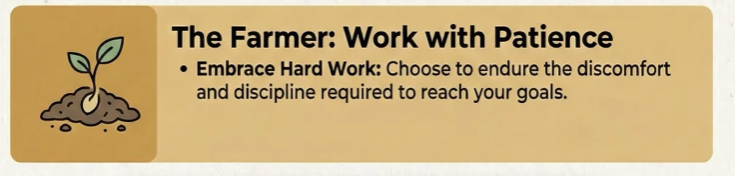
  • Part 3: The Farmer’s Patience — How to work when you can’t see the harvest yet.

Make sure to subscribe to the blog and my YouTube channel so you don’t miss the next leg of the journey.

See my channel on YouTube: https://www.youtube.com/channel/UCCOReIq0xjlIM79DrT0oQ-A

The New Morality is Ancient

23 Nov

Since the adoption of the absurd proposition that there are no absolutes and that truth is relative – (try arguing with your bank manager that you really are not in the red because that is HIS truth, not yours; or the judge that the stop sign you ignored was the cops truth, not your truth), – since that lie became the standard operating principle of society, morality has become meaningless. For example, sexual predators get elected into high office, corruption is standard practice, liars cannot be held accountable and the human race has started the descent into complete anarchy.

The Bible nails it! Eugene Petersen (The Message) paraphrases Romans 1 in such a way that the 2000 year insight is like a polar vortex that reaches through the centuries:

But God’s angry displeasure erupts as acts of human mistrust and wrongdoing and lying accumulate, as people try to put a shroud over truth. … What happened was this: People knew God perfectly well, but when they didn’t treat him like God, refusing to worship him, they trivialized themselves into silliness and confusion so that there was neither sense nor direction left in their lives. They pretended to know it all, but were illiterate regarding life. …

… So God said, in effect, “If that’s what you want, that’s what you get.” It wasn’t long before they were living in a pigpen, smeared with filth, filthy inside and out. And all this because they traded the true God for a fake god, and worshiped the god they made instead of the God who made them—the God we bless, the God who blesses us. Oh, yes!

Since they didn’t bother to acknowledge God, God quit bothering them and let them run loose. And then all hell broke loose: rampant evil, grabbing and grasping, vicious backstabbing. They made life hell on earth with their envy, wanton killing, bickering, and cheating. Look at them: mean-spirited, venomous, fork-tongued God-bashers. Bullies, swaggerers, insufferable windbags! They keep inventing new ways of wrecking lives. 

Sigh, The most frightening thing is that in many “christian” quarters this behavior is lauded and mimicked. Lord have mercy.