Fraternal Twins — Sinai and Zion
Introduction to the Beatitudes: Part 1 of 3
If you could digitize the Beatitudes and project them as a live hologram, the figure standing before you would be Jesus. Within these brief chapters, a remarkable compendium of both how to find God and how to live for God is offered. Truly, if circumstances dictated I could have only two pages from the entire Bible, I would choose this exact Sermon on the Mount.
But why are these specific pages so vital? What is it that keeps us from sinking into a brutish state when life loses its restraints?
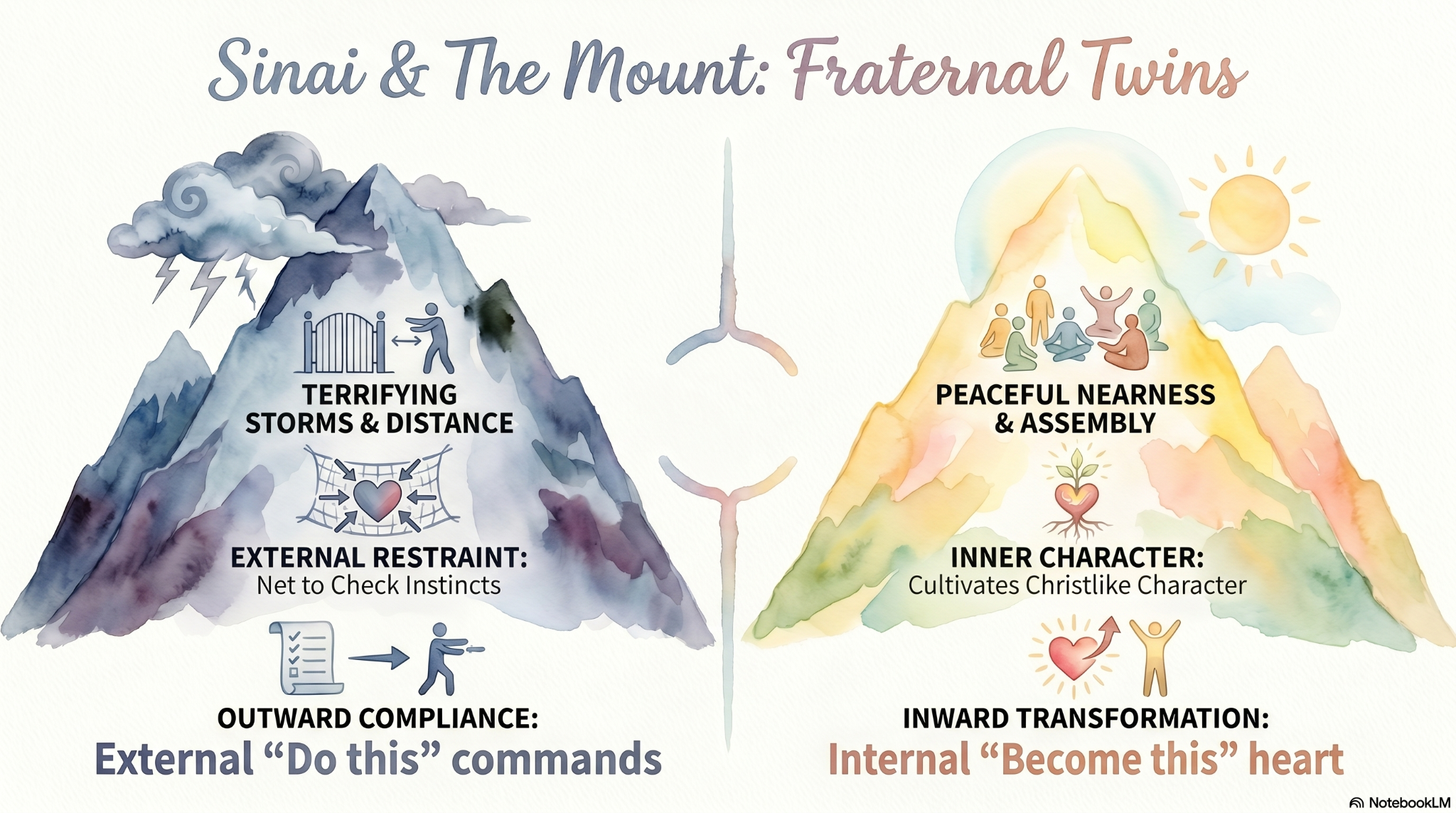
It takes two completely different mountains, two fraternal twins, to answer that question. On one side stands Mount Sinai: a place of smoke, fire, and trembling fear, designed to act as an external check on our behavior. On the other side stands Mount Zion and the Mount of the Beatitudes: a gentle, open hillside offering an inner transformation of grace.
Like an instruction prompt setting the agenda for an Intelligent Agent, the Beatitudes launch this grand shift, casting rays of light and life on everything that follows.
There is a deliberate parallel and contrast between the giving of the 10 commandments and the delivery of the Sermon: The link is not accidental; Matthew especially presents Jesus as a new and greater Moses, but one who fulfills and transforms the Old Covenant rather than merely repeating it. In fact ushering in the New Covenant, an era of grace flowing from law.
The two are compared directly in Hebrews 12:18-24,
The Mountain of Fear and the Mountain of Joy
18 You have not come to a mountain that can be touched and that is burning with fire; to darkness, gloom and storm; 19 to a trumpet blast or to such a voice speaking words that those who heard it begged that no further word be spoken to them, 20 because they could not bear what was commanded: “If even an animal touches the mountain, it must be stoned to death.” 21 The sight was so terrifying that Moses said, “I am trembling with fear.”
22 But you have come to Mount Zion, to the city of the living God, the heavenly Jerusalem. You have come to thousands upon thousands of angels in joyful assembly, 23 to the church of the firstborn, whose names are written in heaven. You have come to God, the Judge of all, to the spirits of the righteous made perfect, 24 to Jesus the mediator of a new covenant, and to the sprinkled blood that speaks a better word than the blood of Abel. (NIV)
Mount Zion as a synonym for The Mount.
Sinai and the Mount: Law Given, Life Transformed
| Category | Mount Sinai (The Ten Commandments) | The Mount of the Beatitudes (The Sermon on the Mount) |
| Location | Mount Sinai; a rugged, smoky mountain | A mountain in Galilee; a gentle, accessible hillside |
| Atmosphere | Thunder, lightning, smoke, and fire; fear and awe | Peaceful, open air; grace and nearness |
| People’s Response | Trembling and standing far off; “Do not let God speak to us…” | Drawing near and sitting at His feet; “He opened His mouth and taught them.” |
| Mediator / Speaker | Moses mediates; “Thus says the Lord…” | Jesus speaks with authority; “But I say to you…” |
| Nature of the Message | Law (Torah); external commands and boundaries | Kingdom Teaching; inner character and transformed living |
| Form | Ten Commandments; primarily prohibitive: “You shall not…” | Beatitudes & Teachings; transformative: “Blessed are…” |
| Focus | Defines what is right and wrong; sets boundaries for holy living | Forms the heart of righteousness; cultivates the character of the Kingdom |
| Scope | Focus on Israel as a nation; a covenant with a people | Extends to all people; love of neighbor expanded to enemy |
| Result | Reveals God’s holiness; convicts sin and demands obedience | Reveals God’s grace; invites transformation and discipleship |
| Covenant | Old Covenant; written on stone tablets | New Covenant Fulfilled in Christ; written on hearts |
| Spiritual Effect | Produces outward compliance; “Do this.” | Produces inward transformation; “Become this.” |
| Theological Significance | Reveals God’s righteous standard; shows humanity our need for grace | Reveals God’s Kingdom way; shows grace empowering true righteousness |
| Summary | The Law Reveals Our Need for a Savior: It shows us we cannot save ourselves. | Grace Reveals Our New Life in Him: It shows us who we can become in His Kingdom. |
Philip Caputo, chronicling his experience in the Vietnam War, captures the necessity of the the two covenants:
“Out there, lacking restraints, sanctioned to kill, confronted by a hostile country and a relentless enemy, we sank into a brutish state. The descent could be checked only by the net of a man’s inner moral values, the attribute that is called character. There were a few-and I suspect Lieutenant Calley was one—who had no net and plunged all the way down, discovering in their bottommost depths a capacity for malice they probably never suspected was there.” (Emphases added)
The Old Covenant is given to restrain our brutish instincts. The New Covenant is required to develop character into Christlikeness. Hence Sinai and Zion are fraternal twins. Restraint is essential to the development of character. The guilt and alienation from God under the law is replaced by “you are My friends.”
God is gracious beyond description.
His invitation to this Banquet has an RSVP, and it requires your acceptance. Respond now—maybe for the first time, and hopefully for the umpteenth time! It leads to a lifetime of enjoyment.
For throughout it all, the refrain is BLESSED.
– – – – – – – – – – – – – – – – – – – – – – – – – – – – – – – – – – – – – – – – – – – – – – – – – – – – – – – – – – – – – – – – – – .
Next up in this series: The Meaning of “Blessed”: unpacking this truly radical word.

 progressingpeople