Archive | Pilgrims RSS feed for this section

Navigating Life When Faith Doesn’t Make Sense

17 Feb

Pilgrim in Process: When Faith Sighs

Navigating the Salt Basins and High Sierra Peaks

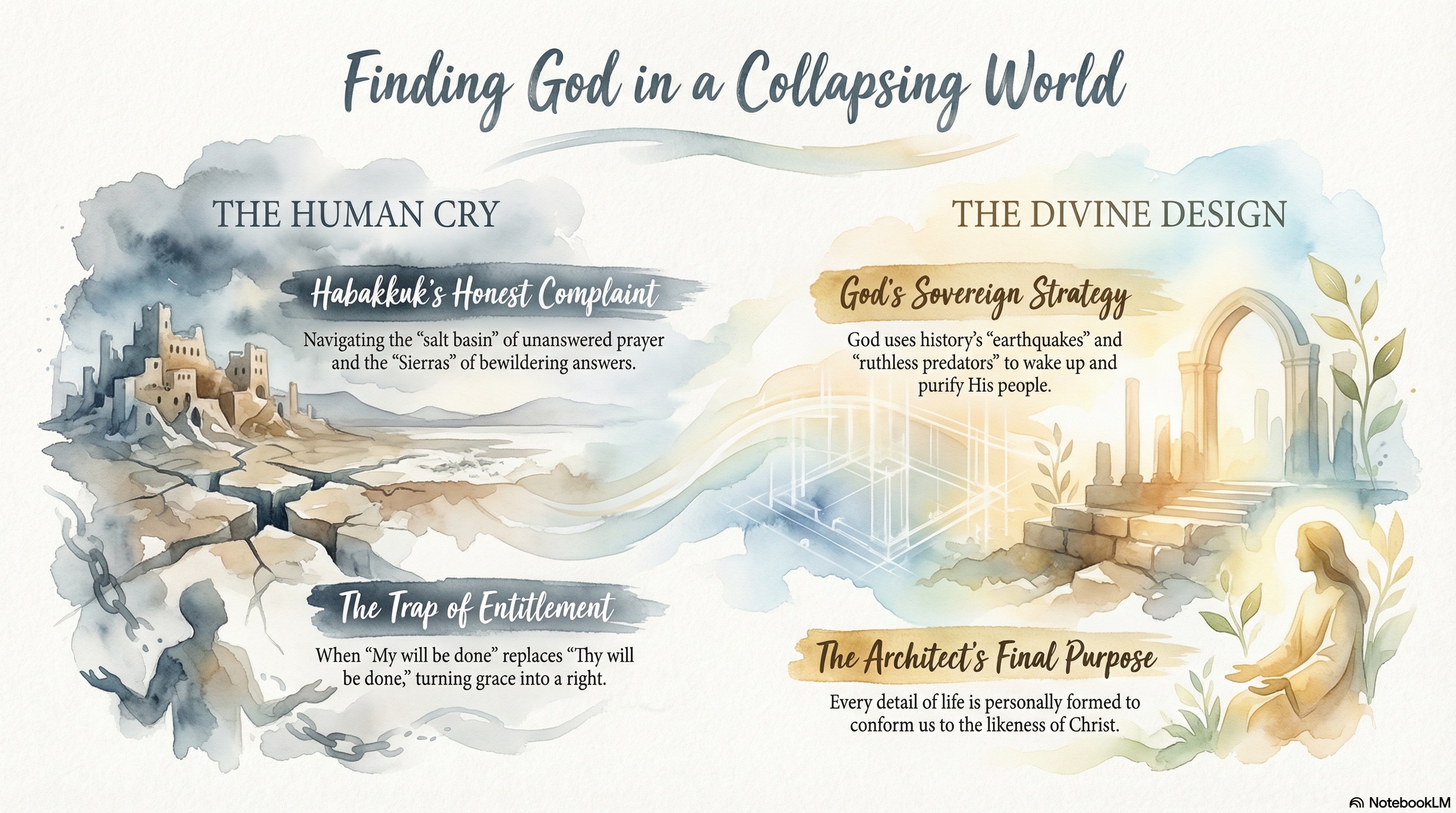
The pioneers who trekked across the salt basin in Utah and crossed the Sierras faced obstacles that killed some and turned others back. For the spiritual pilgrim, the journey involves similar barriers: the salt basin represents unanswered prayer, while the Sierras represent answers to prayer. It may seem counterintuitive, but answers to prayer can often become our greatest obstacles. Every prayer is answered—whether granted, refused, or delayed—but it is the “bewildering answers” that are completely unacceptable to us that cause us to stumble.

1. The Human Cry

Habakkuk’s ancient frustration feels remarkably modern. He looked at a world where destruction and violence were constant, strife abounded, and the law seemed paralyzed. His cry was raw and honest: “How long, Lord, must I call for help, but you do not listen? Or cry out to you, ‘Violence!’ but you do not save?”. Habakkuk was not posing abstract theological riddles; his world was literally crumbling. The nation was decaying from within, and a ruthless predator was approaching from without.

Practical Application: Don’t be afraid to bring your “sighs” to God. Habakkuk’s example shows that faith often begins with an honest complaint about the injustice and wrongdoing we see in our own lives and the world.

2. The Shocking Answer

When God finally answered Habakkuk, it was a “geopolitical earthquake”. God told him to be “utterly amazed” because He was doing something unbelievable: He was raising up the Babylonians. God described them as a “ruthless and impetuous people,” a “feared and dreaded” nation that promoted their own honor and worshiped their own strength as their god. Habakkuk had to wrestle with the reality that God was personally behind the rise of a ruthless enemy marching toward Jerusalem.

Personal Touch: It is a staggering thought that God’s answer to our cry for help might be to send a “Babylonian”—a difficult circumstance or a person that acts as a “wake-up call” when we have grown “dull of hearing”.

3. The Entitlement Trap

Why do we stumble over these shocking answers? Often, it is because we fall into a trap of entitlement. Just as a teenager might turn a one-time relaxed curfew into a “right” or a “bargaining chip,” we often turn God’s grace into a personal merit that we feel we have earned. This logic thrives whenever “My will be done” replaces “Thy will be done”. When this happens, we begin to view God as a “Supermarket” where blessings are expected on demand—an ornament to our lives rather than the sovereign Lord.

Practical Application: Take a moment to audit your prayers. Are you treating God as a Sovereign Lord to be trusted, or as a “Supermarket” where you are shopping for conveniences? Entitlement produces anger when refused; faith produces trust.

4. The Grand Design

Scripture reveals that history is not a chain of random events, but a Grand Design arranged toward redemption. In the “fullness of time,” God used centuries of preparation—Greek language, Roman roads and order, philosophical curiosity, spiritual desire awakened—to weave His redemptive plan.

If God carefully directs the rise of empires, His purpose reaches into the details of our personal lives to conform us to the likeness of Christ.

  • God is the Architect; you are the campus.
  • The “bulldozers, sawdust, and nail guns” of life are not signs of destruction, but the Architect’s tools serving an eternal purpose.
  • These trials become the “steel framework” of your life—a bulwark against life’s storms.

As a Pilgrim in Process, we must learn that prayer matures from making demands to seeking intimacy. The goal is not to bend God to our will, but to know Him, trust Him, and rest in His purposes.

Does the idea of God as an “Architect” change how you view the “bulldozers” currently at work in your own life? Which are you facing right now: a silent “salt basin” or a “Sierra peak” answer that feels like an obstacle?

Let’s Talk

I would love this to become a conversation. Please share your anecdotes, questions and insights in the comments.

Points to Ponder

In the context of your “Pilgrim in Process” journey, do you find that your current “sighs” are born out of a frustration that God isn’t following your blueprint, or a desire to understand His?

Does the idea of God as an “Architect” change how you view the “bulldozers” currently at work in your own life? I’d love to hear your thoughts on how you navigate those “salt basins” of unanswered prayer.
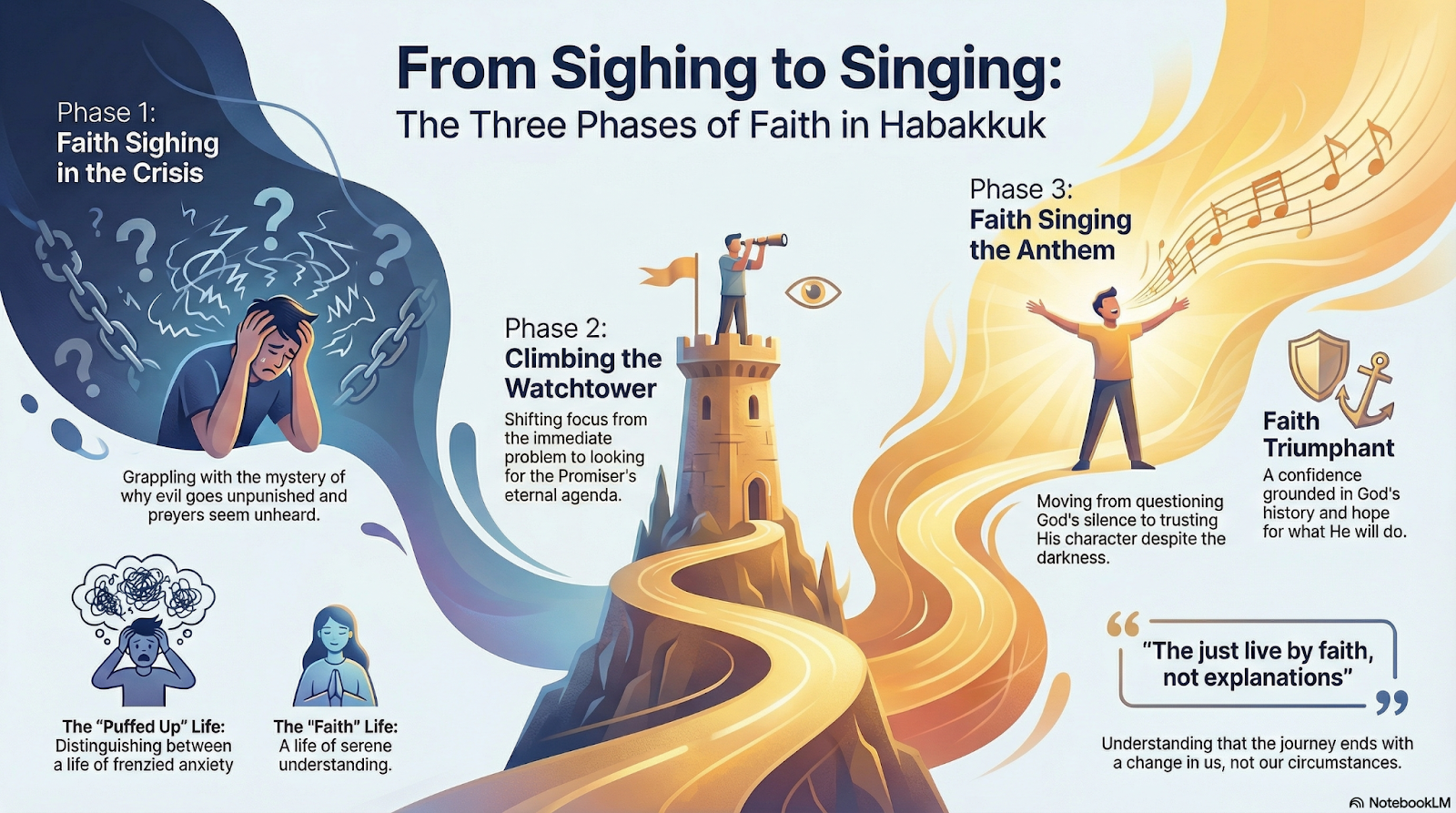
The Pilgrim’s Trajectory of Faith

14 Feb

 Habakkuk- a Modern 3000 Year Old Pilgrim

Faith Sighing in the Valley of Silence

The agonizing question: Where is God when the world burns? 

The Math Doesn’t Add Up:

– the confusing reality where evil goes unpunished;

– The unthinkable answer –  a brutal marauding army, raised up by God Himself.

 Pilgrims often find  their faith under fire, sighing in agonizing confusion.

 Faith Seeing from the Rampart

The Pilgrim trusts God and watches  and waits expectantly:

– Pilgrims avoid The “Puffed Up” restless approach, the impatient demand for an immediate answer.

– Pilgrims don’t live by what they can see right now; they live by who they know

Faith is faithfulness – it is a verb, not a noun. This is not passive sitting; it is active, as demonstrated in the Grand Finale.

Faith Singing in the Grand Finale

The journey ends not with a change in circumstances, but a change in the Pilgrim:

– The Pilgrim moves from questioning God’s silence to trusting His character. 

– This is faith triumphant—grounded in the history of what God has done, and confident in what He will do. 

The Pilgrim  no longer sighs at the mystery; even when suffering the ravages of a ruthless enemy. He sings in a rising crescendo:

I will still be joyful and glad,
    because the Lord God is my savior.

The Sovereign Lord gives me strength.
    He makes me sure-footed as a deer
    and keeps me safe on the mountains.  (Habakkuk 3:18-19)

This very modern 3000 year old book will be explored in six coming posts. Stay tuned.

For Pilgrims, Destination Becomes Destiny

9 Feb

For Pilgrims, Destination Becomes Destiny

Overlooking the North Rim of the Grand Canyon, the setting sun casting shadows in shades of cobalt and indigo, accentuating the crags and crevices with a fleeting, golden splendor, I heard an exhilarated cry: “We made it!”

A group had just arrived from the South Rim—a grueling, 11-hour trek across the heart of the canyon. I was instantly hooked. My gracious wife agreed to drive to our South Rim reservation, and I would hike the canyon.

Comparing routes on a map, the decision seemed like a no-brainer – the North Kaibab Trail was four miles shorter than the Bright Angel Trail. Looking back, it wasn’t a “no-brainer” — it was a case of “no brain.”

The Descent and the Warning

The descent to Phantom Ranch was magical, even mystical — the 14-mile drop of 6,000 feet was sheer delight – awe and wonder every step of the way. However, I was met with a sobering sign. In foot-high letters, it warned hikers not to take the Kaibab ascent lightly. My internal translation: “Don’t be an idiot. This might kill you.” 

The plan was pre-arranged ans I was committed. I set off and the song in my heart soon became a groan. Those final seven miles took seven grueling hours.

I crested the rim as a different person, and the canyon was no longer just a postcard; it was an experience etched into my psyche.

From Place to Purpose

A pilgrim has a destination in mind, but along the way, a transformation occurs. The destination becomes a destiny — the deeper purpose a person grows into through calling, formation, and faithful response. It is a shift from “getting there” to “becoming the kind of person who belongs there.”

What exactly is our destination? For the pilgrim, the destination is to know the will of God. – “Do not be conformed to this world, but be transformed by the renewal of your mind, that by testing you may discern what is the will of God, what is good and acceptable and perfect.” 

1 The Incidental Will of God

We naturally crave to know God’s will for our daily decisions. These are “incidental”. A passenger once asked a boat captain how he navigated a treacherous harbor entrance so unerringly.

“You see those three lights?” the captain replied. “I align my ship up until all three are in a single row. That alignment shows me the safe channel.”

Navigating the tricky waters of the journey requires alignment. Think of these Three Harbor Lights as your markers:

  • Circumstances: A true harbor light isn’t a door we kick down; it’s a path that clears as we walk in obedience.
  • Scripture: is the fixed light that never shifts. If a “circumstance” seems to lead toward something God prohibits, the lights are out of alignment. We don’t need a new sign when we already have a clear command.
  • Wise Counsel: In the heat of the journey, we often have “trail blindness” —  choosing a shorter route because it looks faster on a map. Wise counsel provides the perspective of those who have walked these miles before us.

2 The Primary Will of God

Our ultimate destination is Heaven. However, the pilgrimage is about more than just a future arrival; it is about character formation en route. We seek to know God now so that Heaven, being face to face with God, is current enjoyment.

Paul prays for a “complete knowledge of His will. “The word for “know” used here—epignosis—is a composite word made up of the intensifier epi (think “epic”) joined to the verb “to know.” It is an intense, experiential, epic knowledge. It is the difference between reading a map of the Grand Canyon and hiking the Canyon for yourself. .

When we know God as Guide, Encourager, and Mentor, we aren’t just waiting for a distant reward. We are being forged in real-time, changed into the image of Christ — not through a legalistic keeping of rules, but through a delightful relationship. As the Psalmist says, “The Lord makes firm the steps of the one who delights in him; though he may stumble, he will not fall, for the Lord upholds him with his hand” (Psalm 37:23-24).

This internal delight isn’t meant to be lived in a vacuum, in a quiet corner of spiritual isolation. On the contrary, when we truly delight in Him, it creates a spiritual centrifugal force. The closer we get to the center — the more we rotate around the heart of God — the more powerfully we are propelled outward into the lives of others, propelled by the centrifugal force of God’s love into the thick of daily life. Like Ambassadors, we represent the King wherever our incidental lives are lived — from the stress of the workplace to the long silence of a hospital ward. We don’t just point the way to a distant country; we bring the life of that country into the room with us. Your experiential encounter with God isn’t just for your benefit; a pilgrim is an Ambassador representing God. It is in this sense that the destination — becoming like Him — becomes your destiny.

The Profound Gift of Presence

Jesus promised that He would give the Holy Spirit to be with us in His stead; it is as simple as receiving the gift He pledged.

When offered a piece of essential, life-saving advice, you receive it simply, by saying ““Thank you.” The same is true here. All that is required of you is to remember His promise and respond with gratitude. Jesus said, “if we know how to give good gifts to our children, how much more will the Father give the Holy Spirit to those who ask Him?

Don’t overcomplicate it, remember the promise, and say, “Thank you.” Say it so often that gratitude becomes your routine response to life. Say thank You for all the joy, say thank You for all the sorrow. 

And in saying it, know the gift is yours.

The Pilgrim as Farmer

4 Feb

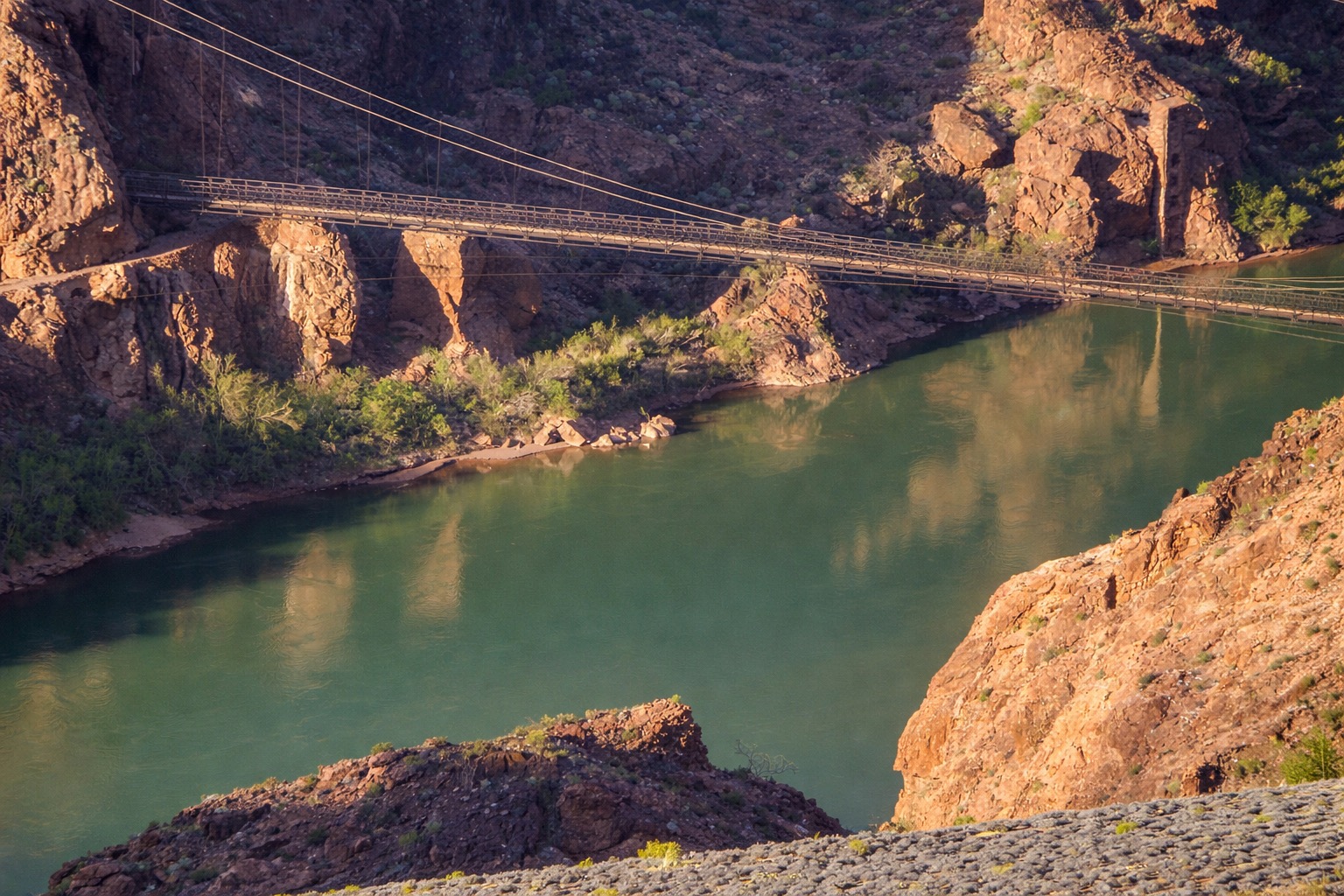
Bridge over Colorado River at Phantom Ranch

Planting Seeds While Passing Through

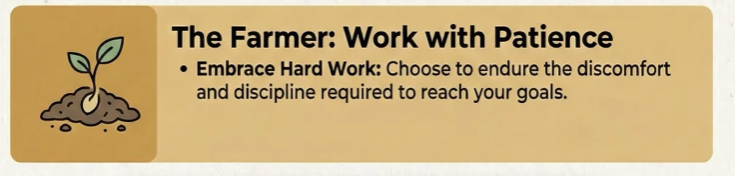
We often think of the spiritual life as a pilgrimage—a steady, linear walk toward a distant horizon. But in 2 Timothy 2:6, the Apostle Paul startles with an arresting contrast: – the pilgrim is a farmer.

At first glance, these identities seem at odds. A pilgrim is always moving; a farmer is rooted in the soil.If you just looked at the surface, you’d say, “You can’t be both!” But by investigating that paradox, an essential perspective comes into view: – we are called to work hard in our neighborhood(Farmer) while never forgetting that we don’t belong to it (Pilgrim).


Cultivating the “In-Between”

The Pilgrim has his eyes fixed, laser-like, on the destination. But he is not so heavenly minded as to be of no earthly use.

  • Whether it’s our careers, our families, our character, or our community, we are called to plow, plant, and weed with intentionality.
  • Farming is cultivation of the art of waiting. The pilgrim knows the road is long; the farmer knows the growth is slow. Together, they create a soul that isn’t discouraged by a lack of immediate results.

Eating What You Plant

God promises a harvest in this life: “The hardworking farmer ought to be the first to receive a share of the crops.”

This is the secret to spiritual endurance. As you plant seeds of kindness, patience, and truth in the lives of others, you are the first one nourished by them. The “crop” we cultivate on our journey—peace and joy—is exactly what fuels us to keep walking the difficult Pilgrim way with joy.

Patient Endurance

Farmers work for a harvest they cannot see yet. Pilgrims walk toward a home they haven’t yet reached. The present harvest sustains and energizes the Pilgrim.

I once walked from the North Rim to the South rim of the Grand Canyon. I had a pint of water and the advice was to take a gallon. I was badly dehydrating, my mouth dry and my tongue swelling. I was alarmed by my situation. To my relief a ranger appeared and offered me his bottle of water laced with gatorade. It invigorated me in indescribable ways. I set out with renewed energy and gratitude, all my symptoms swallowed up. I was enabled to finish, and to finish strong.

The Lessons:

Grow something beautiful in the soil of today while you keep your eyes on the destination of tomorrow.

Be refreshed by the Ranger, the Holy Spirit,   “Let anyone who is thirsty come to me and drink. Whoever believes in me, as Scripture has said, rivers of living water will flow from within them.” By this he meant the Spirit, whom those who believed in him were later to receive. (John 7:37-39 NIV)

The Pilgrim Progresses as an Athlete

22 Jan

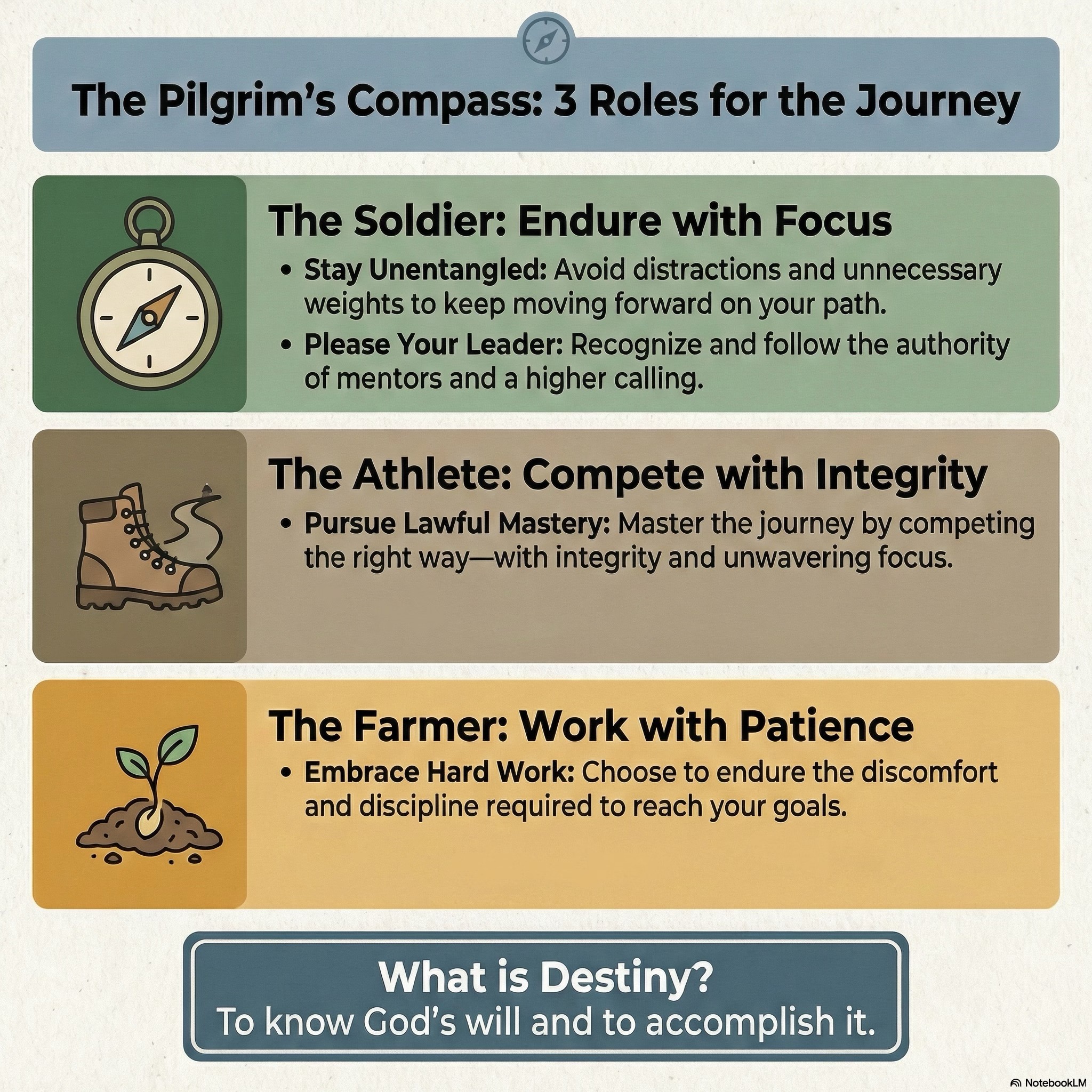
The Pilgrim progresses with the disciplined mindset of a soldier

The Pilgrim masters the rules to travel with integrity and laser like focus

In the 1980 Boston Marathon, Rosie Ruiz crossed the finish line in record-breaking time. She was crowned the victor, draped in the traditional laurel wreath, and celebrated as a marvel of endurance. But the celebration was hollow. Within days, the truth emerged: Ruiz hadn’t run the race. She had slipped out of the crowd undetected by the marshals, and taken a subway to the final stretch, re-entering the course just in time to claim a prize for miles she never covered.

She had the title, but she lacked the integrity. By flouting the rules she demonstrated her lack of character.

The Pilgrim Progresses as an Athlete

Paul’s letter to Timothy warns us against this “subway spirituality.” He reminds us that the life of a pilgrim is not a scramble for status, but an athletic endeavor in which character counts. As Paul writes: “Follow the Lord’s rules for doing his work, just as an athlete either follows the rules or is disqualified and wins no prize” (2 Timothy 2:5, TLB).

To be a Pilgrim in Process is to realize that the shortcut is a lie. True victory is found in the three pillars of the athlete’s integrity.

Follow the Rules

The Two Trails: Why Discipline is a “Four-Wheel Drive” Experience

In the Kingdom, the “rules” aren’t a heavy slog under a whip; they are the practice of keeping in step with the Holy Spirit.

I recently took a father-son’s trip to Costa Rica to hike the trail to the Rio Celeste. Most folks take the busy tourist trail to see the

I recently took a father-son’s trip to Costa Rica to hike the trail to the Rio Celeste. Most folks take the busy tourist trail to see the famous blue waterfall, One views it from a platform and swimming is forbidden, A local tipped off my son about a trailhead a few miles down the road where you could actually swim.

That trail didn’t have a single soul on it. It started as a pleasant meander and then plunged—about 430 feet down a rocky, gnarlymess of a path. My two sons, worried about an octogenarian navigating those rocks, hovered over me like guardian angels. I eventually took a spill, gashing my knee and leaving a bit of skin as a “donation” to an obliging rock.”Dad, you want to turn back?” my younger son asked.

“Not on your nelly,” I told him. “I want to swim in that water.”

We made it down and had the joy of that cool blue water, but the ascent was where character was developed. My younger son took my hand to help me up. At first, it was just a regular hand-hold. Then, he insisted on locking our hold by grabbing one another by the wrist—a double-grip that ensured even if one of us weakened, the connection was solid. I joked that I finally had “four-wheel drive.”

Positive Mastery

The pilgrim faces sections of the trail similar that. Some rules are “negative”—watch your step, find a secure hold, move with caution. But the mastery Paul talks about is positive. Keeping in step with the Holy Spirit provides an exhilaration in the middle of the difficulty. He is the “heft” in the steep places and the “stability” on the slippery ones.

The disciplines of a happy communion with God—being instant in prayer, meditating on scripture, and serving my neighbor—aren’t heavy weights we carry. They are the energy for the ascent, providing lasting joy.

When we try to bypass the disciplines of faith, we arrive at life’s “finish lines” as cheats rather than genuine champions. We practice these disciplines because they are the only way to ensure that the person who reaches the summit is the person the Lord intended us to be—changed, and reflecting His image.

As the Spirit of the Lord works within us, providing that “four-wheel drive” power, we become more and more like Him. We aren’t just reaching a destination; we are being transformed from “glory to glory.”

“And all of us have had that veil removed so that we can be mirrors that brightly reflect the glory of the Lord. And as the Spirit of the Lord works within us, we become more and more like him and reflect his glory even more.” (2 Corinthians 3:18, The Living Bible)

Lawful Mastery: The Work of the Unseen Miles

There is a massive difference between just being active and achieving mastery. Paul speaks of the athlete competing “lawfully.” If you look at a marathon runner, you’ll see that mastery isn’t found on the day of the race under the roar of the crowd. It’s forged months earlier in the cold, gray silence of a 5:00 AM training run. It’s found in the discipline of a sensible diet and a regimen prescribed by those who know the way.

Mastery means honoring the “laws of growth” long before the prize is even in sight. It takes honesty to admit where your form is failing, and the humility to accept the guidance of “Coach Jesus.” It requires the patience to increase your mileage by inches rather than miles, doing the relentless hidden work that happens when no one is watching.

In the spiritual life, we often want the crown of maturity without the drudgery of the training ground. But the trail doesn’t lie. You cannot bypass the laws of growth and expect to finish the distance. True mastery is just a long string of honest, quiet choices made when it’s just you and God. It’s taking the “rules of the race” and living them out in the parts of your life that no one else ever sees. This is an internal attitude. It’s the recognition that our stature is built in those “unseen miles”—the moments of cultivated intimacy where we listen with the heart, instantly recognizing what displeases Him and correcting it right then and there.

No Shortcuts

The pursuit of comfort is the ultimate shortcut, and it is the enemy of integrity. A tourist seeks the easiest path, but a pilgrim embraces the grade. Taking a shortcut is really just an admission that you don’t believe the journey itself is worth the effort. Like that subway ride in Boston, a shortcut might get your body to the coordinates of the finish line, but it cannot give you the character God desires or the “glory” Paul speaks of.

You might reach the destination, but you won’t be the person the Lord intended for the summit. Mastery is the only way to ensure that when you finally stand at the end of the trail, you have the heart and the legs to be there.


The Fireside Reflection

Are you looking for a subway to the summit, or are you mastering the basics? The prize for the shortcut is always hollow and you can fool the crowd for a while, applause is meaningless. It is God’s approval that matters.


Next time: The Pilgrim as Farmer