
Tag Archives: character

Beatitude = Profound Contentment

9 Jun

Inflation

This is not monopoly money. It is a genuine 100-billion-dollar banknote issued by the Reserve Bank of Zimbabwe in 2008.

At the height of the country’s hyperinflation, this staggering sum was just enough to buy a loaf of bread and a pint of milk …. provided you ran to the store. If you waited too long, the currency would devalue so rapidly that you would leave with bread, the milk priced far out of reach.

The modern use of the word “bless” has undergone its own hyperinflation. 

  • After a sneeze: “Achoo!” — “Bless you.”
  • When someone makes a tiny mistake: “Aw, bless him, he tried.”
  • Condescension: “Well, bless your heart.”
  • Responding to mild inconvenience: “Bless you, that sounds exhausting.”
  • Thanking someone for something trivial: “Bless you for bringing napkins.”
  • Celebrity acceptance speeches: “God has really blessed me with this award.”
  • Athletes after winning: “Feeling blessed.”
  • Prosperity language: “We’re blessed with a new SUV.”
  • Hashtags: “#blessed” attached to luxury vacations or gym selfies.
  • End of a letter, instead of sincerely: “Blessings to you and yours.”
  • Clichés: “Have a blessed day.” 
  • Humorous idioms: “Bless this mess” on home décor signs.
  • CondesenscIon: “Bless your little heart.”
  • Pity mixed with affection: “Bless him, he doesn’t understand.”
  • Irony: “Oh, bless…” meaning “you poor fool.”

When a word is used to mean everything, it ultimately means nothing.

Gold 

Gold on the other hand, increases in value The idea of blessing involves the bestowment of divine favor and the conferring of divine benefits. It means enjoying everything that God bestows on those He adopts into His family, including all the benefits of belonging to His royal family. A modern rendering of this idea would be an exclamation: “Oh, the supreme bliss of…!”. (The verb is absent in the original Greek, so it is acceptable grammatically, to read them as exclamations.)

Fools Gold

What!?

Whoever heard of the poor in spirit, the meek, or the persecuted as partakers of supreme bliss?. Our culture is the exact opposite: “Kick, bite, scratch, revile” and “look after #1”. 

For them, these exclamations are found in stained glass windows, where an obscure saint with a mournful face has a weird, otherworldly spotlight on his head. 

Platinum

The nature of this bliss is supreme because it is independent of prosperity and outward circumstance. It has to do with character and the Kingdom that is within—the rule of God over your anger, selfishness, greed, and hatred. It is the growth of character into Christlikeness, experiencing the love and life of Christ, who even in agony maintained communion with His Father. This bliss is not food and drink, but righteousness, peace, and joy in the Holy Spirit.

The Hebrew Foundation: Ashrei

Jesus was steeped in the Psalms and very likely had Psalm 1 in mind. It opens with “Blessed! (here the verb is missing and it is probably an exclamation). “Blessed!  This  man!” it is not expressing a religious wish or a prayer for a blessing to be bestowed. It is not a wishful thought, it is a treadmill in a gymn. The Hebrew word is ashrei, an objective declaration of a state of being. “Blessed! This is what rightly ordered, flourishing human life looks like: His delight is in the law of the Lord, meditating on it day and night. He comes through this relentless practice to resemble a tree planted by streams of water, yielding fruit in due season, with leaves that do not wither.

The Greek Translation: Makarioi

The Hebrew scriptures were translated into Greek, they chose the word makarioi to capture ashrei. They bypassed terms that merely mean “praised” or “well-spoken of” or “happy”. In ancient Greek culture, Makarios described a distinct state of deep well-being and fullness of life. It was the word used to describe the gods, who were untouched by ordinary human misery or the shifting winds of circumstance. 

An Unshakable Joy

Because this bliss is supreme, no one and not a single thing can rob us of it. Worldly happiness promotes concern, trouble, and dissatisfaction based on greed and envy. The Beatitudes are not only independent of circumstances, the hardest circumstances actually fuel the bright flame of bliss. We see this in the martyrs, like Perpetua who exclaimed that her execution was her “coronation”. A village of Anabaptist  believers were roped around a stake, waiting for the licking flames to execute them, when a man galloped up and shouted “Wait! I too am one of them!” Then he leapt into the ring of fire.

Here and Now

Furthermore, this bliss is present. There is no sense of “suffer now and be rewarded later”; it is here and now that we enjoy it. These are not spiritual smelling salts for dying saints, but a kick in the pants to exhibit the life of Christ in fellowship with Him in everyday, trying circumstances.

EMT OR HEART SURGEON

Ultimately, this defines the word “Christian”. A Christian is one who is full of bliss. How is this possible? All my natural instincts run contrary to this. It is critical to grasp that Jesus is not prescribing these things as if through sheer will we could live up to them. He is describing people who are in a relationship with Him. He is not performing an angioplasty to clear clogged arteries, He is offering a heart transplant. 

From this new heart a butterfly begins to emerge. Then it spreads its wings and experiences true freedom; freedom from the angst that defines our age.

The Presence of God

The contemporary world measures a “blessed life” almost exclusively by visible, external metrics:

  • Comfort and physical health;
  • Wealth and material success;
  • Influence and social admiration.

Jesus shifts the focus from circumstance to functional alignment. He defines this well-being by how an entity relates to its design:

  • A compass needle is functional when it points north;
  • A train operates correctly when it remains on the tracks;
  • A branch flourishes when it remains joined to the vine.

We flourish when we are rightly aligned with our Creator.

Biblical blessedness is not the absence of suffering; it is the presence of God.

Series: Introduction to Profound Contentment

1 Hologram https://progressingpeople.wordpress.com/2026/05/21/the-beatitudes-becoming-the-hologram/ Becoming the Hologram

2 Illusion https://progressingpeople.blog/2026/06/02/beatitude-profound-contentment/
Pilgrims Progress as Athletes

30 Jan

The Shortcut is a Lie: Are You Practicing “Subway Spirituality”?

In the 1980 Boston Marathon, Rosie Ruiz pulled off one of the greatest deceptions in sports history. She crossed the finish line in record time, wore the laurel wreath, and basked in the applause—but she hadn’t run the race. She had taken the subway.We often laugh at such a bold cheat, but how often do we try to bypass the “miles” of spiritual discipline in our own lives? The journey is more about the development of character than standing on a podium. Watch the video below to see why true victory isn’t about the finish line—it’s about the integrity of the climb.

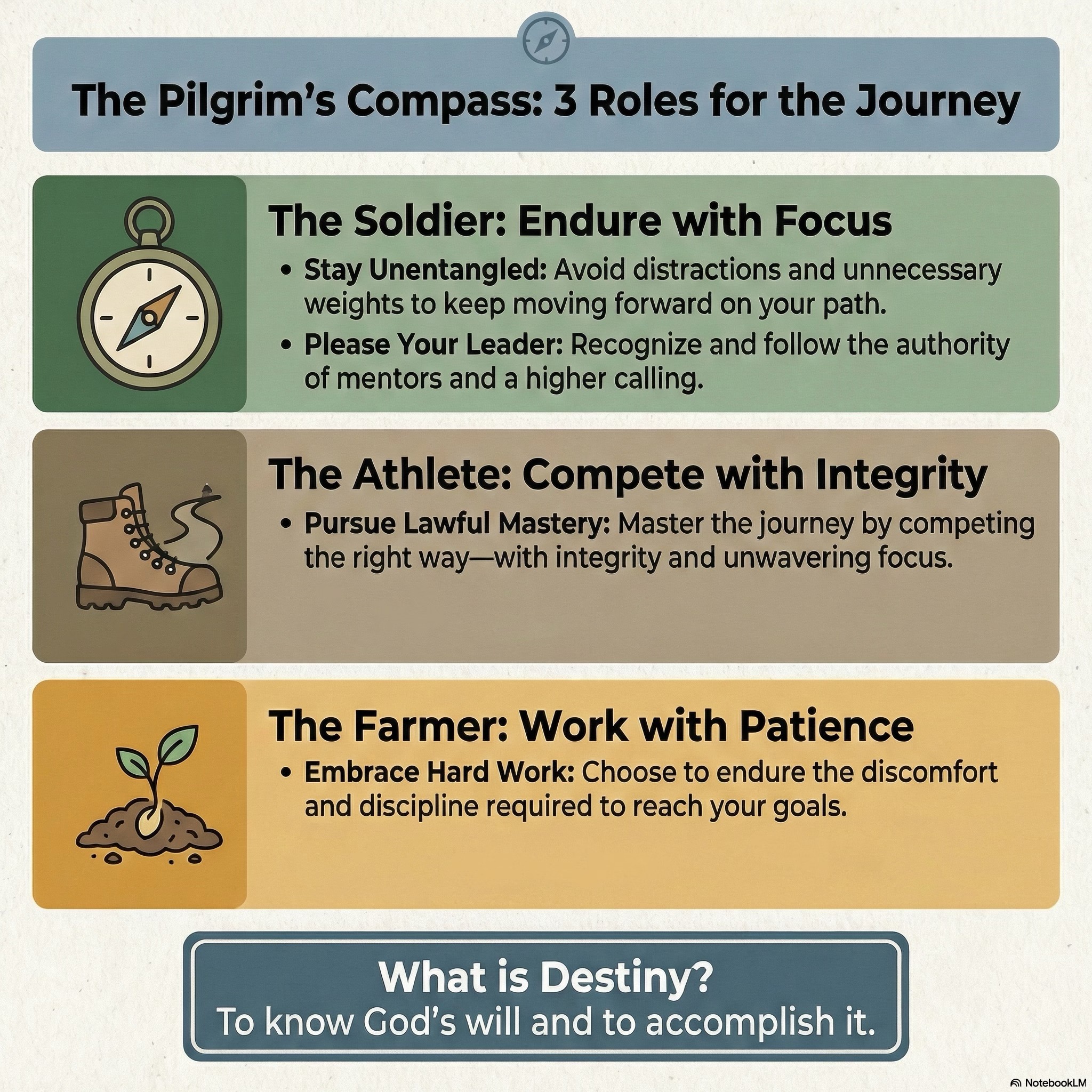
The Pilgrim Progresses as an Athlete

22 Jan

The Pilgrim progresses with the disciplined mindset of a soldier

The Pilgrim masters the rules to travel with integrity and laser like focus

In the 1980 Boston Marathon, Rosie Ruiz crossed the finish line in record-breaking time. She was crowned the victor, draped in the traditional laurel wreath, and celebrated as a marvel of endurance. But the celebration was hollow. Within days, the truth emerged: Ruiz hadn’t run the race. She had slipped out of the crowd undetected by the marshals, and taken a subway to the final stretch, re-entering the course just in time to claim a prize for miles she never covered.

She had the title, but she lacked the integrity. By flouting the rules she demonstrated her lack of character.

The Pilgrim Progresses as an Athlete

Paul’s letter to Timothy warns us against this “subway spirituality.” He reminds us that the life of a pilgrim is not a scramble for status, but an athletic endeavor in which character counts. As Paul writes: “Follow the Lord’s rules for doing his work, just as an athlete either follows the rules or is disqualified and wins no prize” (2 Timothy 2:5, TLB).

To be a Pilgrim in Process is to realize that the shortcut is a lie. True victory is found in the three pillars of the athlete’s integrity.

Follow the Rules

The Two Trails: Why Discipline is a “Four-Wheel Drive” Experience

In the Kingdom, the “rules” aren’t a heavy slog under a whip; they are the practice of keeping in step with the Holy Spirit.

I recently took a father-son’s trip to Costa Rica to hike the trail to the Rio Celeste. Most folks take the busy tourist trail to see the

I recently took a father-son’s trip to Costa Rica to hike the trail to the Rio Celeste. Most folks take the busy tourist trail to see the famous blue waterfall, One views it from a platform and swimming is forbidden, A local tipped off my son about a trailhead a few miles down the road where you could actually swim.

That trail didn’t have a single soul on it. It started as a pleasant meander and then plunged—about 430 feet down a rocky, gnarlymess of a path. My two sons, worried about an octogenarian navigating those rocks, hovered over me like guardian angels. I eventually took a spill, gashing my knee and leaving a bit of skin as a “donation” to an obliging rock.”Dad, you want to turn back?” my younger son asked.

“Not on your nelly,” I told him. “I want to swim in that water.”

We made it down and had the joy of that cool blue water, but the ascent was where character was developed. My younger son took my hand to help me up. At first, it was just a regular hand-hold. Then, he insisted on locking our hold by grabbing one another by the wrist—a double-grip that ensured even if one of us weakened, the connection was solid. I joked that I finally had “four-wheel drive.”

Positive Mastery

The pilgrim faces sections of the trail similar that. Some rules are “negative”—watch your step, find a secure hold, move with caution. But the mastery Paul talks about is positive. Keeping in step with the Holy Spirit provides an exhilaration in the middle of the difficulty. He is the “heft” in the steep places and the “stability” on the slippery ones.

The disciplines of a happy communion with God—being instant in prayer, meditating on scripture, and serving my neighbor—aren’t heavy weights we carry. They are the energy for the ascent, providing lasting joy.

When we try to bypass the disciplines of faith, we arrive at life’s “finish lines” as cheats rather than genuine champions. We practice these disciplines because they are the only way to ensure that the person who reaches the summit is the person the Lord intended us to be—changed, and reflecting His image.

As the Spirit of the Lord works within us, providing that “four-wheel drive” power, we become more and more like Him. We aren’t just reaching a destination; we are being transformed from “glory to glory.”

“And all of us have had that veil removed so that we can be mirrors that brightly reflect the glory of the Lord. And as the Spirit of the Lord works within us, we become more and more like him and reflect his glory even more.” (2 Corinthians 3:18, The Living Bible)

Lawful Mastery: The Work of the Unseen Miles

There is a massive difference between just being active and achieving mastery. Paul speaks of the athlete competing “lawfully.” If you look at a marathon runner, you’ll see that mastery isn’t found on the day of the race under the roar of the crowd. It’s forged months earlier in the cold, gray silence of a 5:00 AM training run. It’s found in the discipline of a sensible diet and a regimen prescribed by those who know the way.

Mastery means honoring the “laws of growth” long before the prize is even in sight. It takes honesty to admit where your form is failing, and the humility to accept the guidance of “Coach Jesus.” It requires the patience to increase your mileage by inches rather than miles, doing the relentless hidden work that happens when no one is watching.

In the spiritual life, we often want the crown of maturity without the drudgery of the training ground. But the trail doesn’t lie. You cannot bypass the laws of growth and expect to finish the distance. True mastery is just a long string of honest, quiet choices made when it’s just you and God. It’s taking the “rules of the race” and living them out in the parts of your life that no one else ever sees. This is an internal attitude. It’s the recognition that our stature is built in those “unseen miles”—the moments of cultivated intimacy where we listen with the heart, instantly recognizing what displeases Him and correcting it right then and there.

No Shortcuts

The pursuit of comfort is the ultimate shortcut, and it is the enemy of integrity. A tourist seeks the easiest path, but a pilgrim embraces the grade. Taking a shortcut is really just an admission that you don’t believe the journey itself is worth the effort. Like that subway ride in Boston, a shortcut might get your body to the coordinates of the finish line, but it cannot give you the character God desires or the “glory” Paul speaks of.

You might reach the destination, but you won’t be the person the Lord intended for the summit. Mastery is the only way to ensure that when you finally stand at the end of the trail, you have the heart and the legs to be there.


The Fireside Reflection

Are you looking for a subway to the summit, or are you mastering the basics? The prize for the shortcut is always hollow and you can fool the crowd for a while, applause is meaningless. It is God’s approval that matters.


Next time: The Pilgrim as Farmer