
Archive | Beatitudes RSS feed for this section

Beatitude = Profound Contentment

9 Jun

Inflation

This is not monopoly money. It is a genuine 100-billion-dollar banknote issued by the Reserve Bank of Zimbabwe in 2008.

At the height of the country’s hyperinflation, this staggering sum was just enough to buy a loaf of bread and a pint of milk …. provided you ran to the store. If you waited too long, the currency would devalue so rapidly that you would leave with bread, the milk priced far out of reach.

The modern use of the word “bless” has undergone its own hyperinflation. 

  • After a sneeze: “Achoo!” — “Bless you.”
  • When someone makes a tiny mistake: “Aw, bless him, he tried.”
  • Condescension: “Well, bless your heart.”
  • Responding to mild inconvenience: “Bless you, that sounds exhausting.”
  • Thanking someone for something trivial: “Bless you for bringing napkins.”
  • Celebrity acceptance speeches: “God has really blessed me with this award.”
  • Athletes after winning: “Feeling blessed.”
  • Prosperity language: “We’re blessed with a new SUV.”
  • Hashtags: “#blessed” attached to luxury vacations or gym selfies.
  • End of a letter, instead of sincerely: “Blessings to you and yours.”
  • Clichés: “Have a blessed day.” 
  • Humorous idioms: “Bless this mess” on home décor signs.
  • CondesenscIon: “Bless your little heart.”
  • Pity mixed with affection: “Bless him, he doesn’t understand.”
  • Irony: “Oh, bless…” meaning “you poor fool.”

When a word is used to mean everything, it ultimately means nothing.

Gold 

Gold on the other hand, increases in value The idea of blessing involves the bestowment of divine favor and the conferring of divine benefits. It means enjoying everything that God bestows on those He adopts into His family, including all the benefits of belonging to His royal family. A modern rendering of this idea would be an exclamation: “Oh, the supreme bliss of…!”. (The verb is absent in the original Greek, so it is acceptable grammatically, to read them as exclamations.)

Fools Gold

What!?

Whoever heard of the poor in spirit, the meek, or the persecuted as partakers of supreme bliss?. Our culture is the exact opposite: “Kick, bite, scratch, revile” and “look after #1”. 

For them, these exclamations are found in stained glass windows, where an obscure saint with a mournful face has a weird, otherworldly spotlight on his head. 

Platinum

The nature of this bliss is supreme because it is independent of prosperity and outward circumstance. It has to do with character and the Kingdom that is within—the rule of God over your anger, selfishness, greed, and hatred. It is the growth of character into Christlikeness, experiencing the love and life of Christ, who even in agony maintained communion with His Father. This bliss is not food and drink, but righteousness, peace, and joy in the Holy Spirit.

The Hebrew Foundation: Ashrei

Jesus was steeped in the Psalms and very likely had Psalm 1 in mind. It opens with “Blessed! (here the verb is missing and it is probably an exclamation). “Blessed!  This  man!” it is not expressing a religious wish or a prayer for a blessing to be bestowed. It is not a wishful thought, it is a treadmill in a gymn. The Hebrew word is ashrei, an objective declaration of a state of being. “Blessed! This is what rightly ordered, flourishing human life looks like: His delight is in the law of the Lord, meditating on it day and night. He comes through this relentless practice to resemble a tree planted by streams of water, yielding fruit in due season, with leaves that do not wither.

The Greek Translation: Makarioi

The Hebrew scriptures were translated into Greek, they chose the word makarioi to capture ashrei. They bypassed terms that merely mean “praised” or “well-spoken of” or “happy”. In ancient Greek culture, Makarios described a distinct state of deep well-being and fullness of life. It was the word used to describe the gods, who were untouched by ordinary human misery or the shifting winds of circumstance. 

An Unshakable Joy

Because this bliss is supreme, no one and not a single thing can rob us of it. Worldly happiness promotes concern, trouble, and dissatisfaction based on greed and envy. The Beatitudes are not only independent of circumstances, the hardest circumstances actually fuel the bright flame of bliss. We see this in the martyrs, like Perpetua who exclaimed that her execution was her “coronation”. A village of Anabaptist  believers were roped around a stake, waiting for the licking flames to execute them, when a man galloped up and shouted “Wait! I too am one of them!” Then he leapt into the ring of fire.

Here and Now

Furthermore, this bliss is present. There is no sense of “suffer now and be rewarded later”; it is here and now that we enjoy it. These are not spiritual smelling salts for dying saints, but a kick in the pants to exhibit the life of Christ in fellowship with Him in everyday, trying circumstances.

EMT OR HEART SURGEON

Ultimately, this defines the word “Christian”. A Christian is one who is full of bliss. How is this possible? All my natural instincts run contrary to this. It is critical to grasp that Jesus is not prescribing these things as if through sheer will we could live up to them. He is describing people who are in a relationship with Him. He is not performing an angioplasty to clear clogged arteries, He is offering a heart transplant. 

From this new heart a butterfly begins to emerge. Then it spreads its wings and experiences true freedom; freedom from the angst that defines our age.

The Presence of God

The contemporary world measures a “blessed life” almost exclusively by visible, external metrics:

  • Comfort and physical health;
  • Wealth and material success;
  • Influence and social admiration.

Jesus shifts the focus from circumstance to functional alignment. He defines this well-being by how an entity relates to its design:

  • A compass needle is functional when it points north;
  • A train operates correctly when it remains on the tracks;
  • A branch flourishes when it remains joined to the vine.

We flourish when we are rightly aligned with our Creator.

Biblical blessedness is not the absence of suffering; it is the presence of God.

Series: Introduction to Profound Contentment

1 Hologram https://progressingpeople.wordpress.com/2026/05/21/the-beatitudes-becoming-the-hologram/ Becoming the Hologram

2 Illusion https://progressingpeople.blog/2026/06/02/beatitude-profound-contentment/

Beatitude = Profound Contentment

2 Jun

Happiness – an Illusion?

“CNN wishes its many viewers a “Happy Christmas.

Billions of greeting cards are bought each year. The senders fondly express an impossibility: “We wish you a happy New Year” (or birthday, or anniversary). Significant in these greetings is the word “wish”. Happiness will always remain on the wish list; a dream, if not impossible, then certainly so fleeting as to be insignificant. No one can actually grant the wish. 

Consider the parallel of defining the Loch Ness Monster. There are fuzzy pictures and dubious sightings. These indicate that something may exist, but there is strong doubt as to whether it exists merely in beery imagination or in actuality.

When folk describe happiness, it is invariably connected with an emotional state. It is the feeling that arises from:

  • not being haunted by the past,
  • not being worried about financial or bodily security in the present,
  • not being fearful about the future.

But emotions are as fickle and changeable as politicians on campaign. They arise from some unknown inner recess of the psyche and disappear as quickly as a paycheck. Happiness is therefore as shy and elusive as the Loch Ness Monster.

One sure way of achieving an emotional high on a permanent basis would be by purchasing a time-share in the local cemetery. People who are permanently euphoric are generally found in asylums. Yet when reading or talking about happiness, a distinction between “happiness” and “true happiness” soon creeps into the discussion. This illustrates the problem very nicely: how do we distinguish between the two?

And what shall we say about people who live with vicious memories of past atrocities, stare death in the face daily, and have no security because they are refugees, yet still appear to be supremely happy?

The answer is that happiness, the number one quest of the human race, is a chasing after the wind. Billions of dollars are spent annually pursuing what is largely an illusion. Advertisements picture people made happy by the products on display. Like the great migration of gnus across the African plain, people follow the notion that happiness can be had if only they were slimmer, more tanned, drove a fancier car, smoked a different brand, or had more money in the bank. Quacks promising health and wealth flourish no less than their snake-oil forefathers in the Wild West.

How strange then that most people equate the word “happy” with “Blessed”, the word used to introduce each Beatitude.

The reality remains that happiness is as inaccessible as Mars and just as barren.

Next up:  If happiness is little more than a passing emotional weather pattern, then the Beatitudes are either cruel mockery or they are speaking about something entirely different. Jesus calls the poor in spirit, the mourning, the persecuted, and the meek “Blessed.” Whatever He meant, it plainly had nothing to do with the modern pursuit of happiness. The next question therefore becomes unavoidable: what did the word actually mean?

Full disclosure: I use AI as IA (Intelligent Assistant). And no, I am not dyslexic. All the words and ideas are mine alone. I prompt it to smooth the flow, check the logic and check for redundancy. I also use AI for infographics.

The Beatitudes Derivation: each statement begins with Blessed are…”, derived from the Latin word for blessed, beatus. “Favoured by God; enjoying divine grace.

Next up: Blessed! A Word Recaptured! I examine the profound biblical origins of the word “blessed,” The modern use of ‘bless’ has been hyper-inflated, like money in hyper inflation, stripping the word of its original value.

Series :      

1 https://progressingpeople.wordpress.com/2026/05/21/the-beatitudes-becoming-the-hologram/  Becoming the Hologram

The Beatitudes (Profound Contentment): Becoming the Hologram

21 May

Fraternal Twins — Sinai and Zion

Introduction to the Beatitudes: Part 1 of 3

If you could digitize the Beatitudes and project them as a live hologram, the figure standing before you would be Jesus. Within these brief chapters, a remarkable compendium of both how to find God and how to live for God is offered. Truly, if circumstances dictated I could have only two pages from the entire Bible, I would choose this exact Sermon on the Mount.

But why are these specific pages so vital? What is it that keeps us from sinking into a brutish state when life loses its restraints?

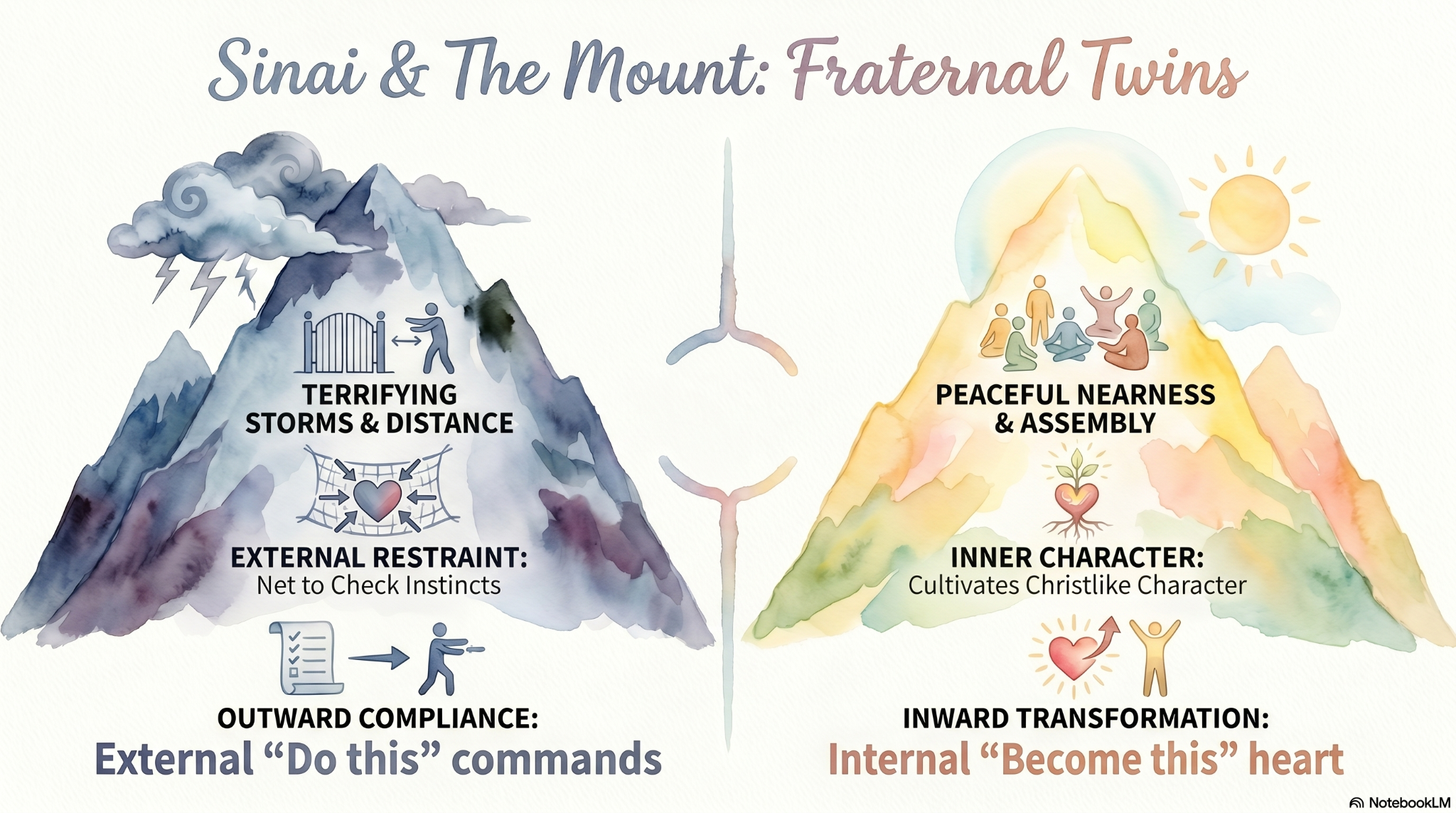
It takes two completely different mountains, two fraternal twins, to answer that question. On one side stands Mount Sinai: a place of smoke, fire, and trembling fear, designed to act as an external check on our behavior. On the other side stands Mount Zion and the Mount of the Beatitudes: a gentle, open hillside offering an inner transformation of grace.

Like an instruction prompt setting the agenda for an Intelligent Agent, the Beatitudes launch this grand shift, casting rays of light and life on everything that follows.

There is a deliberate parallel and contrast between the giving of the 10 commandments and the delivery of the Sermon: The link is not accidental; Matthew especially presents Jesus as a new and greater Moses, but one who fulfills and transforms the Old Covenant rather than merely repeating it. In fact ushering in the New Covenant, an era of grace flowing from law.

The two are compared directly in Hebrews 12:18-24,

The Mountain of Fear and the Mountain of Joy

18 You have not come to a mountain that can be touched and that is burning with fire; to darkness, gloom and storm; 19 to a trumpet blast or to such a voice speaking words that those who heard it begged that no further word be spoken to them, 20 because they could not bear what was commanded: “If even an animal touches the mountain, it must be stoned to death.” 21 The sight was so terrifying that Moses said, “I am trembling with fear.”

22 But you have come to Mount Zion, to the city of the living God, the heavenly Jerusalem. You have come to thousands upon thousands of angels in joyful assembly, 23 to the church of the firstborn, whose names are written in heaven. You have come to God, the Judge of all, to the spirits of the righteous made perfect, 24 to Jesus the mediator of a new covenant, and to the sprinkled blood that speaks a better word than the blood of Abel. (NIV)

Mount Zion as a synonym for The Mount.

Sinai and the Mount: Law Given, Life Transformed

CategoryMount Sinai (The Ten Commandments)The Mount of the Beatitudes (The Sermon on the Mount)
LocationMount Sinai; a rugged, smoky mountainA mountain in Galilee; a gentle, accessible hillside
AtmosphereThunder, lightning, smoke, and fire; fear and awePeaceful, open air; grace and nearness
People’s ResponseTrembling and standing far off; “Do not let God speak to us…”Drawing near and sitting at His feet; “He opened His mouth and taught them.”
Mediator / SpeakerMoses mediates; “Thus says the Lord…”Jesus speaks with authority; “But I say to you…”
Nature of the MessageLaw (Torah); external commands and boundariesKingdom Teaching; inner character and transformed living
FormTen Commandments; primarily prohibitive: “You shall not…”Beatitudes & Teachings; transformative: “Blessed are…”
FocusDefines what is right and wrong; sets boundaries for holy livingForms the heart of righteousness; cultivates the character of the Kingdom
ScopeFocus on Israel as a nation; a covenant with a peopleExtends to all people; love of neighbor expanded to enemy
ResultReveals God’s holiness; convicts sin and demands obedienceReveals God’s grace; invites transformation and discipleship
CovenantOld Covenant; written on stone tabletsNew Covenant Fulfilled in Christ; written on hearts
Spiritual EffectProduces outward compliance; “Do this.”Produces inward transformation; “Become this.”
Theological SignificanceReveals God’s righteous standard; shows humanity our need for graceReveals God’s Kingdom way; shows grace empowering true righteousness
SummaryThe Law Reveals Our Need for a Savior: It shows us we cannot save ourselves.Grace Reveals Our New Life in Him: It shows us who we can become in His Kingdom.

Philip Caputo, chronicling his experience in the Vietnam War, captures the necessity of the the two covenants:

“Out there, lacking restraints, sanctioned to kill, confronted by a hostile country and a relentless enemy, we sank into a brutish state. The descent could be checked only by the net of a man’s inner moral values, the attribute that is called character. There were a few-and I suspect Lieutenant Calley was one—who had no net and plunged all the way down, discovering in their bottommost depths a capacity for malice they probably never suspected was there.” (Emphases added)

The Old Covenant is given to restrain our brutish instincts. The New Covenant is required to develop character into Christlikeness. Hence Sinai and Zion are fraternal twins. Restraint is essential to the development of character. The guilt and alienation from God under the law is replaced by “you are My friends.”

God is gracious beyond description.

His invitation to this Banquet has an RSVP, and it requires your acceptance. Respond now—maybe for the first time, and hopefully for the umpteenth time! It leads to a lifetime of enjoyment.

For throughout it all, the refrain is BLESSED.

– – – – – – – – – – – – – – – – – – – – – – – – – – – – – – – – – – – – – – – – – – – – – – – – – – – – – – – – – – – – – – – – – – .

Next up in this series: The Meaning of “Blessed”: unpacking this truly radical word.