The Shortcut is a Lie: Are You Practicing “Subway Spirituality”?
In the 1980 Boston Marathon, Rosie Ruiz pulled off one of the greatest deceptions in sports history. She crossed the finish line in record time, wore the laurel wreath, and basked in the applause—but she hadn’t run the race. She had taken the subway.We often laugh at such a bold cheat, but how often do we try to bypass the “miles” of spiritual discipline in our own lives? The journey is more about the development of character than standing on a podium. Watch the video below to see why true victory isn’t about the finish line—it’s about the integrity of the climb.
The Pilgrim progresses with the disciplined mindset of a soldier
The Pilgrim masters the rules to travel with integrity and laser like focus
In the 1980 Boston Marathon, Rosie Ruiz crossed the finish line in record-breaking time. She was crowned the victor, draped in the traditional laurel wreath, and celebrated as a marvel of endurance. But the celebration was hollow. Within days, the truth emerged: Ruiz hadn’t run the race. She had slipped out of the crowd undetected by the marshals, and taken a subway to the final stretch, re-entering the course just in time to claim a prize for miles she never covered.
She had the title, but she lacked the integrity. By flouting the rules she demonstrated her lack of character.
The Pilgrim Progresses as an Athlete
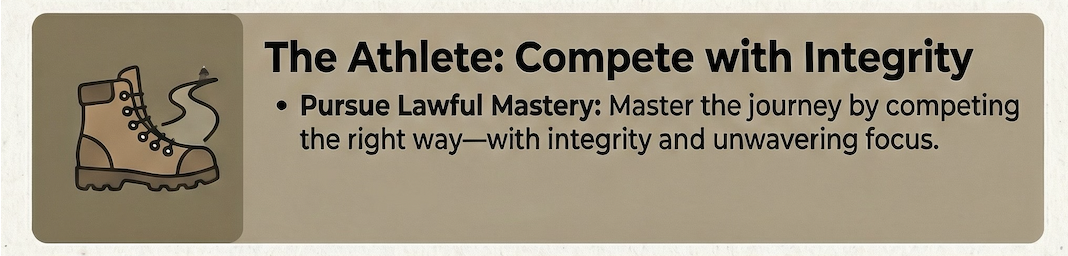
Paul’s letter to Timothy warns us against this “subway spirituality.” He reminds us that the life of a pilgrim is not a scramble for status, but an athletic endeavor in which character counts. As Paul writes: “Follow the Lord’s rules for doing his work, just as an athlete either follows the rules or is disqualified and wins no prize” (2 Timothy 2:5, TLB).
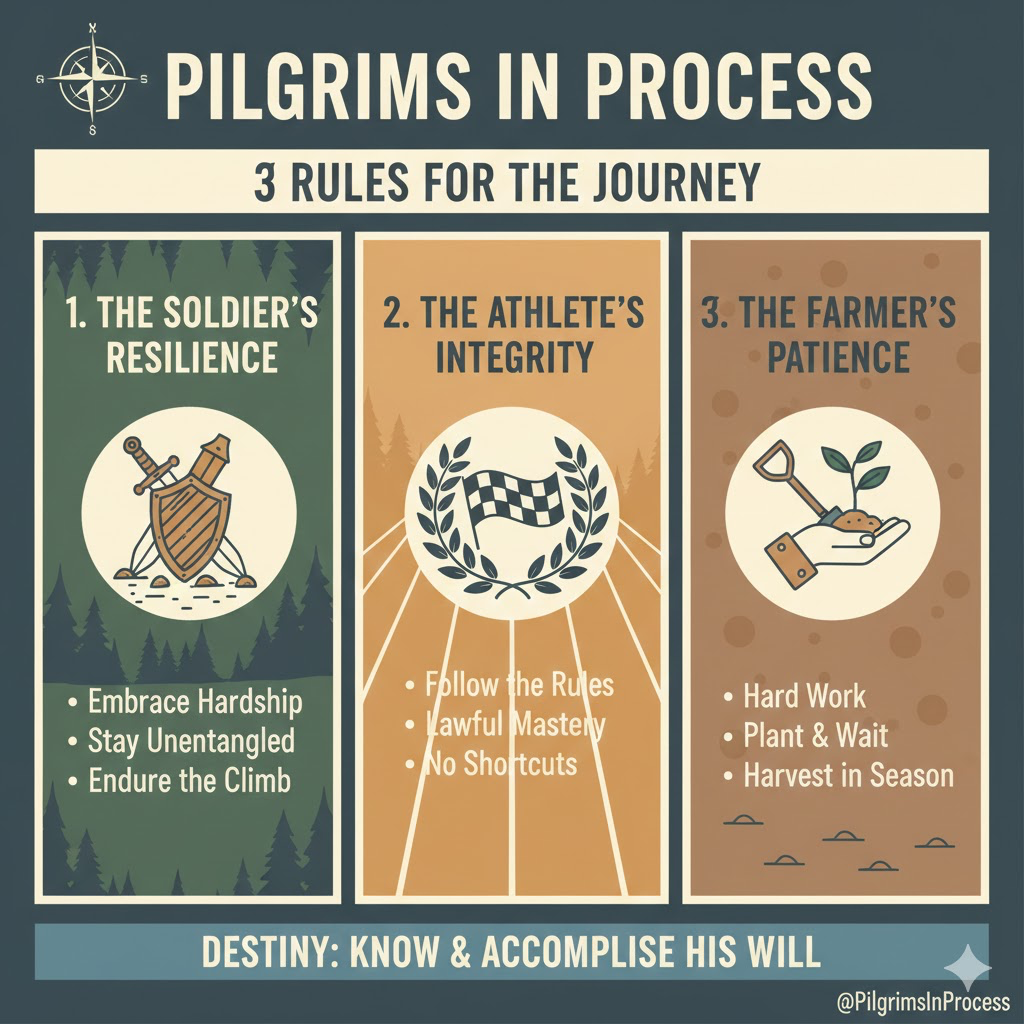
To be a Pilgrim in Process is to realize that the shortcut is a lie. True victory is found in the three pillars of the athlete’s integrity.
Follow the Rules
The Two Trails: Why Discipline is a “Four-Wheel Drive” Experience
In the Kingdom, the “rules” aren’t a heavy slog under a whip; they are the practice of keeping in step with the Holy Spirit.
I recently took a father-son’s trip to Costa Rica to hike the trail to the Rio Celeste. Most folks take the busy tourist trail to see the
I recently took a father-son’s trip to Costa Rica to hike the trail to the Rio Celeste. Most folks take the busy tourist trail to see the famous blue waterfall, One views it from a platform and swimming is forbidden, A local tipped off my son about a trailhead a few miles down the road where you could actually swim.
That trail didn’t have a single soul on it. It started as a pleasant meander and then plunged—about 430 feet down a rocky, gnarlymess of a path. My two sons, worried about an octogenarian navigating those rocks, hovered over me like guardian angels. I eventually took a spill, gashing my knee and leaving a bit of skin as a “donation” to an obliging rock.”Dad, you want to turn back?” my younger son asked.
“Not on your nelly,” I told him. “I want to swim in that water.”
We made it down and had the joy of that cool blue water, but the ascent was where character was developed. My younger son took my hand to help me up. At first, it was just a regular hand-hold. Then, he insisted on locking our hold by grabbing one another by the wrist—a double-grip that ensured even if one of us weakened, the connection was solid. I joked that I finally had “four-wheel drive.”
Positive Mastery
The pilgrim faces sections of the trail similar that. Some rules are “negative”—watch your step, find a secure hold, move with caution. But the mastery Paul talks about is positive. Keeping in step with the Holy Spirit provides an exhilaration in the middle of the difficulty. He is the “heft” in the steep places and the “stability” on the slippery ones.
The disciplines of a happy communion with God—being instant in prayer, meditating on scripture, and serving my neighbor—aren’t heavy weights we carry. They are the energy for the ascent, providing lasting joy.
When we try to bypass the disciplines of faith, we arrive at life’s “finish lines” as cheats rather than genuine champions. We practice these disciplines because they are the only way to ensure that the person who reaches the summit is the person the Lord intended us to be—changed, and reflecting His image.
As the Spirit of the Lord works within us, providing that “four-wheel drive” power, we become more and more like Him. We aren’t just reaching a destination; we are being transformed from “glory to glory.”
“And all of us have had that veil removed so that we can be mirrors that brightly reflect the glory of the Lord. And as the Spirit of the Lord works within us, we become more and more like him and reflect his glory even more.” (2 Corinthians 3:18, The Living Bible)
Lawful Mastery: The Work of the Unseen Miles
There is a massive difference between just being active and achieving mastery. Paul speaks of the athlete competing “lawfully.” If you look at a marathon runner, you’ll see that mastery isn’t found on the day of the race under the roar of the crowd. It’s forged months earlier in the cold, gray silence of a 5:00 AM training run. It’s found in the discipline of a sensible diet and a regimen prescribed by those who know the way.
Mastery means honoring the “laws of growth” long before the prize is even in sight. It takes honesty to admit where your form is failing, and the humility to accept the guidance of “Coach Jesus.” It requires the patience to increase your mileage by inches rather than miles, doing the relentless hidden work that happens when no one is watching.
In the spiritual life, we often want the crown of maturity without the drudgery of the training ground. But the trail doesn’t lie. You cannot bypass the laws of growth and expect to finish the distance. True mastery is just a long string of honest, quiet choices made when it’s just you and God. It’s taking the “rules of the race” and living them out in the parts of your life that no one else ever sees. This is an internal attitude. It’s the recognition that our stature is built in those “unseen miles”—the moments of cultivated intimacy where we listen with the heart, instantly recognizing what displeases Him and correcting it right then and there.
No Shortcuts
The pursuit of comfort is the ultimate shortcut, and it is the enemy of integrity. A tourist seeks the easiest path, but a pilgrim embraces the grade. Taking a shortcut is really just an admission that you don’t believe the journey itself is worth the effort. Like that subway ride in Boston, a shortcut might get your body to the coordinates of the finish line, but it cannot give you the character God desires or the “glory” Paul speaks of.
You might reach the destination, but you won’t be the person the Lord intended for the summit. Mastery is the only way to ensure that when you finally stand at the end of the trail, you have the heart and the legs to be there.
The Fireside Reflection
Are you looking for a subway to the summit, or are you mastering the basics? The prize for the shortcut is always hollow and you can fool the crowd for a while, applause is meaningless. It is God’s approval that matters.
Your life is a process, either as a tourist vacantly gaping at attractions, or wandering bewildered through a foreign grocery store; or, as a determined pilgrim living with intentionality. Life is not a simple path from A to B. It is a winding, rocky ascent through fog and friction—a path defined not by the miles covered, but by the fortitude forged in the climb. To be a “Pilgrim in Process”—one genuinely committed to this path—requires more than forward movement; it demands an intentional internal posture.
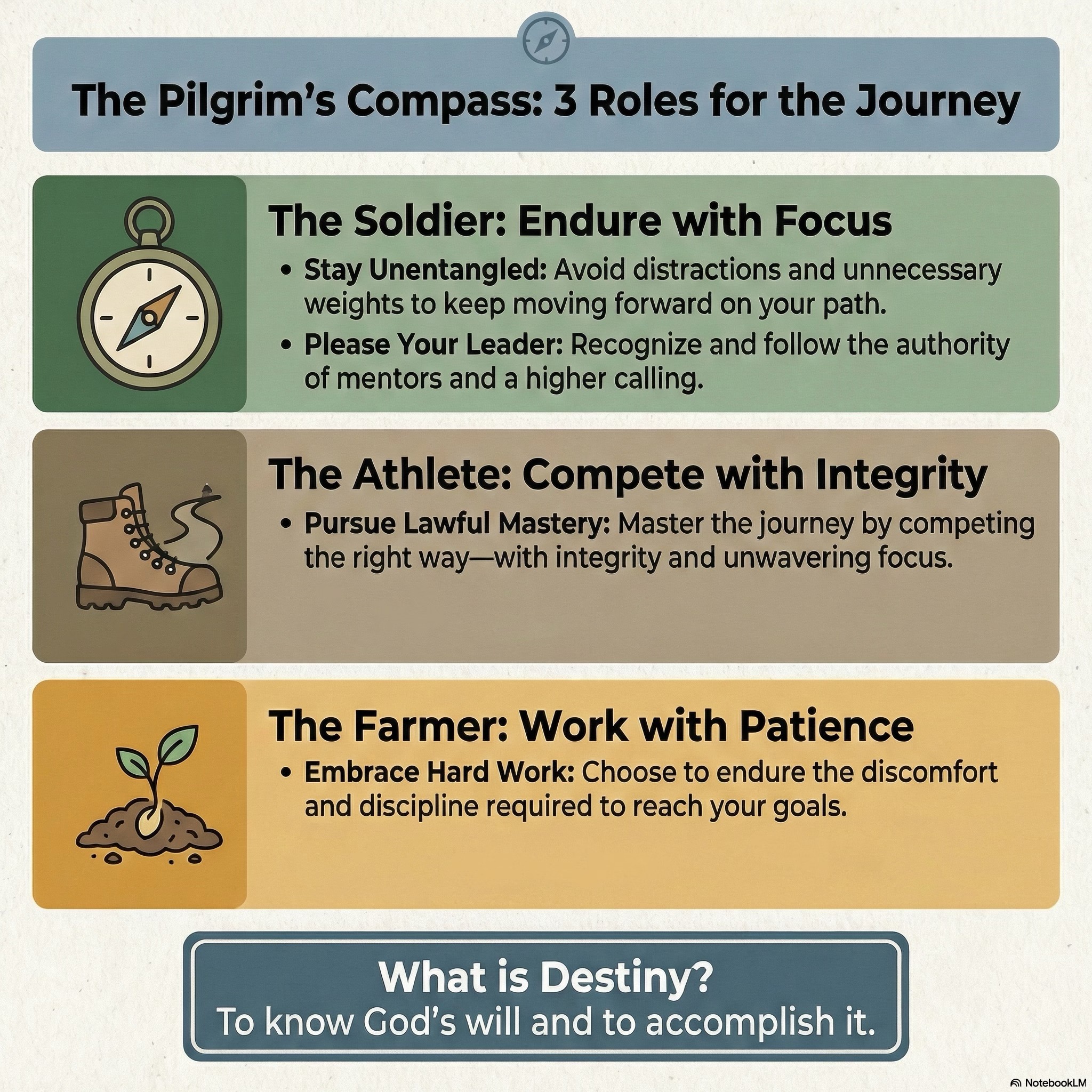
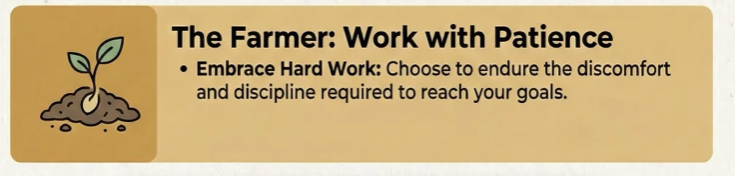
In 2 Timothy 2:3-7 Paul admonishes his protege: “3 Take your share of suffering as a good soldier of Jesus Christ, just as I do; 4 and as Christ’s soldier, do not let yourself become tied up in worldly affairs, for then you cannot satisfy the one who has enlisted you in his army. 5 Follow the Lord’s rules for doing his work, just as an athlete either follows the rules or is disqualified and wins no prize. 6 Work hard like a farmer who gets paid well if he raises a large crop.7 Think over these three illustrations, and may the Lord help you to understand how they apply to you.” (Living Bible)
Let’s look at the metaphor of the soldier in this blog. (Paul gives us three distinct pictures of the pilgrim life: the Soldier, the Athlete, and the Farmer. While we will dive deep into the Athlete’s integrity and the Farmer’s patience in my next two posts, today we begin with the foundation: the resilience of the Soldier.”)
1. Embrace the Soldier’s Suffering
Pilgrim/Soldiers make the choice: discipline over the siren song of comfort. In a culture that worships ease, and equates happiness with wealth and power, a pilgrim understands that growth only happens at the edge of our capacity. We are not tourists on this path, ready to retreat at the first sign of trouble. We are, as the source notes remind us, “soldiers in a spiritual sense,” committed to the mission no matter the terrain. “This means accepting that a fixation on comfort acts as a barrier to progress—it encourages a slow slide into complacency and leaves our character fragile when the terrain inevitably turns rough.”
This willingness to ‘suffer’ through the rigors of discipline is not a call for self-punishment; it is the fundamental price of admission for achieving your destiny. And therefore it is not burdensome, but joyful. But this resilience is the engine, not the compass. It must be paired with a singular focus, which brings us to the second rule.
2. Stay Intentionally Unentangled
The second rule is to carry only what is essential for the journey. A tourist collects souvenirs; a pilgrim sheds weight. A pilgrim’s progress is immediately halted by the gravity of unnecessary burdens. Getting ‘entangled’ in the world’s distractions—the petty dramas, the fleeting pursuits, or even the ‘lawful’ but non-essential activities—will anchor you in place.
Progress requires doing things the “lawful way”—not just in a legal sense, but with a profound integrity and a disciplined focus that honors the mission. This is the art of strategic renunciation. By letting go of what doesn’t serve the journey, you gain the freedom and momentum to move with purpose. This singular focus clears the path, but a clear path is useless without a map.
3. Understand Your Place in the Ranks
The third rule is to recognize and respect the structure of the journey. Tourists wander where they please; pilgrims understand their part in the caravan. A true pilgrim is not like a sheep wandering aimlessly but is part of a larger body with a defined order. This means acknowledging the role of the “man of authority”—the leaders, mentors, or the “Undershepherd” who provides guidance—and even answering to a higher calling that serves as an internal compass.
“Stop measuring your life by the ease of the terrain or the miles you’ve logged. Measure it by the resolve you’ve built and the community you’ve kept. The fog will lift and the rocks will give way, but the fortitude you forge in the climb is yours forever. Keep walking. You are a Pilgrim in Process, and the path is exactly where you are meant to be.”
This is not a call for blind obedience, but for strategic alignment and teachability. Humility isn’t a weakness; it’s a strategic tool for accelerated learning. It allows you to absorb wisdom from those ahead, preventing costly errors and positioning you to contribute and, eventually, to lead. One must first know how to follow before one can ever hope to guide others.
Conclusion: The True Meaning of Destiny
“At the end of the day, we have to realize that these three postures—the Soldier, the Athlete, and the Farmer—aren’t just a checklist to complete. They are a trinity of principles that create the rhythm of the walk itself.
The Soldier’s Hardness is like your steady breath; it’s the grit to keep your feet moving when the trail gets steep and the air gets thin. Intentional Unentanglement is the lightness of your pack; it’s the constant work of making sure you aren’t carrying ‘stones’ from the world that only serve to slow you down. And finally, understanding your Place in the Ranks is your compass. It’s the humble recognition that you are following a path blazed by those who went before you, ensuring that all your disciplined, focused energy is actually leading you in the right direction.
When these three things click, the ‘process’ stops being a burden and starts being the way we find our destiny.”
They are the internal architecture required to see the journey through to its end. The goal is not aimless wandering but focused accomplishment. We are here to discern our purpose and then do the work to finish it.
To know God’s will. To accomplish it — that is destiny and only that.
What is one thing you can do today to shift from being a tourist to a pilgrim on your own journey?
Coming Next in the Series:”
Part 2:The Athlete’s Integrity — Why the ‘Process’ matters more than the ‘Podium’.
Part 3:The Farmer’s Patience — How to work when you can’t see the harvest yet.
Make sure to subscribe to the blog and my YouTube channel so you don’t miss the next leg of the journey.



 progressingpeople