Tag Archives: trust

Faith Enables Perseverance

26 Feb

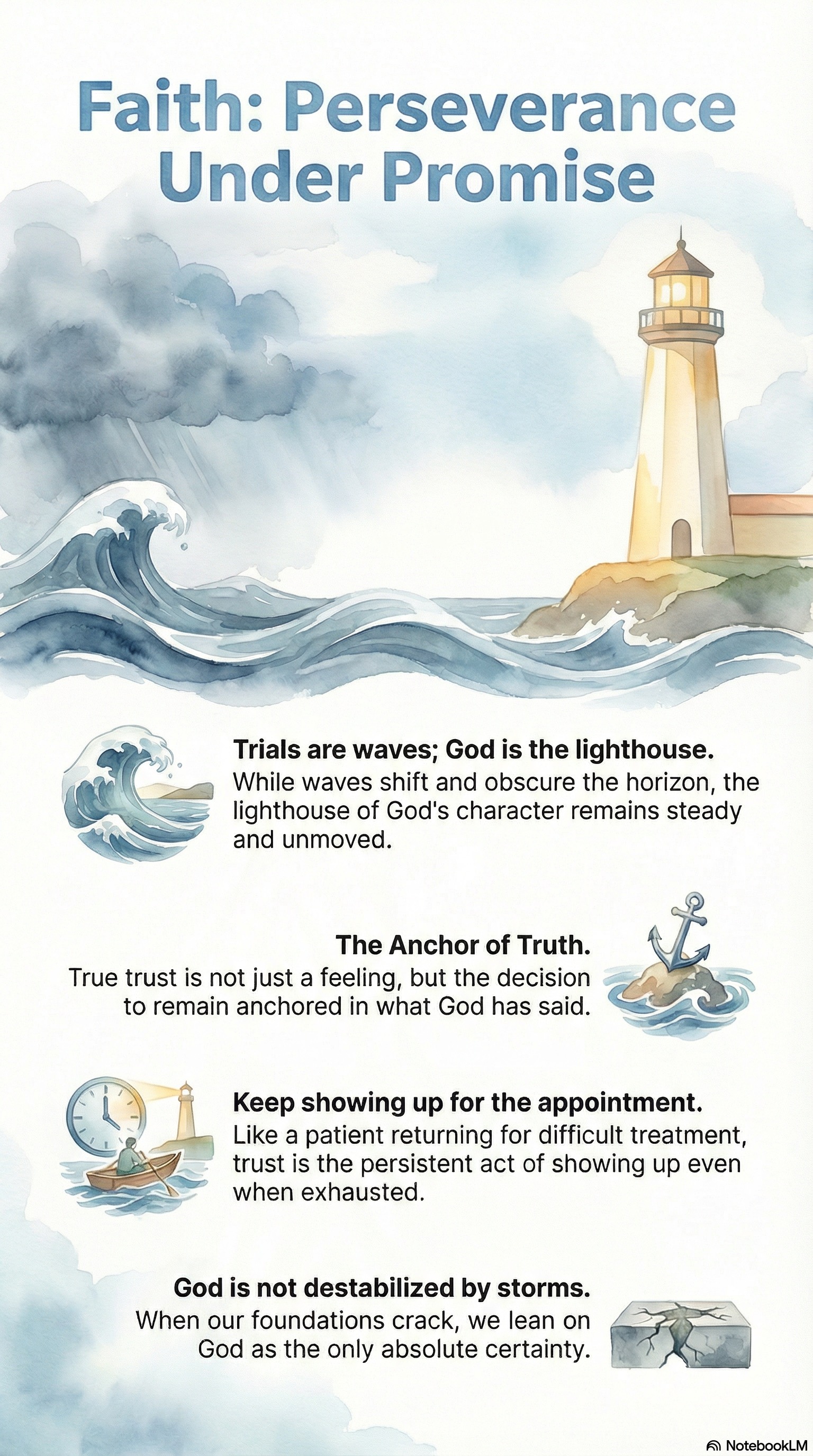
Imagine yourself in a small ship on a violent sea. Thunder splits the sky, and waves rise like mountains, dropping you into valleys so deep that the world disappears. In the trough of the wave, you see nothing but walls of shifting water; the horizon is gone, and the shore is a memory.
Then, a Word breaks through the roar of the storm, like a shaft of illumination from a lighthouse:

“For the earth will be filled with the knowledge of the glory of the Lord, as the waters cover the sea.” — Habakkuk 2:14

When you are in the trough, the light vanishes. You are surrounded by the spray and the dark. But as you crest the wave, you see it gain—steady, and unwavering. 

“But the Lord is in his holy temple; let all the earth keep silence before him.” — Habakkuk 2:20

The lighthouse never shifted; it did not flicker or fail. Only your position changed. These promises are beams of light from a distant, permanent shore.

Those who know God trust Him. When the foundation of our world begins to crack, we don’t lean on our circumstances; we lean on our deepest-held certainty: God as the only absolute. God is not destabilized by what destabilizes you.

Persevering Faith

I saw this lighthouse-faith in my friend Julia. She faced a rare and deadly metastasis of melanoma; what had begun on her skin had migrated to her lungs. There was no known treatment at the time. The prognosis was six months of life remaining.

Her physician proposed an aggressive, unproven course of action. There were no guarantees, only severe side effects and a slim margin of hope. In a profound act of surrender, Julia had faith in him and entrusted her life to his hands.

The path was brutal: thirteen chemotherapy cocktails, administered three weeks apart. Each infusion left her depleted for an entire week. Her skin burned a vivid red against her blonde hair. She had every reason to quit. As each appointment approached, the dread intensified. But she kept returning. Today, the cancer is defeated. She lives now with gratitude sharpened by the edge of survival.

The Anatomy of Trust

Julia’s faith was not merely what she professed with her lips; her faith was that she kept showing up. To abandon the treatment would have been to abandon confidence in the promise.

Habakkuk wrestled with this question: Can God be trusted in a collapsing world? In his day, national life was unstable and international powers were predatory. We live shaky lives in a shaking world that grows more shaky by the day.

Habakkuk anchored himself not in his circumstances, but in God’s character. He affirmed that God is Holy, God is the Rock, and God is enthroned. The lighthouse stands outside the storm; it is not subject to the tides.

Trust is not the repetition of a creed. It is the act of returning for the next appointment. It is enduring the side effects of a life of faith. It is standing in silence before the Lord when the waves rise high enough to obscure the light.

Faith is perseverance under promise.


Coming Next: From the Trough to the Tower

In the midst of the storm, we look for the Lighthouse to survive the next wave. But what happens when we step out of the ship and onto the solid ground of the Rampart?

Next, we’ll explore God’s word to Habakkuk – the just live their faith.—a posture of anticipation that sparked the Reformation, warmed the heart of John Wesley, and fueled the Great Awakening, and is the key to a full Christian experience. Don’t just endure the storm; learn how to watch for the dawn.
Navigating Life When Faith Doesn’t Make Sense

17 Feb

Pilgrim in Process: When Faith Sighs

Navigating the Salt Basins and High Sierra Peaks

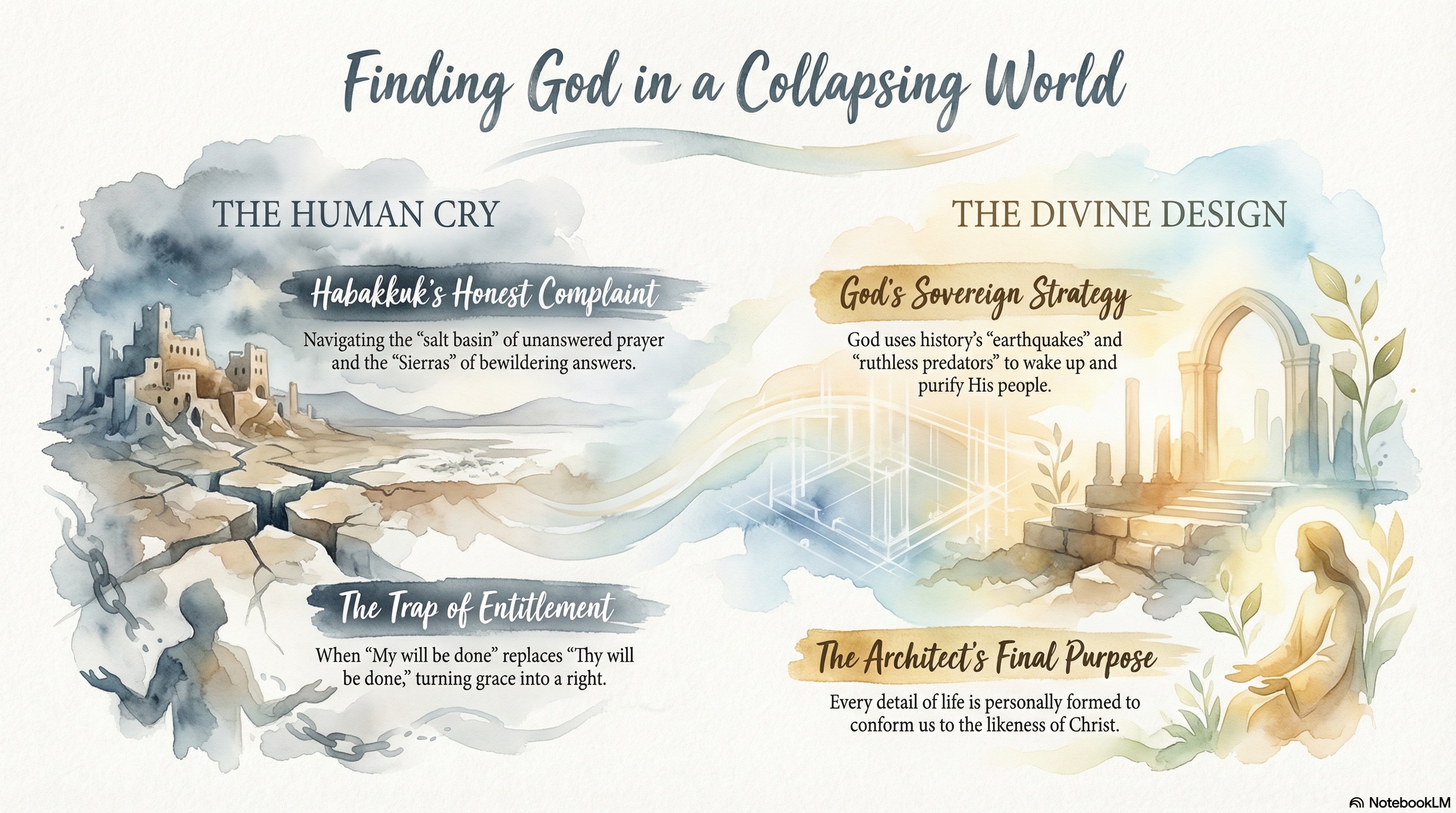
The pioneers who trekked across the salt basin in Utah and crossed the Sierras faced obstacles that killed some and turned others back. For the spiritual pilgrim, the journey involves similar barriers: the salt basin represents unanswered prayer, while the Sierras represent answers to prayer. It may seem counterintuitive, but answers to prayer can often become our greatest obstacles. Every prayer is answered—whether granted, refused, or delayed—but it is the “bewildering answers” that are completely unacceptable to us that cause us to stumble.

1. The Human Cry

Habakkuk’s ancient frustration feels remarkably modern. He looked at a world where destruction and violence were constant, strife abounded, and the law seemed paralyzed. His cry was raw and honest: “How long, Lord, must I call for help, but you do not listen? Or cry out to you, ‘Violence!’ but you do not save?”. Habakkuk was not posing abstract theological riddles; his world was literally crumbling. The nation was decaying from within, and a ruthless predator was approaching from without.

Practical Application: Don’t be afraid to bring your “sighs” to God. Habakkuk’s example shows that faith often begins with an honest complaint about the injustice and wrongdoing we see in our own lives and the world.

2. The Shocking Answer

When God finally answered Habakkuk, it was a “geopolitical earthquake”. God told him to be “utterly amazed” because He was doing something unbelievable: He was raising up the Babylonians. God described them as a “ruthless and impetuous people,” a “feared and dreaded” nation that promoted their own honor and worshiped their own strength as their god. Habakkuk had to wrestle with the reality that God was personally behind the rise of a ruthless enemy marching toward Jerusalem.

Personal Touch: It is a staggering thought that God’s answer to our cry for help might be to send a “Babylonian”—a difficult circumstance or a person that acts as a “wake-up call” when we have grown “dull of hearing”.

3. The Entitlement Trap

Why do we stumble over these shocking answers? Often, it is because we fall into a trap of entitlement. Just as a teenager might turn a one-time relaxed curfew into a “right” or a “bargaining chip,” we often turn God’s grace into a personal merit that we feel we have earned. This logic thrives whenever “My will be done” replaces “Thy will be done”. When this happens, we begin to view God as a “Supermarket” where blessings are expected on demand—an ornament to our lives rather than the sovereign Lord.

Practical Application: Take a moment to audit your prayers. Are you treating God as a Sovereign Lord to be trusted, or as a “Supermarket” where you are shopping for conveniences? Entitlement produces anger when refused; faith produces trust.

4. The Grand Design

Scripture reveals that history is not a chain of random events, but a Grand Design arranged toward redemption. In the “fullness of time,” God used centuries of preparation—Greek language, Roman roads and order, philosophical curiosity, spiritual desire awakened—to weave His redemptive plan.

If God carefully directs the rise of empires, His purpose reaches into the details of our personal lives to conform us to the likeness of Christ.

  • God is the Architect; you are the campus.
  • The “bulldozers, sawdust, and nail guns” of life are not signs of destruction, but the Architect’s tools serving an eternal purpose.
  • These trials become the “steel framework” of your life—a bulwark against life’s storms.

As a Pilgrim in Process, we must learn that prayer matures from making demands to seeking intimacy. The goal is not to bend God to our will, but to know Him, trust Him, and rest in His purposes.

Does the idea of God as an “Architect” change how you view the “bulldozers” currently at work in your own life? Which are you facing right now: a silent “salt basin” or a “Sierra peak” answer that feels like an obstacle?

Let’s Talk

I would love this to become a conversation. Please share your anecdotes, questions and insights in the comments.

Points to Ponder

In the context of your “Pilgrim in Process” journey, do you find that your current “sighs” are born out of a frustration that God isn’t following your blueprint, or a desire to understand His?

Does the idea of God as an “Architect” change how you view the “bulldozers” currently at work in your own life? I’d love to hear your thoughts on how you navigate those “salt basins” of unanswered prayer.

The Pilgrim’s Trajectory of Faith

14 Feb

 Habakkuk- a Modern 3000 Year Old Pilgrim

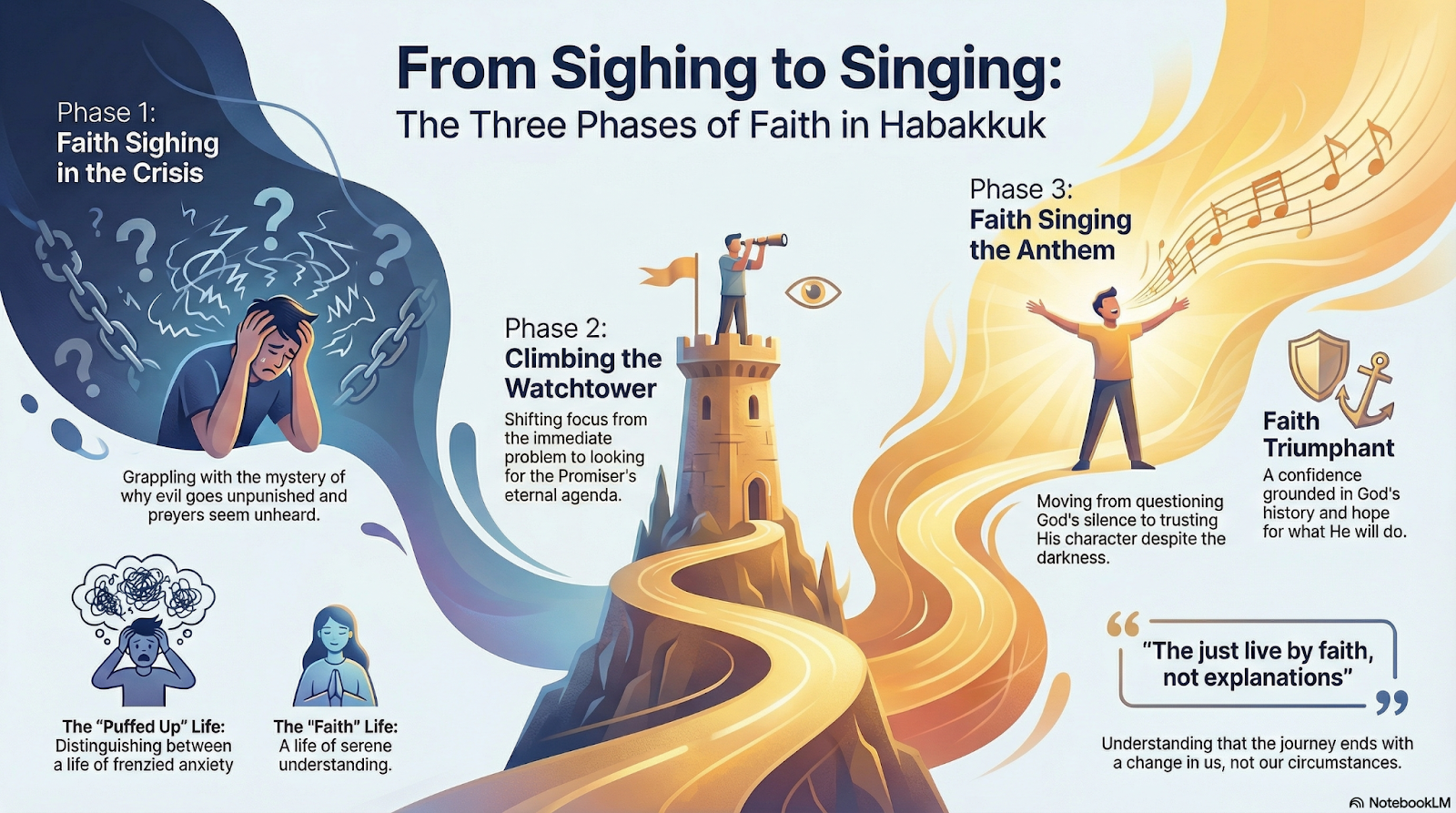
Faith Sighing in the Valley of Silence

The agonizing question: Where is God when the world burns? 

The Math Doesn’t Add Up:

– the confusing reality where evil goes unpunished;

– The unthinkable answer –  a brutal marauding army, raised up by God Himself.

 Pilgrims often find  their faith under fire, sighing in agonizing confusion.

 Faith Seeing from the Rampart

The Pilgrim trusts God and watches  and waits expectantly:

– Pilgrims avoid The “Puffed Up” restless approach, the impatient demand for an immediate answer.

– Pilgrims don’t live by what they can see right now; they live by who they know

Faith is faithfulness – it is a verb, not a noun. This is not passive sitting; it is active, as demonstrated in the Grand Finale.

Faith Singing in the Grand Finale

The journey ends not with a change in circumstances, but a change in the Pilgrim:

– The Pilgrim moves from questioning God’s silence to trusting His character. 

– This is faith triumphant—grounded in the history of what God has done, and confident in what He will do. 

The Pilgrim  no longer sighs at the mystery; even when suffering the ravages of a ruthless enemy. He sings in a rising crescendo:

I will still be joyful and glad,
    because the Lord God is my savior.

The Sovereign Lord gives me strength.
    He makes me sure-footed as a deer
    and keeps me safe on the mountains.  (Habakkuk 3:18-19)

This very modern 3000 year old book will be explored in six coming posts. Stay tuned.