Archive | February, 2025

Going to Church is Wrong

25 Feb

While shaving this morning, I was anticipating with great joy the prospect of going to church. I like to prepare myself so that I get the full benefit.

The thought came to me forcibly, “STOP USING THAT PHRASE!” 

In biblical context, you cannot “go to church.” The Greek word that the bible uses  for church is “kuriakes.” It appears twice in the New Testament. It literally means “of the Lord”, describing people as “belonging to the Lord.” (See Gemini answer in ENDNOTE) You can trace the English word back to the Greek word: the krk in “K u r ia k es” became “kirche” in German, was abbreviated to “kerk” in Dutch, Scotland added brogue and it became “kirk”, and since England is slightly (considerably?) an island unto itself, it is “church” in English – the hard k starting and ending the word in the other languages was changed and softened to ch, as it chat, in English.

When Jesus spoke of what is now called “church”, he used a different Greek word “ekklesia”. Its secular use was political, “to call out citizens to a public meeting”. The antecedent to it is found in the Old Testament. The Hebrew word “qahal” describes people gathering for public meetings, including legal proceedings, military call up, and worship.

So how did the switch happen? It was illegal to translate the bible into English, and early translators were in peril. Wycliffe translated the Latin Vulgate into English, and hand copied versions circulated. He escaped execution, but was declared a heretic after he died, and his body was exhumed and burned at the stake. (really!)
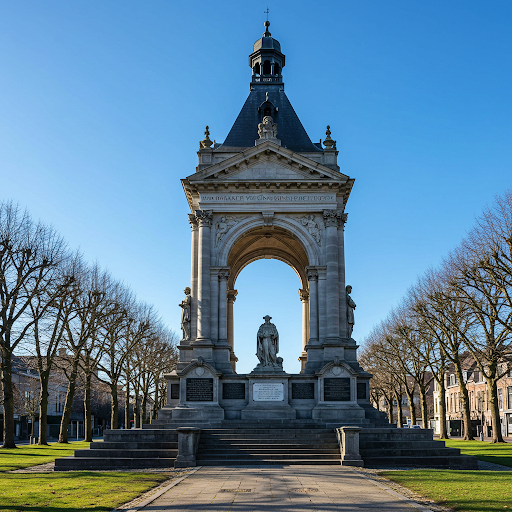
Tyndale translated the original Hebrew and Greek texts into English, working from Belgium to escape persecution. He was captured, however, and executed by strangling and then his body was burnt at the stake as a heretic in Vilvoorde, Belgium. There is a park, impressive memorial and museum there now. (Picture generated by Gemini AI)

Why such opposition? To distill a complex issue to one implication; both the Roman Church and Kings (who were Roman Catholics) feared any challenge to their absolute power and authority. Church and state were so intertwined that those who did not baptize their infants were considered treasonous. Heresy and treason were somewhat of a synonym. Any gathering of believers not sanctioned by “The Church” could well lead to unintended consequences.

However, when it became apparent in England that due to popular demand a translation was inevitable, King James authorized a translation so that he could control it. Some 47 scholars appointed by King James, worked under the constraint of 15 rules set by the King. One rule was that the word ekklesia, translated by Tyndale as “congregation” (and In some cases as “assembly”), must be translated as “church”. This choice was deliberate – a new meaning was threatening to the institution of church and state. Church was an entity with the King (or the Pope) in charge, a congregation was a loose cannon on the ship of state. Since it became the only standard translation, it enshrined “church” as a politically controlled entity, the very thing Jesus refused. He refused to acknowledge either the Sanhedrin or Caesar and this was the human cause of His public execution. 

Ekklesia is a composite noun made up of the preposition “ek”, meaning “out of”, and the verb “kaleo”, “to call”. So the ekklesia is the mustering of those who have been called to gather to worship. 

What should I anticipate and what will the eyes of my understanding grasp as I gather? Hear these magnificent words! “… you have come to Mount Zion, to the city of the living God, the heavenly Jerusalem, and to countless thousands of angels in a joyful gathering. You have come to the assembly of God’s firstborn children, whose names are written in heaven. You have come to God himself, who is the judge over all things. You have come to the spirits of the righteous ones in heaven who have now been made perfect.” (Hebrews 12:22-23 NLT)

Going to church? Nah! Could be, has been, very boring. I sit as a critic, evaluating people, performances and practices, all have self at the center. Worship has God at the center.

Fanny Crosby went blind at an early age. Her secretary, knowing she was alone in her office, once heard her talking, and crept up to hear if help was needed. She heard the hymn writer exclaiming in prayer, “O Lord! If only those poor sighted people could see what I see now!” The experience was captured in the great hymn, “Blessed assurance, Jesus is mine, O what a foretaste of heaven divine . . . Perfect submission, perfect delight, Visions of rapture now burst on my sight; Angels descending bring from above, Echoes of mercy, whispers of  love.”

Reflecting on the gathering: the choir sang a piece beyond their capabilities, I was in a “dead space” in the auditorium and missed some things, the liturgy was wordy and rushed but magnificent, the sermon was outstanding and short, I sat – inadvertently – where families with small children were constantly and delightfully on the bustle. I am only aware of it retrospect, my spirit was soaring, glued in worship and wonder to the Lord of Glory.

Open the eyes of your heart. 

Go to Worship! 

ENDNOTE:

The Greek word “kuriakos” (κυριακός) appears twice in the New Testament:

  • 1 Corinthians 11:20:
    • Here, it’s used in the phrase “kuriakon deipnon” (κυριακὸν δεῖπνον), which translates to “Lord’s supper.”
  • Revelation 1:10:
    • In this verse, it’s found in the phrase “kuriake hemera” (κυριακῇ ἡμέρᾳ), meaning “Lord’s day.”

Essentially, “kuriakos” signifies something “belonging to the Lord.” So, in these instances, it specifies that the supper and the day are associated with or belong to the Lord (Jesus Christ).


Choose Contentment Over Un-Happy-Mess

5 Feb

I find that I have no control over my feelings – I have no idea where they come from, am bewildered by their intensity and dismayed by the turmoil they can promote. Like prowling predators, say a grizzly bear in my attic, emerging to ambush me when I least expect it.

Choice

What I have learned though, is that I can choose what to do with them.

I can focus on them, nurture them and wallow in them. That makes them determinative of my mood, and that in turn controls my reactions to life in general spilling over into behavior. They are in control, they are the landscape in which I live, I am trapped as a victim.

Or I can choose to take control. I do this by examining them and deciding if they are valid. By that I mean, if they are a reflection of unrealistic expectations, harsh self-judgement, embarrassment, shame, or  …   ?They invite me to remain mired in them, trapped by them, controlled by them, but I can evaluate them and decide that they belong in the rearview mirror, not filling the windshield of my life. By weighing them up I can decide they are not worth entertaining.

Acceptance

By acknowledging them, examining them and recognizing them I find I am able to sigh deeply, and then view them as helpful because they have given me insight and I can take what I learned about myself and then walk into the future with a new confidence and maturity. Happiness is in this sense a choice. I cannot control how and when the emotions arise, but I can choose to change my point of view about them. Then something significant occurs –  that elusive thing called happiness is no longer all consuming. (Generally happiness is realized in retrospect, I experience it when I reflect afterwards on a happy event or interaction.) 

A Human Becoming – not a Human Being

The remarkable thing is that I then experience contentment. Contented with who I am, joyful that I am a human becoming who learns from the past; expects more misery in future learning experiences, but know it is part of the rounding out of my personality. Also, it enables me to be sensitive to the moods of those around me. Contentment is a learned state of joyful acceptance, happiness is a yo-yo of conflicting misery. Contentment promotes wholeness, replacing woundedness.

Perspective is essential to every problem: it resituates us and reveals the way ahead,

Instead

How do I escape the quicksand of all encompassing sorrow or anxiety or sadness? A train heading to a washed out bridge needs the switch thrown that will change its track to a safe siding called Contentment. “Stop it!” as a command adds to the stress because like an endless looping video it will not cease. Paul writes in Philippians 4 “Do not worry about anything.” As a blunt command it is cruel, because I then add the worry that I cannot stop worrying to the worry intensifying its terror. He finishes the thought, “Instead .. by prayer, with thanksgiving, make your request known.” Do something else instead. “Instead” is the switch that changes the track of the train.

Prayer with Thanksgiving

Prayer captures the practice that focuses on the worship God. So, I immediately set the problem to one side and engage fully in contemplating God.

He is our Creator: “Try to realize what this means—the Lord is God! He made us—we are his people, the sheep of his pasture. Go through his open gates with great thanksgiving; enter his courts with praise. Give thanks to him and bless his name.  For the Lord is always good. He is always loving and kind, and his faithfulness goes on and on to each succeeding generation.” (ps 100:3-5)

He is our Savior: “…. as I worship, giving thanks to you for all your loving-kindness and your faithfulness, for your promises are backed by all the honor of your name. When I pray, you answer me and encourage me by giving me the strength I need.” Psalm 138:3

He is a Redeemer: “For you know what was paid to set you free from the worthless manner of life …. It was not something that can be destroyed, such as silver or gold;  it was the costly sacrifice of Christ, who was like a lamb without defect or flaw.” 1 Peter 1:18-19. ” “But the LORD says, Do not cling to events of the past

  or dwell on what happened long ago.
19 Watch for the new thing I am going to do.

 It is happening already—you can see it now!
I will make a road through the wilderness
    and give you streams of water there.” Isaiah 43:18-19

He is our Companion. In Psalm 23 replace the personal pronouns with my name. “The Lord is Anton’s shepherd. Anton shall not want.” And so on. Be astonished by this! “He prepares a banquet for Anton,
    He welcomes Anton as an honored guest
    and fills Anton’s cup to the brim.”

Let the astonished delight be expressed in thanks giving.

Request, not Demand

Now make a request, not a demand. Only now, and not before prayer and thanksgiving, do I make a request. It is a request, not a panic stricken screaming demand. And in the light of the prayer, my request may be more like desire for a closer walk with the Shepherd rather than an outright deliverance from the situation; a yearning to let the peace that floods my being with contentment be mirrored in the situation as a testimony to His Living Presence, or asking for wisdom in the fulness of the Holy Spirit. So it it becomes a dynamic process that is like the heavy flywheel of an engine, it keeps momentum going even when the engine is idling.

Practice Makes Contentment

Paul says, and I affirm, it is a state of consciousness that is learned through practice. Just as a skill is obtained through an apprenticeship, so must we practice this dynamic of “Instead”. Every time some emotion disturbs you, determine that you will immediately set the circumstance aside, contemplate God with thanksgiving, and request His Shepherding. Ultimately it will become your reflex action, but only if you take the first faltering steps and make progress through continued practice.