Pilgrim in Process: When Faith Sighs
Navigating the Salt Basins and High Sierra Peaks
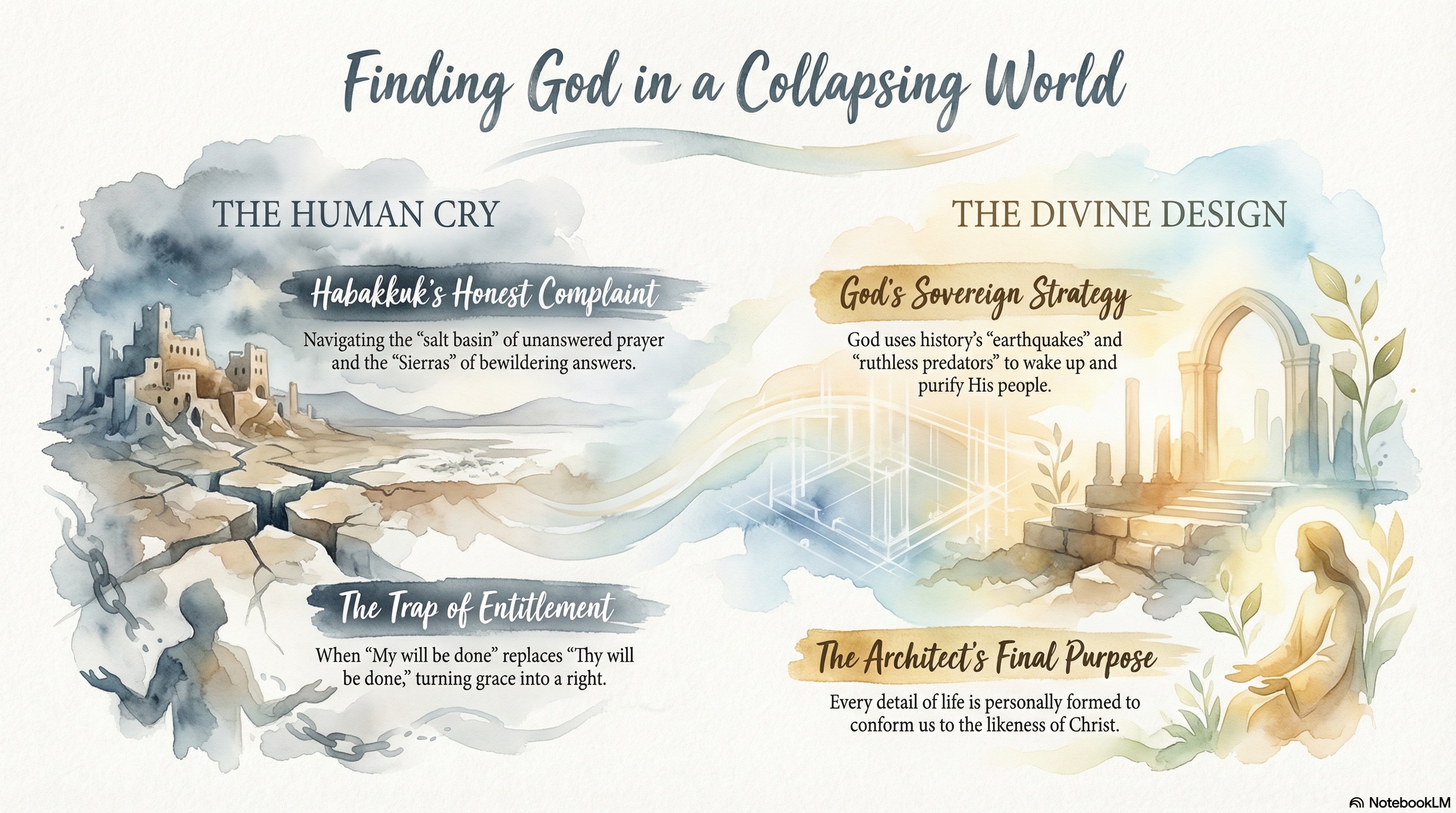
The pioneers who trekked across the salt basin in Utah and crossed the Sierras faced obstacles that killed some and turned others back. For the spiritual pilgrim, the journey involves similar barriers: the salt basin represents unanswered prayer, while the Sierras represent answers to prayer. It may seem counterintuitive, but answers to prayer can often become our greatest obstacles. Every prayer is answered—whether granted, refused, or delayed—but it is the “bewildering answers” that are completely unacceptable to us that cause us to stumble.
1. The Human Cry
Habakkuk’s ancient frustration feels remarkably modern. He looked at a world where destruction and violence were constant, strife abounded, and the law seemed paralyzed. His cry was raw and honest: “How long, Lord, must I call for help, but you do not listen? Or cry out to you, ‘Violence!’ but you do not save?”. Habakkuk was not posing abstract theological riddles; his world was literally crumbling. The nation was decaying from within, and a ruthless predator was approaching from without.
Practical Application: Don’t be afraid to bring your “sighs” to God. Habakkuk’s example shows that faith often begins with an honest complaint about the injustice and wrongdoing we see in our own lives and the world.
2. The Shocking Answer
When God finally answered Habakkuk, it was a “geopolitical earthquake”. God told him to be “utterly amazed” because He was doing something unbelievable: He was raising up the Babylonians. God described them as a “ruthless and impetuous people,” a “feared and dreaded” nation that promoted their own honor and worshiped their own strength as their god. Habakkuk had to wrestle with the reality that God was personally behind the rise of a ruthless enemy marching toward Jerusalem.
Personal Touch: It is a staggering thought that God’s answer to our cry for help might be to send a “Babylonian”—a difficult circumstance or a person that acts as a “wake-up call” when we have grown “dull of hearing”.
3. The Entitlement Trap
Why do we stumble over these shocking answers? Often, it is because we fall into a trap of entitlement. Just as a teenager might turn a one-time relaxed curfew into a “right” or a “bargaining chip,” we often turn God’s grace into a personal merit that we feel we have earned. This logic thrives whenever “My will be done” replaces “Thy will be done”. When this happens, we begin to view God as a “Supermarket” where blessings are expected on demand—an ornament to our lives rather than the sovereign Lord.
Practical Application: Take a moment to audit your prayers. Are you treating God as a Sovereign Lord to be trusted, or as a “Supermarket” where you are shopping for conveniences? Entitlement produces anger when refused; faith produces trust.
4. The Grand Design
Scripture reveals that history is not a chain of random events, but a Grand Design arranged toward redemption. In the “fullness of time,” God used centuries of preparation—Greek language, Roman roads and order, philosophical curiosity, spiritual desire awakened—to weave His redemptive plan.
If God carefully directs the rise of empires, His purpose reaches into the details of our personal lives to conform us to the likeness of Christ.
- God is the Architect; you are the campus.
- The “bulldozers, sawdust, and nail guns” of life are not signs of destruction, but the Architect’s tools serving an eternal purpose.
- These trials become the “steel framework” of your life—a bulwark against life’s storms.
As a Pilgrim in Process, we must learn that prayer matures from making demands to seeking intimacy. The goal is not to bend God to our will, but to know Him, trust Him, and rest in His purposes.
Does the idea of God as an “Architect” change how you view the “bulldozers” currently at work in your own life? Which are you facing right now: a silent “salt basin” or a “Sierra peak” answer that feels like an obstacle?
Let’s Talk
I would love this to become a conversation. Please share your anecdotes, questions and insights in the comments.
Points to Ponder
In the context of your “Pilgrim in Process” journey, do you find that your current “sighs” are born out of a frustration that God isn’t following your blueprint, or a desire to understand His?
Does the idea of God as an “Architect” change how you view the “bulldozers” currently at work in your own life? I’d love to hear your thoughts on how you navigate those “salt basins” of unanswered prayer.
 progressingpeople