Tag Archives: peace

A Five Year Old With a Mid-life Crisis

14 Apr

My parents refused to let me ride it in the dark, so I went to sleep with it in my bed.

The next morning, I nudged the rooster to crow, and for the next two weeks, I was glued to that bike until bedtime. Then school started, and I had to share my biking hours with my school desk.

The best Christmas gift I can recall was my first bicycle at age five. In our German tradition, we received gifts on Christmas Eve and had to wait until after dark. It is summer in South Africa in December, so somewhere around 9 p.m., I finally got MY BIKE.

The rush of adrenaline, the novelty, the sense of wonder, the exploration, and the joy—all were stolen from me by the hard reality and tediousness of school. I entered what might be called a midlife crisis with regard to my bicycle.

Middle age in your pilgrimage follows the same pattern: excitement, exuberance, energy, and enthusiasm. Everything is new and thrilling. Then you get to know almost everything, and you realize the walk with Christ is not a casual stroll along the shores of the lake with free picnics and thrilling crowds; it requires selflessness and discipline.

My parents refused to let me ride it in the dark, so I went to sleep with it in my bed.

The next morning, I nudged the rooster to crow, and for the next two weeks, I was glued to that bike until bedtime. Then school started, and I had to share my biking hours with my school desk.

The rush of adrenaline, the novelty, the sense of wonder, the exploration, and the joy—all were stolen from me by the hard reality and tediousness of school. I entered what might be called a midlife crisis with regard to my bicycle.

Middle age in your pilgrimage follows the same pattern: excitement, exuberance, energy, and enthusiasm. Everything is new and thrilling. Then you get to know almost everything, and you realize the walk with Christ is not a casual stroll along the shores of the lake with free picnics and thrilling crowds; it requires selflessness and discipline.

When the Wonder Wears Off

The wonder of God’s love is breathtaking, but you can only hold your breath for so long, and after a while, the edge wears off. School starts. Ouch! Many drop out here entirely.

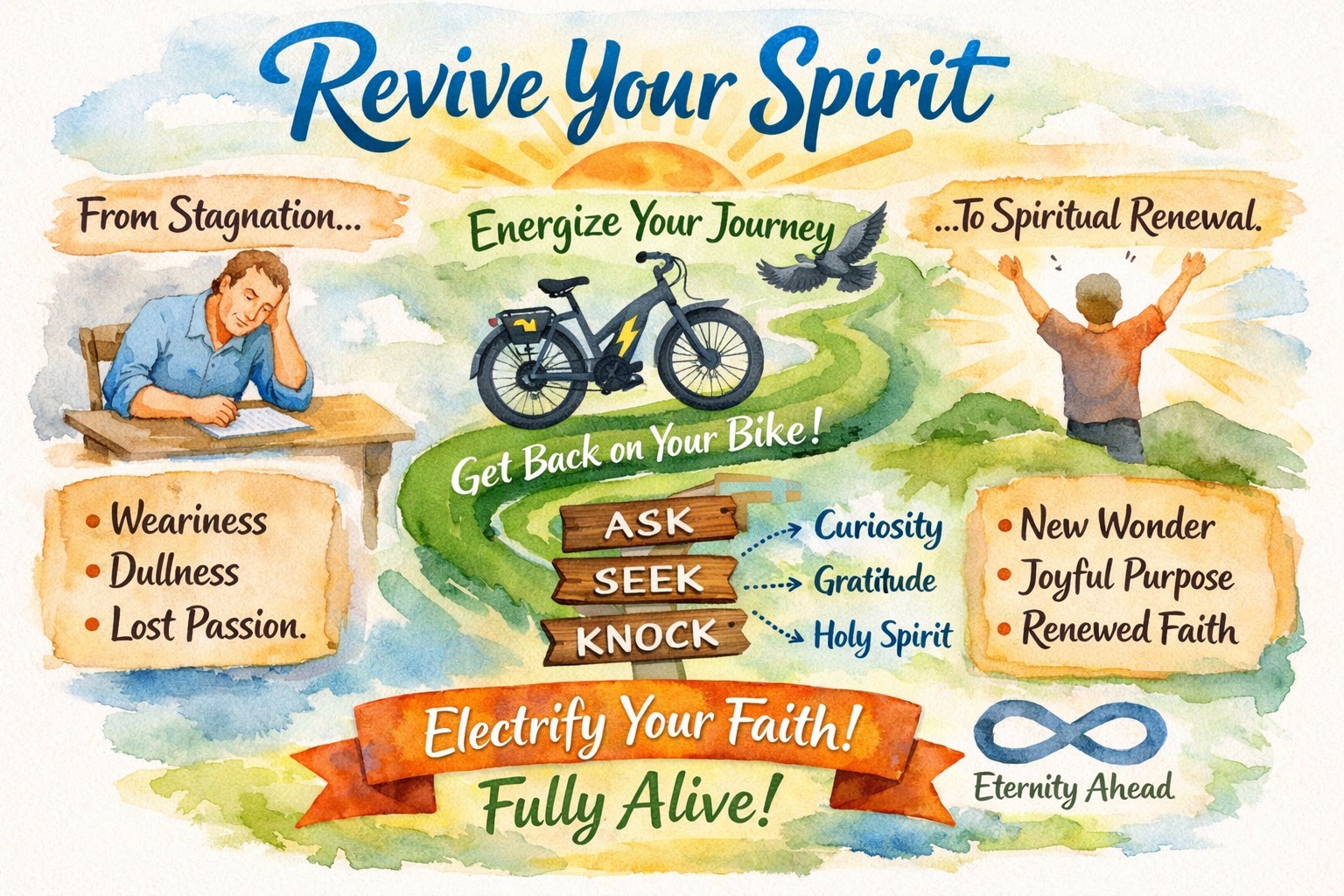
A middle-age crisis is a dangerous time. Weariness and dullness take hold, and one loses interest. Many abandon the pilgrimage at this point, so it is essential to know the symptoms and take urgent corrective measures.
A Cry for Renewal

This is the crisis Habakkuk addresses. “In the midst of the years revive; in the midst of the years make known”  

The repetition is significant; it is the way Hebrew emphasizes something. If you want to say the Grand Canyon, Hebrew would say, “the Canyon Canyon”. It is a crisis of a crisis, a rut that differs from a grave merely in depth.

Right Standing With God

Habakkuk continues: “…the person in right standing before God, through loyal and steady believing, is fully alive—really alive” (The Message). We need an upgrade.

Rediscovering the Ride

In my sixties, I bought another bicycle! The freedom to explore returned. It was still exuberant, but the decades had brought a new perspective. I was no longer enamored by the bike itself, but by the journey.

New destinations continually beckoned me. My limited walking radius of three miles an hour was instantly enlarged to a world of possibilities at ten-plus miles an hour. I rode with a smile of pure delight.

Electrified Living

Then came the innovation of an electric bike! A new wonder gripped me as new possibilities and options opened up. Suddenly, I wasn’t just working harder—I was going further.

This is the exact connotation of what it means to be “revived”. The way forward is simpler than you may imagine. The answer is not simply: “Work harder. Grit your teeth and continue with sheer determination”. If that is your strategy, you will burn out before the horizon. The answer is to “electrify” your experience.

A Marriage Awakens

Marriage provides a vivid illustration. Flying back from a speaking engagement, I began thinking about my marriage. It was in a midlife crisis. Seven years in, with two small children one year apart, a very busy solo pastorate with many teaching, administrative, and pastoral duties did not leave much time or energy.

How could I revive the fire? 

I began to reflect, and soon I was filled with gratitude. She was beautiful, kind, wise, generous, loyal, and humorous. Then I tried to recall all the special moments of joy we shared. Then I challenged myself to stand in her shoes and appreciate what she did routinely that I was overlooking.

What could she do that I was unable to do? What could I learn from her? 

I began to hunger to know her at a deeper level than the simple chemistry and hormones that had so vividly promoted our early passion. That original passion was ecstatic in its novelty, but it had grown stale because there were no new expectations.

The Power of Spiritual Electricity

You must start that same process with your thinking about God:

  • Start exploring His “hiddenness”.
  • Express gratitude for things He has done and is doing.
  • Cultivate curiosity – find people and read books that stoke your passion.

In short, get back on your bike—but with a different intention and a gifted energy.

Jesus gives us the blueprint for this spiritual electricity in Luke 11: “Ask, Seek, Knock”. The verbs are in the present continuous tense: “keep on, never stop, and always be asking, seeking, and knocking”. Practice it until, like riding a bicycle, wobbly at first, but ultimately requires no thinking, your response to life is to connect with God in every situation.

What are we seeking? The Holy Spirit. He is the electric energy of your spiritual experience. He doesn’t replace your pedaling; He elevates it to new possibilities.

Your Discovery Awaits

To start that stoking process, I challenge you to explore the dynamic the Holy Spirit brings to your own experience.

Remember: Eternity is the horizon. It will NEVER be boring.
EARTHQUAKE!

4 Apr

lasting peace and spiritual revival.

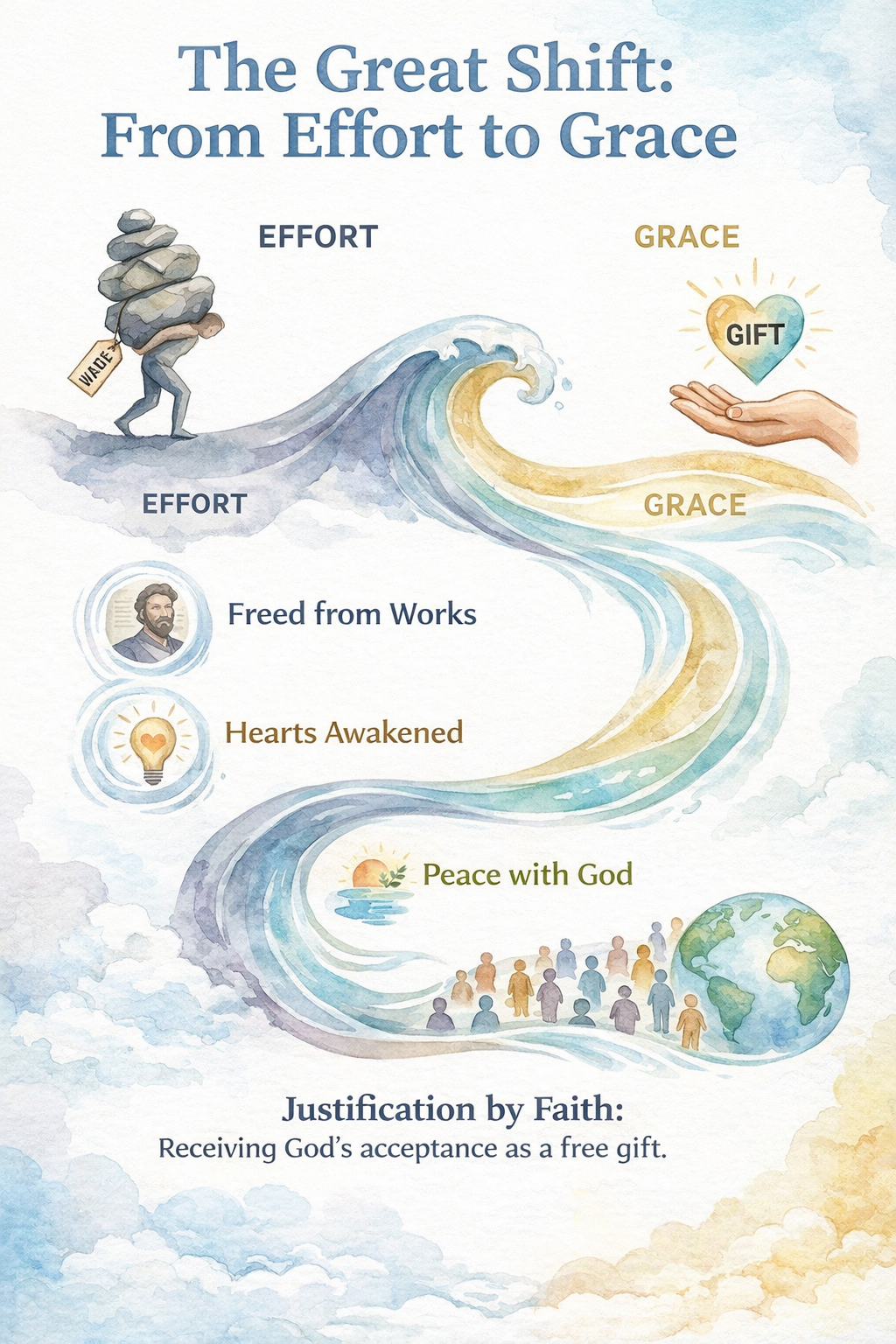
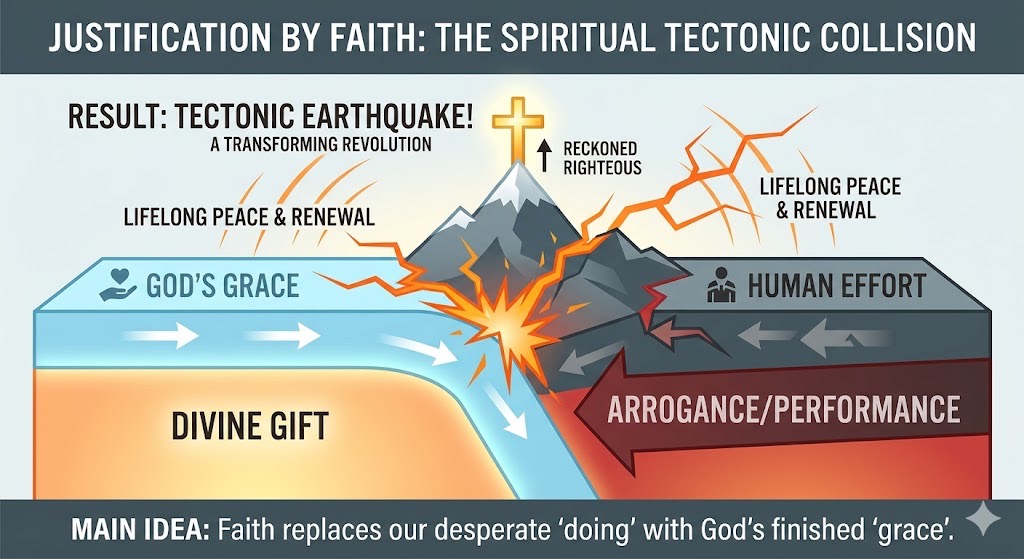
Mount Everest continues to rise about ¼ inch (5 mm) a year due to a massive, ongoing “tectonic smashup” between two tectonic plates: the Indian Plate and the Eurasian Plate. The region is prone toJustification by faith is more than a doctrine; it is a seismic event. It is the moment human effort is swallowed up by divine grace. continuing earthquakes. https://www.youtube.com/watch?v=z4WLHIUU2uU&t=7s

Justification by faith is a tectonic smashup between the grace of God and human arrogance. This contrast is clearly surfaced in the difficulties in prayer: unanswered as well as  answers not to my agenda. (Habakkuk:1-2:5) Human arrogance demands God do what an arrogant human desires. (The many who testify they tested God and he failed them highlight the matter.) Specifically 2:4 “Look at that man, bloated by self-importance— full of himself but soul-empty. But the person in right standing before God  through loyal and steady believing  is fully alive, really alive.” (The Message) 

Paul and the Shock Within Judaism

Paul was a Pharisee of the Pharisees, indicating a brand of fussy obedience that was all enveloping. Friendship with God cannot be earned. It is offered as a gift to be accepted. The obverse side to this coin is a pernicious human perception that God requires performance for acceptance. Here is an historical trajectory of the performance model: The Torah, the five books attributed to Moses, were analyzed to contain 613 commandments. The Talmud (which came after Paul) demonstrates where this led: a  63-volume “instruction manual” that explains the 613 details in depth. It is like the tax code of the USA” The “page count” of the U.S. tax code is a moving target because it depends entirely on whether you are looking at the literal laws passed by Congress or the massive library of regulations required to actually follow those laws.As of 2026, here is the breakdown of the length of the tax code:If you only count the actual Internal Revenue Code (Title 26 of the U.S. Code) as published by the government, it is approximately 6,800 to 7,000 pages. 

Paul recognized that it was impossible to be scrupulous enough. His discovery that God declared a person righteous, or justified, based on faith in the doing and dying of Jesus in his place, was a tectonic shift with continuing impact.  Harking back to the revelation made to Habakkuk, he found that accepting the gift of God, offered freely, was pivotal in friendship with God. Mount Everest, after all, is still rising! 

Luther and the Shock Within the Church

More than a thousand years later, the same idea shook Europe.

The medieval church had developed a complex system of penance, sacramental participation, and religious effort. Many believers lived with deep anxiety about whether they had done enough to satisfy God’s perfection. All who were sincere in seeking God lived with quiet anxiety: had they done enough to satisfy God’s perfection?

Martin Luther certainly tried. Reflecting on his years as a monk, he wrote, “If ever a monk got to heaven by monkery, I should have been that monk.” 

Despite his scrupulous observance, he  was wracked by doubt. He thought a pilgrimage to The Holy City would resolve his crisis of faith. Luther ascended the 28 marble steps (which tradition says were the steps Jesus climbed to face Pontius Pilate) on his knees. On each individual step, he stopped to recite the “Our Father” (Pater Noster) and, according to some accounts, kissed the steps where he believed he saw stains of Christ’s blood.  Instead of feeling the spiritual peace or “certainty” he expected, he reportedly stood up and thought (or whispered), “Who knows if it is true?” Maybe God requires a 100 steps, and/or a Pater Noster and a Hail Mary on each step? How do we satisfy perfection?

While teaching the Epistle to the Romans, Luther came to understand that righteousness before God was not something earned but something given through faith. This realization became the shock that led to the Protestant Reformation. The chain from Habakkuk to Paul gained another link, 

The discovery of “justification by faith” brought profound personal relief to Luther and soon spread across Europe. This shift was a geopolitical seismic event: when the established Church in Rome collided with these simplified Biblical truths, the resulting “shockwaves” permanently fractured the monolithic religious landscape, forcing a complete reordering of the map of Europe.

Wesley and the Shock of Methodism
Two centuries later, the same truth again changed a life—with far-reaching consequences.

John Wesley devoted himself to rigorous discipline and the pursuit of holiness. Yet he lacked assurance about his standing with God. That insecurity was exposed during his 1735 voyage to Georgia.

Mid-Atlantic, a storm so violent struck, that even the experienced sailors were terrified.. Waves crashed over the deck, sails tore apart, and passengers panicked, certain they would die. Wesley, though a devout Anglican priest, found himself afraid—without the calm confidence he thought he possessed.

In stark contrast, a group of Moravians calmly sang hymns through the chaos. When Wesley later asked if they had been afraid, their answer was simple: they were not—even their children faced death without fear.

The moment unsettled him deeply. Wesley realized he had religion, but not assurance. His faith was disciplined and sincere, yet lacked the settled trust he saw in them.

The storm did not convert him, but it destabilized him in the best way. It forced a question he could no longer avoid: did he truly trust God, or merely practice religion?

On May 24, 1738, while listening to Luther’s commentary on Romans, Wesley felt his “heart strangely warmed.” He came to trust in Christ alone for salvation.

That shift transformed his preaching. Its impact spread rapidly, helping spark a national awakening. Some historians even suggest it played a role in England avoiding a revolution like France’s.

The Shock in America
The same doctrine ignited the First Great Awakening in eighteenth-century America.

Preachers like George Whitefield and Jonathan Edwards confronted a comfortable assumption: that being right with God came through birth, baptism, or respectable behavior. For many, religion had become little more than inherited custom. Justification, they insisted, comes by faith alone—not by family background, moral effort, or outward religion. A person is made right with God only through a personal, inward trust in Jesus Christ.

Whitefield called people to the “new birth,” pressing for inner transformation rather than external reform. Edwards argued that true religion consists of “holy affections”—a heart genuinely reshaped by love for God. Faith, in their preaching, was not mere agreement, but deep reliance.

This shifted Christianity from cultural assumption to personal encounter. It unsettled the self-assured, yet opened the door to all: anyone could be reconciled to God through faith.

Removing the Bottleneck
The Awakening didn’t just change the message—it changed how it spread.

Before the revivals, preaching was largely confined to ordained clergy, creating a natural bottleneck. Growth was slow, limited by how many ministers could be trained and installed.

But if faith is personal, then testimony becomes universal. Those who experienced new life began to speak of it. The result was explosive: the rise of lay preaching.

Methodists and Circuit Riders
John Wesley’s decision to authorize lay preachers multiplied the movement overnight. Circuit riders carried the message across vast distances—on horseback, in fields, homes, and frontier settlements—spreading Methodism far beyond the reach of traditional structures.

The Baptist Grassroots Model
The Baptists, with their emphasis on local leadership and personal testimony, were already positioned for this shift. Lay preaching fit naturally. Ordinary people with a clear conversion and a gift for speaking could lead, enabling rapid growth across the South and West.

Lay preaching didn’t just support the revival—it fueled it. The message created transformed people; lay preaching turned them into messengers. Together, they reshaped the American religious landscape.

The Personal Shock

The impact of justification by faith is not only historical; it is deeply personal.

In the Epistle to the Romans, Paul writes: “Therefore, since we have been justified by faith, we have peace with God through our Lord Jesus Christ.”

The passage continues through Romans 5:1–12, describing the remarkable results of justification: peace with God, access to God, hope, and glory in suffering, and the assurance of reconciliation, all made real in the power of the Holy Spirit.

For countless individuals throughout history, these words have brought profound relief. The fear of never being good enough is replaced with the confidence that acceptance with God rests on Christ’s work rather than human effort. 

A Message That Continues to Change Lives

From the revelation to Habakkuk, Paul’s proclamation in the first century, Luther’s rediscovery in the Reformation, to Wesley’s awakening of heart, the doctrine of justification by faith has repeatedly brought renewal.

It reminds us that the foundation of the Christian life is not human achievement but divine grace.

And whenever that message is rediscovered, it has the power to transform both history and the human heart.

What’s In It For Me?

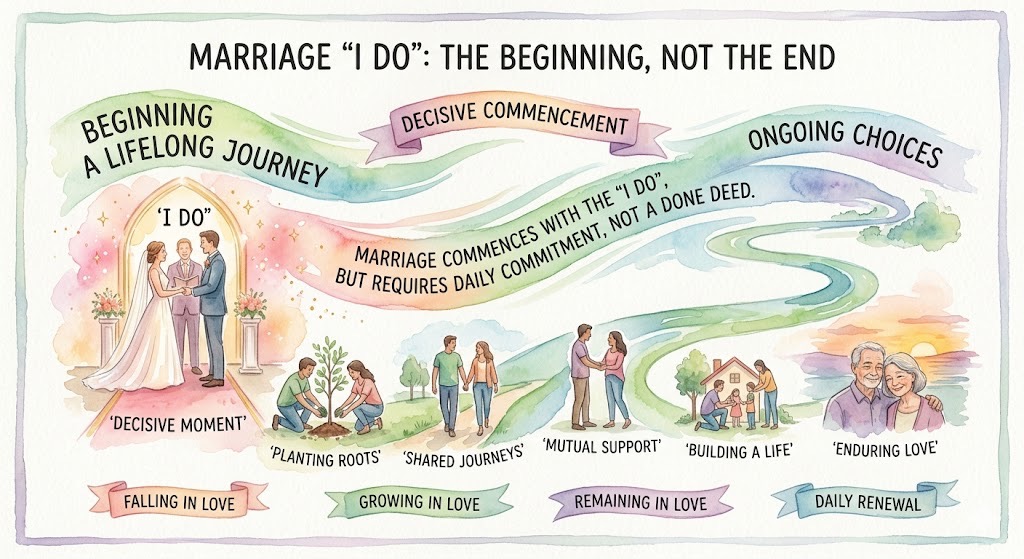
“Revived” medically speaking, is a miracle – a dead body is brought back to life. That, in a spiritual sense, is what happens when someone trusts in Christ. Baptism mirrors this miracle. We are baptized or initiated into His death and Resurrection.  It can be compared to a marriage ceremony where the parties say“I do”. “I do” must not be construed as “I did it!” -as if the ceremony was the conclusion.  it IS a done deed, but with the promise to keep up at it, loving, honoring, tending, 

And that is a description of revival. It begins when you say “I do” to Jesus. That “first love” needs constant renewal, or revival. Each time we feel distant, the way back is to say “I do” in response to God’s question

Say “I do” now! Maybe for the first time. Maybe for the hundredth time. It is a process of falling in love, growing in love and staying in love.

The Pilgrim’s Trajectory of Faith

14 Feb

 Habakkuk- a Modern 3000 Year Old Pilgrim

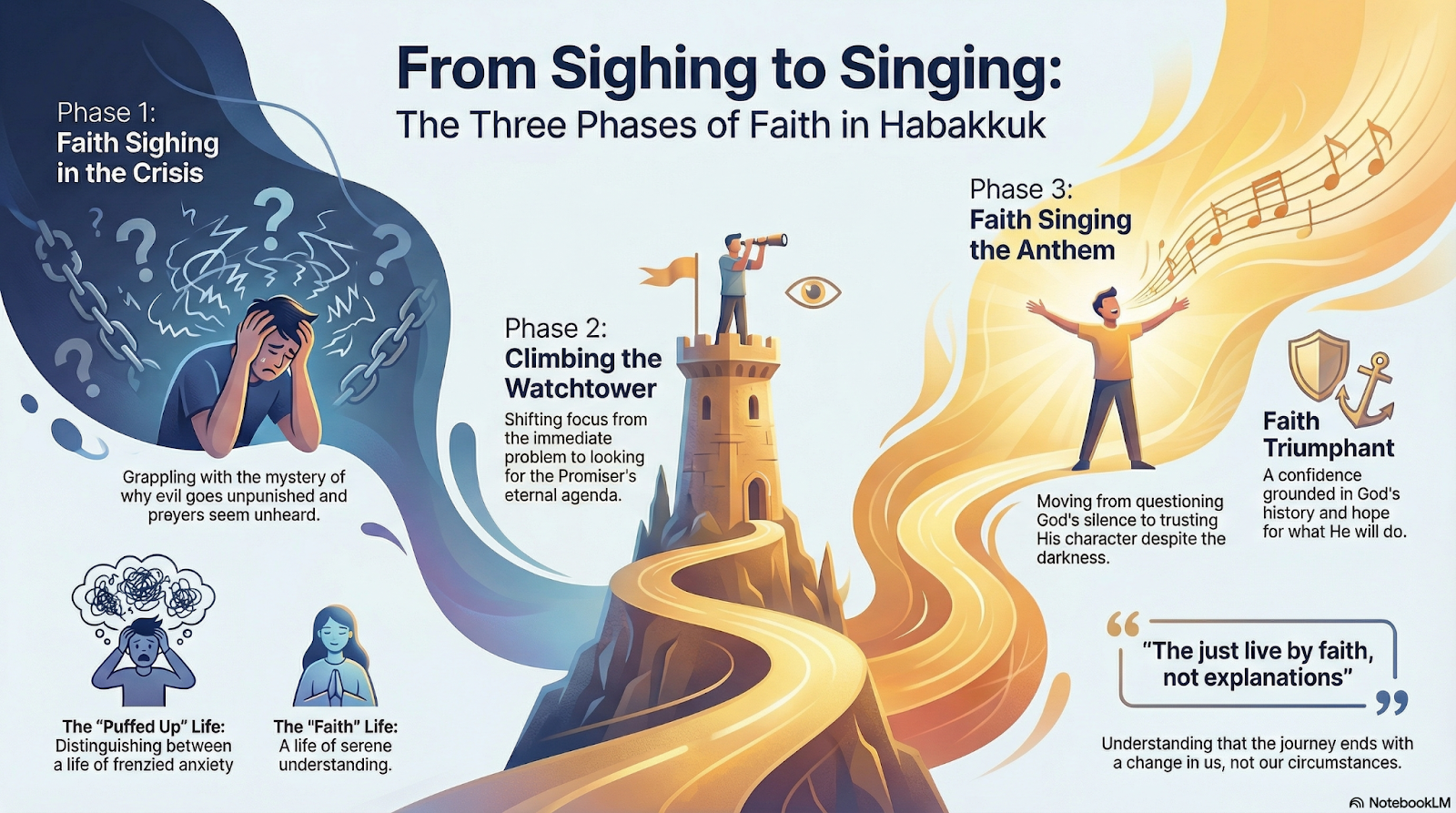
Faith Sighing in the Valley of Silence

The agonizing question: Where is God when the world burns? 

The Math Doesn’t Add Up:

– the confusing reality where evil goes unpunished;

– The unthinkable answer –  a brutal marauding army, raised up by God Himself.

 Pilgrims often find  their faith under fire, sighing in agonizing confusion.

 Faith Seeing from the Rampart

The Pilgrim trusts God and watches  and waits expectantly:

– Pilgrims avoid The “Puffed Up” restless approach, the impatient demand for an immediate answer.

– Pilgrims don’t live by what they can see right now; they live by who they know

Faith is faithfulness – it is a verb, not a noun. This is not passive sitting; it is active, as demonstrated in the Grand Finale.

Faith Singing in the Grand Finale

The journey ends not with a change in circumstances, but a change in the Pilgrim:

– The Pilgrim moves from questioning God’s silence to trusting His character. 

– This is faith triumphant—grounded in the history of what God has done, and confident in what He will do. 

The Pilgrim  no longer sighs at the mystery; even when suffering the ravages of a ruthless enemy. He sings in a rising crescendo:

I will still be joyful and glad,
    because the Lord God is my savior.

The Sovereign Lord gives me strength.
    He makes me sure-footed as a deer
    and keeps me safe on the mountains.  (Habakkuk 3:18-19)

This very modern 3000 year old book will be explored in six coming posts. Stay tuned.

Choose Contentment Over Un-Happy-Mess

5 Feb

I find that I have no control over my feelings – I have no idea where they come from, am bewildered by their intensity and dismayed by the turmoil they can promote. Like prowling predators, say a grizzly bear in my attic, emerging to ambush me when I least expect it.

Choice

What I have learned though, is that I can choose what to do with them.

I can focus on them, nurture them and wallow in them. That makes them determinative of my mood, and that in turn controls my reactions to life in general spilling over into behavior. They are in control, they are the landscape in which I live, I am trapped as a victim.

Or I can choose to take control. I do this by examining them and deciding if they are valid. By that I mean, if they are a reflection of unrealistic expectations, harsh self-judgement, embarrassment, shame, or  …   ?They invite me to remain mired in them, trapped by them, controlled by them, but I can evaluate them and decide that they belong in the rearview mirror, not filling the windshield of my life. By weighing them up I can decide they are not worth entertaining.

Acceptance

By acknowledging them, examining them and recognizing them I find I am able to sigh deeply, and then view them as helpful because they have given me insight and I can take what I learned about myself and then walk into the future with a new confidence and maturity. Happiness is in this sense a choice. I cannot control how and when the emotions arise, but I can choose to change my point of view about them. Then something significant occurs –  that elusive thing called happiness is no longer all consuming. (Generally happiness is realized in retrospect, I experience it when I reflect afterwards on a happy event or interaction.) 

A Human Becoming – not a Human Being

The remarkable thing is that I then experience contentment. Contented with who I am, joyful that I am a human becoming who learns from the past; expects more misery in future learning experiences, but know it is part of the rounding out of my personality. Also, it enables me to be sensitive to the moods of those around me. Contentment is a learned state of joyful acceptance, happiness is a yo-yo of conflicting misery. Contentment promotes wholeness, replacing woundedness.

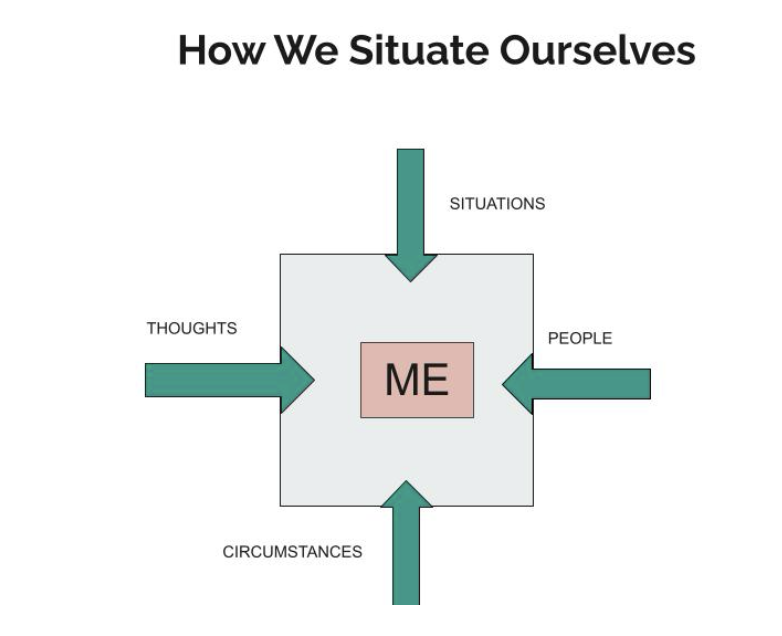
Perspective is essential to every problem: it resituates us and reveals the way ahead,

Instead

How do I escape the quicksand of all encompassing sorrow or anxiety or sadness? A train heading to a washed out bridge needs the switch thrown that will change its track to a safe siding called Contentment. “Stop it!” as a command adds to the stress because like an endless looping video it will not cease. Paul writes in Philippians 4 “Do not worry about anything.” As a blunt command it is cruel, because I then add the worry that I cannot stop worrying to the worry intensifying its terror. He finishes the thought, “Instead .. by prayer, with thanksgiving, make your request known.” Do something else instead. “Instead” is the switch that changes the track of the train.

Prayer with Thanksgiving

Prayer captures the practice that focuses on the worship God. So, I immediately set the problem to one side and engage fully in contemplating God.

He is our Creator: “Try to realize what this means—the Lord is God! He made us—we are his people, the sheep of his pasture. Go through his open gates with great thanksgiving; enter his courts with praise. Give thanks to him and bless his name.  For the Lord is always good. He is always loving and kind, and his faithfulness goes on and on to each succeeding generation.” (ps 100:3-5)

He is our Savior: “…. as I worship, giving thanks to you for all your loving-kindness and your faithfulness, for your promises are backed by all the honor of your name. When I pray, you answer me and encourage me by giving me the strength I need.” Psalm 138:3

He is a Redeemer: “For you know what was paid to set you free from the worthless manner of life …. It was not something that can be destroyed, such as silver or gold;  it was the costly sacrifice of Christ, who was like a lamb without defect or flaw.” 1 Peter 1:18-19. ” “But the LORD says, Do not cling to events of the past

  or dwell on what happened long ago.
19 Watch for the new thing I am going to do.

 It is happening already—you can see it now!
I will make a road through the wilderness
    and give you streams of water there.” Isaiah 43:18-19

He is our Companion. In Psalm 23 replace the personal pronouns with my name. “The Lord is Anton’s shepherd. Anton shall not want.” And so on. Be astonished by this! “He prepares a banquet for Anton,
    He welcomes Anton as an honored guest
    and fills Anton’s cup to the brim.”

Let the astonished delight be expressed in thanks giving.

Request, not Demand

Now make a request, not a demand. Only now, and not before prayer and thanksgiving, do I make a request. It is a request, not a panic stricken screaming demand. And in the light of the prayer, my request may be more like desire for a closer walk with the Shepherd rather than an outright deliverance from the situation; a yearning to let the peace that floods my being with contentment be mirrored in the situation as a testimony to His Living Presence, or asking for wisdom in the fulness of the Holy Spirit. So it it becomes a dynamic process that is like the heavy flywheel of an engine, it keeps momentum going even when the engine is idling.

Practice Makes Contentment

Paul says, and I affirm, it is a state of consciousness that is learned through practice. Just as a skill is obtained through an apprenticeship, so must we practice this dynamic of “Instead”. Every time some emotion disturbs you, determine that you will immediately set the circumstance aside, contemplate God with thanksgiving, and request His Shepherding. Ultimately it will become your reflex action, but only if you take the first faltering steps and make progress through continued practice.

Peace That Transcends Understanding

10 Nov

Sometimes our need is so pressing that we rush to demand our requests. We experience such anxiety as the aquatic pressure that water exerts on our submarine, and we feel set to implode. Panic motivates us, helplessness paralyzes us, we hit the emergency call button repeatedly. 
Paul, writing from a Roman prison where his future meant probable death, writes, “Do not be anxious about anything, but in every situation, by prayer and petition, with thanksgiving, present your requests to God. And the peace of God, which transcends all understanding, will guard your hearts and your minds in Christ Jesus.”
His statement is not made from a secure palace by a cozy fire surrounded by a moat and an army.  He is in the trenches.
He exercised his choice to resituate himself. He saw himself, not languishing in prison, but luxuriating in a palace.

https://docs.google.com/document/d/e/2PACX-1vQw0pWKsnAFhIF1gZjlMpv6lwg_5FKxKCq7BUAefsX4wfrWH1kuKWePQ6PI_-lx0Ji9d-rkGpqhSC8S/pub?embedded=true

Who’s Calling?

21 Oct

Roaming in Romans

The promise is “peace that transcends  understanding.”

That alone should set the alarm bells ringing loudly.

And what must I invest for this priceless gift?

Nothing! Nothing?

What’s the catch?

Conclusion: An imposter is scamming me!

My inner voice is screaming: “Check the credentials!”

Paul’s Credentials 

I, Paul, am a devoted slave of Jesus Christ on assignment, authorized as an apostle to proclaim God’s words and acts. (Romans 1:1 The Message)

He is a slave 

Four things are pertinent concerning a slave:

  • Absolute obedience constrains him. 

Slaves do not punch time clocks or have off hours. They cannot resign or choose their assignments. They cannot argue about their assignments. Paul’s words were spoken in obedience and not concocted in the laboratory of his own mind. (Galatians 1:11-2:10)

  • A great love binds him. 

In the Hebrew scheme, slaves were to be released after 7 years. Slaves could elect to remain in the ownership of their masters when the time came for their release. This indicated they were happy in the household, they loved their master. A slave who elected this option would have his ear pierced by pinning it to the door post with an awl. This was a sign that symbolized his ear was open to hear his master and he was fixed to the household. Paul opted to remain in the service of the greatest King for the rest of his life.

  • A great office honored him.  

He is not just any slave – he is a slave of Jesus Christ. Far from being embarrassed, there is immense pride by the addition of the words “of Jesus Christ”. Slaves no doubt boasted of the great houses they served in. “You belong to who? I belong to Caesar!” While the world may pity his slavery, he is honored to serve such a great King.

  • A humble attitude envelops him. 

He always defers to the King. He does not put on airs or seek to promote self. He dies daily with great cheerfulness. This relationship alone brings significance to life and all else is relatively trivial. He lives humbly and happily as a slave of Jesus Christ.

He is called to be an apostle – A Plenipotentiary

A slave is the lowest denominator in society. Slaves do not generally generate a lot of excitement. As menials they can be ignored as safely as little sisters. An Apostle, on the other hand, is a specially chosen and authorized envoy, of the same order as an ambassador. These officers are known as “plenipotentiaries”. They are empowered (potent) in all areas (pleni). His call to the office is exceptional. Intently bent on stamping out Christ and his followers, God interrupted his agenda in a most dramatic way. (Acts 9:1-18) His message was imparted to him directly. (Gal 2:12) 

He is set apart for the gospel

Paul is of the order of a Test Pilot, a breed apart and set apart for a specific function. They are unique in their capabilities and have honed their skills through rigorous and arduous discipline. God called Paul from his mother’s womb, uniquely equipping him from conception, overseeing his development, so setting him apart for this exceptional calling.

His credentials are impeccable and are backed by the authority of God himself. 

They minimize the man, exalt the office and authenticate his message. We may fully expect to enjoy all the benefits of the spectacular promise. We will see that the message itself also has authenticating credentials, which will make a sure thing made more certain. 

Reflections

Slavery requires application in four areas of life. Assess yourself in each category, with 10 being perfect and 1 being pathetic. Ask someone close to you to honestly assess you in the same way. Confess your sin and then determine specific ways to bring about improvement. Ask your honest assessor to hold you accountable. Do this not as a duty, but as an exercise in demonstration of your love for God. In other words, be relaxed, concentrate on the friendship and enjoy his encouragement.

How should the idea of being Christ’s ambassador  (2 Corinthians 5:20) impact you today? 

You too have a calling. You too are uniquely conceived and your life has been an equipping for service. Let this astonishing fact elevate your life this day. “For You created my innermost parts; You wove me in my mother’s womb.” (Psalm 139:13)

Would you describe yourself as a person who knows this “peace that transcends understanding?” Recent data shows that unclaimed lottery winnings have averaged between $40 million and $50 million annually.

Unclaimed! 

Peace is like a winning lottery ticket. All you have to do is cash it in. How? Remember who God is, then pray: “Dear Lord, thank you for the gift of peace. You are in charge now.” Every time you feel disturbed, focus on God’s greatness and repeat the prayer. Initially it may mean praying it once every ten minutes! Gradually the truth will take hold and the peace will become pervasive.

Promised Peace: Scam Or For Real?

14 Oct

ROAMING IN ROMANS

Existential Angst

My three year old grandson was experiencing the acrimonious separation of his mother and father. His mother took him to visit some friends. He asked the host this staggering question: “Who do you belong to?” The host looked astonished and laughingly responded: “That is a very theological question.” The three year old was terribly earnest and followed up with another zinger: “Do you belong here?”

This three year old was caught up in the turmoil of family strife, he was disorientated and the pain of his restless heart came out in those two existential questions. At the tumultuous heart of every being lies the agony of those two questions: “Who do you belong to?” “Do you belong here?” When the gospel extends peace to us, it is setting our hearts at rest concerning those two fundamental existential issues. God is wrapping His arms around us to say: “You belong to me.” “You are at home in my Presence.” 

The Apostle Paul starts his letter to the Romans with this gigantic phrase:  “Grace and Peace to you.” Those two concepts address the existential questions troubling every heart.

Grace

Readers of Romans are not goaded to find peace, as if it were at the end of some obstacle course as a prize or reward for accomplishments. Peace is imparted as a gift. And that is the meaning of grace. Grace gives what we cannot earn. Our response to grace is often downright disbelief. We cannot fathom how we can possibly be given such a spectacular present. It is too good to be true. So we ask, correctly, “Is this a hoax?” 

“Mow the lawn,” says a younger sister. “Who says?” is the belligerent retort. Should I act on the information or can I simply ignore it? “Dad says!” brings an immediate obedience. “I say!” would bring a sneering jeer of contempt. 

“Grace and Peace to you.” “Who says?” 

The Apostle says, and he has provided ample evidence that he has been commissioned by God to be His direct spokesman, therefore God says. 

Peace

Distill every desire in your heart, and the residue will be peace. We crave it for our world, our neighborhood, our families and our hearts.

How will we achieve peace, this universally intense desire? 

Two solutions come to mind:

The first is daunting. 

Work for it. Organize and invest and strive and labor. Understand the system of rewards and punishments and work hard to enjoy peace as a reward. The trouble is that many things are beyond my control. Life requires co-operation and some that I need may be dancing to different music. Others are inept and keep treading on my toes. Circumstances often dictate nasty twists of destiny, and inner turmoil is generated by emotions that I cannot always control. Peace is an eel with a soaped skin. Just when I think I have a grip on it, it slithers out of my grasp.

The second is delightful. 

Peace is a gift. Peace is not at the mercy of emotions, other people or circumstances. It is not an onward search, promoted by self-effort. It is the result of a relationship with God, the gift of his friendship. Security and satisfaction are nowhere else to be found.  It cannot be engineered. So the promise of Christ is different to popular conceptions. “Peace I give unto you … not as the world gives,” he says. He promises it and also provides it. It is there for the taking. How do you accept a gift of friendship? With gratitude you accept the invitation to walk and talk together.

Notice once more how Paul phrases the concept. He does not exhort us to obtain peace. It is an impartation of grace and not an incitement. He can only do that because peace is the gift that grace bestows. Life with all its sin and strain is in constant interplay with grace that leads to peace. Without the stress and pain there could be no appreciation of the grace of peace. The greater the stress, the more we lean on him and the deeper our friendship becomes.

Reflections

In what areas of your life are you struggling with the enjoyment of peace?

How have you sought to find peace in the past? How successful have you been?

When offered a gift that is non-tangible, how do you go about accepting it?

Does the offer constitute the enjoyment of the gift, or is there some responsibility for the recipient to exercise?


Avoiding Worry in Chaotic Times

3 Apr

War, terrorism, refugees, famine, climate change, political polarity, shootings, road rage, dictators, (insert your own nightmares here) all tangled up in our consciousness like roots in mangrove swamp, \making our walk torturous and dangerous.

Inside of me is a resigned paralysis. I am bewildered, not just by the outward circumstances, but by the murmuring of my anxious heart that seems arrhythmic right now, and worse, by the strong, even violent, unChristlike thoughts and emotions that overwhelm me at times.

I responded: “No. But a great idea! I will start thinking about it. I think it’s a process of resting in God every time the anxiety registers at a conscious level. I mean deliberately and then persisting. You got any ideas? Some scriptures spring to mind: Phil 4 (be anxious for nothing); 1 Peter (casting all your care on Him); Can you by thought add a cubit to your stature – consider the lilies (Jesus in Sermon on Mount). Maybe something on how to love them that hate you as well as those who distress you. How to turn worry into relaxed concern? “

Inside of me is a resigned paralysis. I am bewildered, not just by the outward circumstances, but by the murmuring of my anxious heart that seems arrhythmic right now, and worse, by the strong, even violent, unChristlike thoughts and emotions that overwhelm me at timesJoan Kruger wrote:  “So Anton, have you thought about doing a series on how to let go of one’s rising anxiety level during this election?  Would help a whole lot of people!” 

Joan: “You made me laugh. What really got me going was the Habakkuk study. Totally paraphrasing. God why aren’t you doing anything with these evil people. God, I’m using them to bring you back to me.  And guess what, you ain’t seen anything yet. My point is more that God is using the world’s turmoil for our good and to advance His kingdom but turmoil, even for our good, can be painful.””

So with Joan as a collaborator, here we go.

A Map of the Journey

Entering a wilderness without a map is lunacy. It is dangerous lunacy, survival is at stake.

It is my prayer that these articles will provide a map so that we can gain insight and grow. I do not think we will ever fully understand, always seeing through glass, coated with sticky smoke from the wildfires, until we see Him Face to face in glory, but distress is dealt with in numerous ways that will hopefully provide secure stepping stones through the quicksands.

Let’s keep our concentration on these scriptural stones.

Habakkuk says he rushed to the Temple to await God’s response, and Asaph the Psalmist  was deeply distressed by the prosperity of the wicked until … he entered the temple:

Surely God is good to Israel,
    to those who are pure in heart.

But as for me, (not sure pure of heart) my feet had almost slipped;
    I had nearly lost my foothold.
For I envied the arrogant
    when I saw the prosperity of the wicked.

They have no struggles;
    their bodies are healthy and strong. 

They are free from common human burdens;
    they are not plagued by human ills. 

Surely in vain I have kept my heart pure
    and have washed my hands in innocence.

All day long I have been afflicted,
    and every morning brings new punishments.

When I tried to understand all this,
    it troubled me deeply…

… UNTIL

Until …  I entered the sanctuary of God (Psalm 73 NIV)

Always, The First Response, Always

Set the problem to one side, and go straight into the Presence of God. He will enable you “to be still, and know that I am God” (Psalm 46:10). This is so important, because it immediately changes the context, putting the issue into the background and God in the forefront. Now the problem is no longer free to float in the frame of your life with its limitations, but is placed in the orbit of God’s infinite care. You can heave a sigh of relief and let go while you figure out the next step with your Heavenly Guide navigating  the map of God’s Word.

HINDS FEET ON HIGH PLACES

Earlier Habakkuk said:

 “ … will climb up to my watchtower

    and stand at my guardpost.

There I will wait to see what the Lord says

    and how he[a] will answer my complaint.” (Hab 2:1 NLT)

concludes in a similar way:

YET 

Yet I will rejoice in the Lord!

    I will be joyful in the God of my salvation!

The Sovereign Lord is my strength!

    He makes me as surefooted as a deer, 

    able to tread upon the heights. (Hab 3:18 NLT)

Life is not lived from an armchair, it is a journey, sometimes in a jolting stagecoach through rough terrain with masked bandits committing life threatening hold ups. 

A map with an experienced guide is getting the best of two worlds. 

May these meditations be like oasis’ on the map, and may the Holy Spirit be your guide.