Tom, a recovering alcoholic, faced another challenge: to quit smoking. He confessed to many failed attempts. I asked what was the worst part. He said the first four days were torture for his family; he was like a bear with a sore head and impossible to live with. I wanted to climb Mount Whitney and proposed we take four days to do it so that he could “bear” it out in a remote location. As a pilot, Tom suggested a scouting flight over the 14,505-foot peak before we set foot on the trail.The view was an awe inspiring contrast of snow-capped sentinels and the parched Mojave Desert until the musing was shattered. At 16,000 feet, the wind attacked. The aircraft bucked violently, the wind torqued the plane so violently that the passenger door wrenched open, and I found myself staring down at Lone Pine. From that altitude the layout looked remarkably like a cemetery.
In that moment when I thought I was going to die, I discovered a calm. It is this tension—facing death—that defines genuine faith. True faith is not the panic during the storm, but the calm trusting confidence in God.
Previously we saw how Habakkuk reoriented himself by focusing on the character of God amidst a violent storm. https://progressingpeople.wordpress.com/2026/02/26/faith-enables-perseverance/
Here he takes the next step: “I will stand at my watch and station myself on the ramparts; I will look to see what he will say to me and what answer I am to give to this complaint” (Habakkuk 2:1).
God responds with a vivid contrast: “The arrogant person stands tall in his own eyes, confident in his strength, his intellect, his position. But something inside him is twisted. His inner life is misaligned. His confidence rests on himself, and that foundation is unstable.
In contrast, the righteous person lives differently. He does not rely on pride, power, or appearances. He lives by trust—steady, enduring trust—in God. His life is sustained not by self-assertion, but by faithfulness.” (2:1-4)
The contrast is sharp. One life is powered by self-reliance; the other is sustained by trust. The proud person may look secure, but his foundation is unstable. The righteous person may look vulnerable, but his foundation is firm. It is about what you lean on when the world shakes.
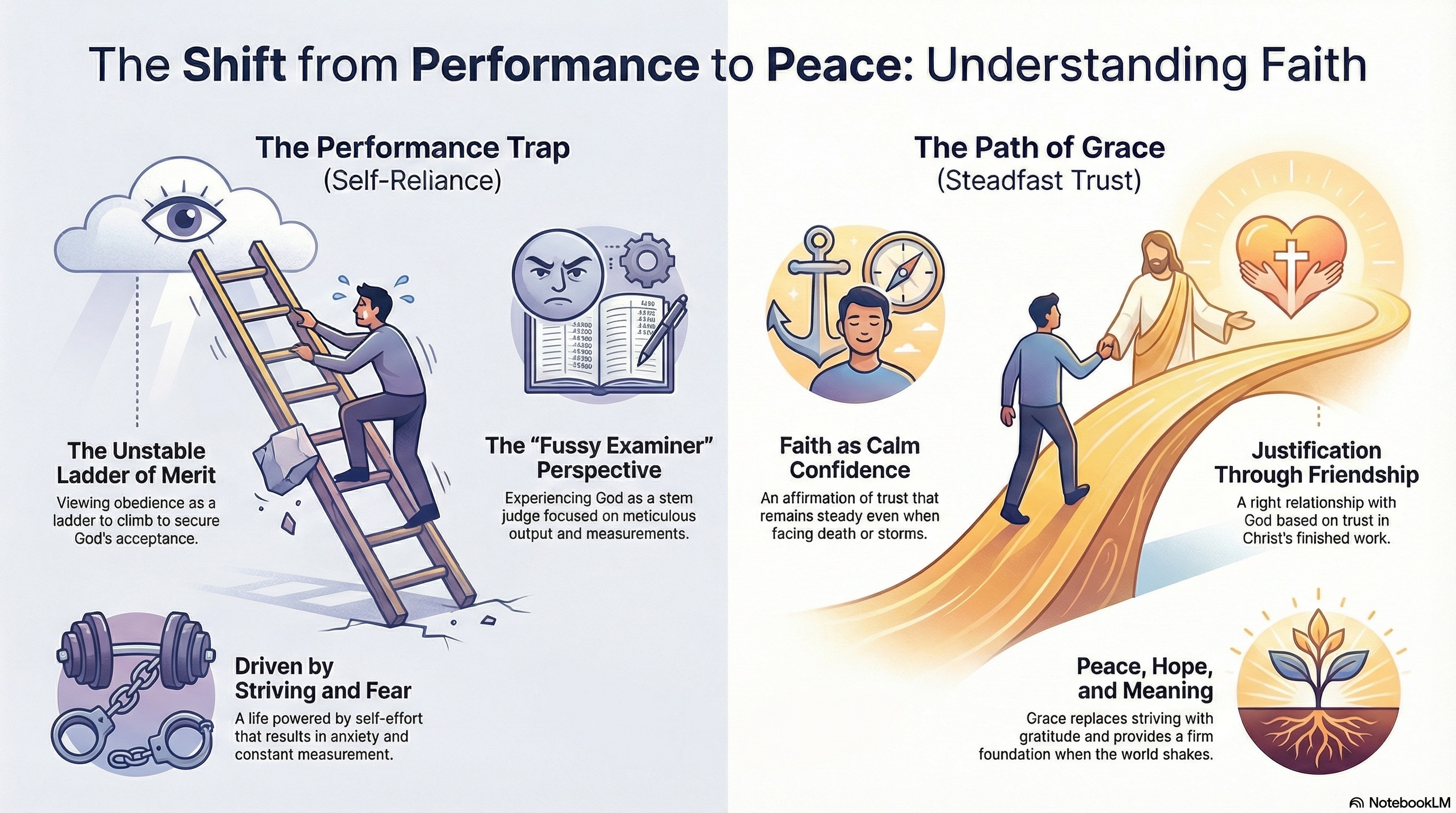
God resolved the crisis in a single sentence: “The righteous shall live by his faith.” That is the essence of the Christian message. The trajectory of “the just” can be explored: it began as covenant loyalty—a desire to walk faithfully with God—was replaced by increasingly detailed interpretations of keeping the Law. Over time righteousness was measured by precision that required breath taking analysis rather than trust. The commandments multiplied in straining to apply them. In such an atmosphere, God was experienced less as a gracious companion, a Deliverer and more as an Examiner, fussy and stern. Against this drift, God’s words stand clear: life does not flow from meticulous self-effort, but from steadfast trust.
What began as a heartfelt desire to please God morphed into self-righteousness. It became a system of performance, defined by being meticulous to a bewildering extent. A person’s standing before God was measured by output. Obedience was no longer a response to love, but a ladder used to secure acceptance. God upended this climb. Being “just” was not about the height reached on the ladder of performance, but about the gracious bestowal of Friendship.
To be justified is to stand in a right relationship with God—to be friends with God. “Justified by faith” describes a grace-based relationship that rests not on performance or accumulated merit, but on trust in Christ’s finished work. Obedience is a response to love, not a test to pass.
Love Struck or Duty Bound
Performance-based relationships keep us measuring, striving, fearing.
Grace-based relationships replace anxiety with assurance and striving with gratitude.
Whenever this truth—that we are justified by faith alone—is rediscovered, it acts like a match to dry wood.
Martin Luther in the 16th century was trapped in a system of religious performance and indulgences. When he realized that Habakkuk’s and Paul’s words offered a way out through trust, he renounced the system. That change of perspective started the Reformation.
John Wesley was shaken by his fear of death during a violent transatlantic crossing, in contrast to Amish emigrants singing joyfully. Later, while listening to a reading of Luther’s preface to Romans, he found his heart “strangely warmed.” He moved from trying to be a Christian to trusting the Christ who had already done the work.
This “strangely warmed heart” was instrumental in the Great Awakening in the USA. It was characterized by the realization that God was not a distant judge to be appeased, but a present reality to be encountered by anyone standing on the watchtower of faith.
Martyn Lloyd-Jones of Westminster Chapel insisted that justification by faith and the benefits in Romans 5:1–11—peace, access, hope, and meaning, even in suffering—are the heart of Christian experience. And they are the result of Jesus our Lord being delivered over to death for our sins and raised to life for our justification. (Rom 4:31)
By abandoning the ladder of self-effort, the focus moves from the climber to the Creator. We long for peace and hope; for that we need access to God. We long for an explanation of suffering; for that we need perspective. These longings belong to our existence as moral beings.
To be justified is to stand in a right relationship with God—to be friends with God. “Justified by faith” describes a grace-based relationship that rests not on accumulated merit, but on trust in Christ’s finished work.
Performance-based relationships keep us measuring, striving, fearing. Grace-based relationships replace anxiety with assurance and striving with gratitude.
Next time: Faith is not a Leap into Dark.


Leave a Reply