The Beatitudes
Right of Admission
Exclusive clubs sport the sign: “Right of Admission Reserved – Members Only.”
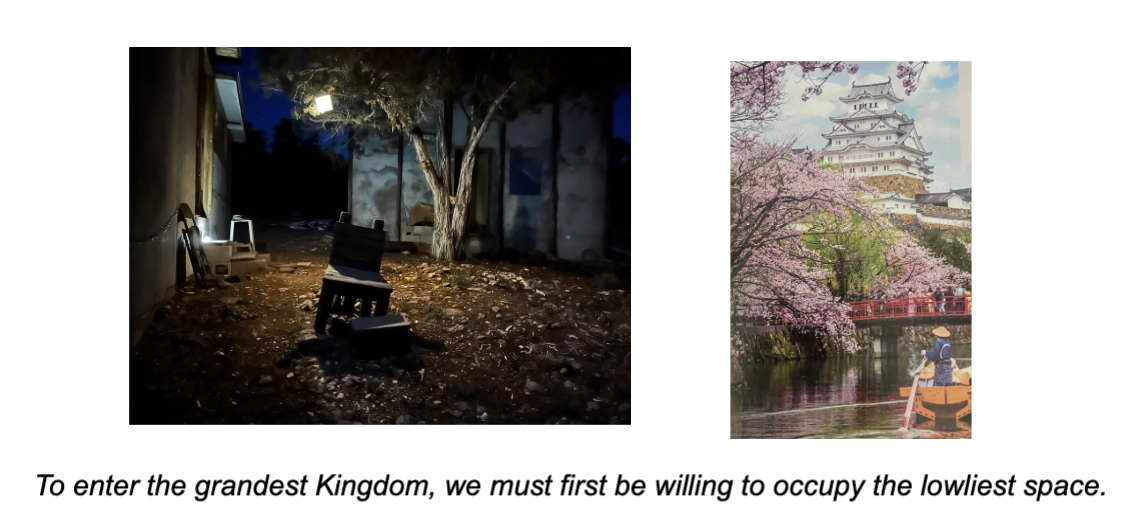
The Kingdom is also exclusive. Its sign reads: “Right of Admission Reserved – Only Destitute Beggars.”
The paradox is that far from being a snobbish, exclusive club, profound contentment is actually all-inclusive. An honest spiritual appraisal reveals the truth about every person: when we weigh ourselves in the sight of God, we are all as destitute as beggars. Yet it is precisely by acknowledging this that we gain entry. There is a trash dumpster at the door, and with great relief we can dump both our failures and our achievements, walking through as our unvarnished selves.
The Kingdom is the one club everyone truly wants to join, because it’s the only place that satisfies the deepest hunger of the human heart. The Beatitudes show us who gets in, what they are really looking for, and who they become. It is the place of profound contentment, the pure essence of what we all crave.
Jesus told this parable to people who were complacently pleased with themselves over their moral performance and looked down their noses at others:
“Thank God I am responsible, educated, and self-controlled. I don’t rely on government handouts, I don’t ruin my life with bad habits, and I’m certainly not like that corrupt corporate grifter over there.”
Meanwhile, slumped alone at a bar after a day of exploiting people, unable to look himself in the mirror, another man thought: “I’ve ruined my soul. God, if you exist, have mercy on a piece of trash like me.”
Jesus concluded, “The trash man, not the self-righteous man, was approved by God. If you walk around with your nose in the air, you’re going to end up flat on your face, but if you’re content to be simply yourself, you will become more than yourself.” (Luke 18:9–14, The Message).
To be poor in spirit is not self-hatred. It is the courage to abandon illusion. It is the willingness to stand before God exactly as you are, with empty hands and no claim upon His favor. It is the courage to confront the darkest tendencies and biases head on.
Nothing to Lose
This truth is profoundly liberating.
Almost destitute and newly married, we rented a semi-detached house so run-down that no self-respecting burglar would give it a second glance. We never worried about being robbed. One day we returned to find the front door standing wide open.
My wife asked, “Did you think to close it?”
“What’s the point?” I replied. “We have nothing worth stealing.”
The same freedom belongs to the poor in spirit. There is no need to defend, rationalize, justify, excuse, or hide. Valid accusations can simply be acknowledged with a “yes,” and a sincere apology. A clear conscience remains unburdened because nothing is left to protect.
Achievement Replaced by Potential
There is a practical irony in the Kingdom: you cannot fill a cup that is already full. Pride and the illusion of self-reliance leave no room for grace. Poverty of spirit is the deliberate acknowledgment of that illusion.
Stop trying to impress God as an achiever. Approach Him instead as a debtor seeking mercy. That creates the room grace requires. The doorway into God’s Kingdom is purposely built low. No one who acknowledges the truth about themselves and approaches God accordingly is excluded.
The remarkable upside is that achievement, always partial and relative, is replaced by potential. Empty hands receive God’s grace and are then free to be filled with His life. Instead of scrutinizing performance that is past, the focus of attention shifts entirely to the future.
“We have come at last to see Ego in a new way: as a pod… which has now become our prison. If we are not to suffocate in it, we have to burst it open.” Peter Shaffer
We become our true selves only when the false self is surrendered before God. Becoming the person God created you to be requires nothing less than the radical breaking of the shell.
The Essential Craving: Shalom
Take every ingredient that the heart desires in the pursuit of happiness—money, sex, power, material possessions, fame, superficial happiness, even physical health—and distill them so that the pure essence is left. The crystal that remains is peace.
All superficiality eventually evaporates. Then the one desire that is the true craving of the heart is peace. Contentedness, or peace, is the promise of the beatitudes. This thesis can be proved by simple experience: think about incidents that are richest in your memory, and inevitably they will link to contentedness or satisfaction.
A person watching a thrilling and absorbing TV program may shout at the family, “Leave me in peace! Kids! Go play outside!” But this is not the peace this beatitude means. This peace is Shalom: the all-embracing peace of Hebrew thought. It is comprehensive wholeness, an unshakeable wellness that permeates every layer of existence, and the one thing that truly produces deep, lasting contentment.
Interestingly, the goal the beatitudes set is not simply peace, but peacemaking! Everyone is peace-loving, but Jesus has something bigger in mind: peacemaking. Supreme contentment shows the way to become a peacemaker. That satisfying journey begins with the radical honesty of the first beatitude.
Jesus didn’t merely tweak the world’s blueprint for success—winning the lottery, self-sufficiency, money, sex, and power (insert your own fantasies). He shredded it. The first beatitude calls neither for low self-esteem nor self-loathing. It calls for an honest assessment of your true standing before God.
The “Press Secretary” called ego must be dismissed so the unvarnished truth can finally speak. Stand before God with empty hands. Acknowledge that you have no claim upon His favor and no right to enter His presence on your own merit. That is where Shalom begins.
A Lifelong Posture
Spiritual poverty is not an entry-level requirement that mature believers eventually outgrow. It is the lifelong posture of every disciple.
The earliest followers of Jesus were called “the People of the Way.” The Beatitudes are The Way. The longer you walk with Christ, the more aware you become of your desperate need for Him. Maturity is measured not by growing self-confidence but by becoming increasingly teachable and increasingly dependent upon His grace.
Closing Reflection: Finding Freedom in Brokenness
What a relief to stop pretending. The exhausting burden of maintaining appearances immediately begins to disappear. There is no longer any need to prove yourself because your standing rests entirely on God’s grace rather than your own performance.
Brokenness is not a barrier to God; it is the very meeting place He chooses. The Kingdom does not belong to the capable, the successful, or the religiously accomplished. It belongs to those who know they desperately need the King.
Before there can be mourning, meekness, mercy, purity, or the realization of Shalom, there must first be poverty of spirit. It is the foundation upon which every other beatitude rests.
Apart from Christ you bring nothing, deserve nothing, and accomplish nothing of eternal value. Yet it is precisely to such people that Jesus makes His astonishing promise:
“Theirs is the kingdom of heaven.”
Previously:
Introduction to The Beatitudes. Jesus describes and invite us to make them our way of life, becoming like Him. (Hologram) They exclaim pilgrims as “Blessed!” The word “blessed” has lost all meaning, with the vague idea of “happiness.” The word points to Blissful Contentment. Becoming like Jesus is a life long process, God is not supplying a prefabricated Mobile Home. He is building a Cathedral to showcase His Glory.
1.1 Holograms of Jesus
1.2. “Bless” – God’s bestowal of blissful contentment
1.3 Cathedrals Showcasing His Majesty
Next: The Wealth of Spiritual Poverty (2) From Past Achievement to Future Potential


Leave a Reply