Jesus: Oh the supreme bliss of the MEEK! They will inherit the earth.
Culture: Oh the supreme misery of the Meek! They are losers who shall be despised.
These horses are meek!
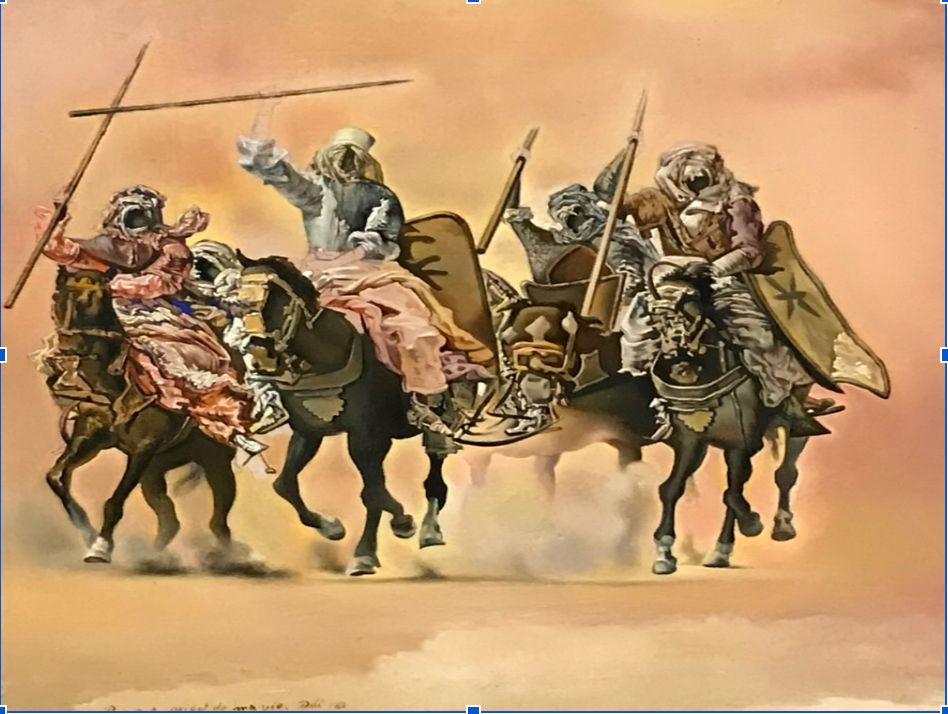
Salvador Dalí, “Premier Orient de ma vie” (1942). “The central orientation of my life”. Photo taken at the Dalí Theatre-Museum, Figueres.
God first confronts us with His glory. That makes us painfully aware that we are paupers. We must fearlessly explore the darkness within. That in turn causes us to mourn the damage we have caused and the resultant alienation. Following poverty of spirit and mourning, we take another step: transparency; jettisoning our false personas to live in complete transparency, letting our true poverty shape our demeanor before God and the world. That is what meekness is.
Our poverty and mourning begin to affect everything about us—our attitude toward life, our relationships, our thinking, our speaking. This is repellant to natural man, who seeks to protect his reputation and project an image of grandeur. But the Christian freely acknowledges his poverty and does not resent it, even when other people point it out. The believer can say, with sincerity, “It is all true.”
MEEKNESS IS NOT WEAKNESS
David killed a bear and a lion with his bare hands, yet in his dealings with Saul he demonstrated extraordinary meekness. He was not afraid of Saul. His meekness came out of his strength.
Moses entered so deeply into the suffering of his people that he killed an Egyptian overseer, yet he became known as a meek man. Emboldened by God he confronted Pharaoh who had absolute power.
Paul endured persecution, beatings, and suffering, yet could say, “Of all the sinners in this world, I am the chief.”
The supreme example: our Lord Himself. He faced the Pharisees, the Romans and Herod without flinching. He went to the cross and prayed, “Father, forgive them; they don’t know what they are doing.”
Far from passive weakness, real meekness confronts the situation, whatever the cost.
Meekness is therefore a test of our genuineness. It involves our very heart and demeanor being brought under God.
MEEKNESS IS CONTROLLED STRENGTH
The Greek word translated as “meek” in the Beatitudes (Matthew 5:5) is πραΰς (transliterated as praos), which translates to meekness, gentleness, or humility. Controlled Energy best describes it: the perfect middle ground between excessive anger and total apathy; the capacity to exert strength or indignation at the right time, against the right thing, and for the right purpose, while remaining utterly patient under personal insult.
In ancient Greek literature, the word had a very specific, dynamic meaning rather than a passive one: A horse captured in the wild, rearing and kicking, bucking and snorting, is completely useless to its owner. It was gradually brought under discipline. A saddle was placed on it. It was patiently tamed and trained to obey the word of command. It was trained to answer to the reins of the rider. It was now said to be meek. The horse lost none of its speed, vigor, or strength; rather, that violent power was brought under control to respond to the rein and bit: those have been harnessed to a specific purpose. This is what meekness is. It is God harnessing your spirit and your strength, so that you learn to answer to the reins of God, and you are trained to obey his word of command.
In the biblical context, to be praus is to have your strength, drive, and raw nature completely harnessed under God’s authority.
MEEKNESS IS TRANSPARENCY
Meekness means that we really have insight into ourselves.
We are delivered from the curse of keeping up appearances, we are no longer interested in putting our best foot forward. When we discover ourselves deceiving people as to how good we are, we despise the maneuver.
To be truly meek means that we do not have to spend our lives wondering what other people think about us. We do not have to spend our energy protecting our name. This is fantastically liberating, to care for neither the smiles nor the frowns of friends and critics.
If someone tells a lie about me and slanders me, I can assure you that if they had access to the inner workings of my heart, they would find something much more vile than the lie they are spreading.
To be meek is to understand this about myself and say, “There is nothing worth protecting.”
When first married, we lived in a ramshackle old semi-detached house—a rather terrible place, but one that we came to love as home. When the buses went by, the windows rattled in their frames. In winter, with no internal heating whatsoever, we woke to ice on the inside of the windows.
But there was one great advantage. We never had to lock the house. No self-respecting burglar would give it a second glance. Just so, meekness emancipates us from the tiresome necessity to hide behind locked doors for the sake of self image. There is no need to prove myself. Our identity is now reliant not on self, but on Christ. This removes all constraints to grow into His likeness.
There is no need to rationalize, defend (by attacking sometimes), excuse or ignore. We can leave it with God.
To be meek is not groveling in the dirt. It is to hand the reins of your strength over to the God who made you. Unlocked, untamed by culture, and wholly His, we finally step into the freedom of having nothing to lose, nothing to prove, and everything to inherit.
Next Up: From Fret to Peace – the map the meek walk.
The Beatitudes Contents: https://progressingpeople.blog/2026/07/27/the-beatitudes/


Leave a Reply