“Blissful are those who mourn.” (Matthew 5:4)

“Know thyself? If I knew myself, I would run away.” (Goethe)
Complete self-knowledge is so unsettling that one wants to flee from oneself.
Judge Learned Hand, one of the most influential federal appellate judges in American history, who many legal scholars regard as one of the greatest judges never appointed to the Supreme Court, whose opinions are still widely studied in law schools and frequently cited by courts, reached this conclusion toward the end of his career on the Bench: “Here I am, an old man in a long black nightgown, sitting up here making muffled noises at a man who may be no worse than I.”
The Director of Federal Prisons for nearly three decades, James V. Bennett set a goal of improving conditions in Federal Prisons. This was partly the motivation: “My associates and I would now try to show that there was no essential difference between men in prison and men on the outside.”
The first Beatitude brings us face to face with the reality of sin in our lives. The second shows us how we are to respond to it.
Whenever I come to God, I am never anything but a sinner. From a human point of view, this sounds like suicide of sorts. God turns human evaluations upside down. This truth is a glorious paradox: the deeper the humiliation, the greater the exaltation.
Even so, everything within us resists this reality. The moment we are confronted with our sin, our ego immediately goes to work. It becomes our personal Press Secretary, spinning the facts to protect our self-image. We instinctively defend, attack, and rationalize. We rename our sin as a shortcoming, a harmless habit, a weakness, or a simple mistake, cosmetic adjustments that are like putting lipstick on a pig.
Three Ways We Respond to Our Sin
When faced with our own sin, we generally respond in one of three ways.
The Hard-Nosed Realist. He lets his Press Secretary manage the narrative. He rationalizes, excuses, hides, boasts, disguises, compares, and blames. Everything is spun to make it appear that life is under control.
The Hypochondriac. He is paralyzed by morbid introspection, constantly checking his spiritual temperature and vital signs; he hopes God will have mercy because, after all, he is “doing his best.”
The Spiritual Person. The biblical response is neither denial nor despair. It is simply to acknowledge our sin and mourn over it.
In the Greek, mourn is a vigorous, intense word. It describes the wailing and lamenting of someone overwhelmed by deep personal loss. Jesus uses this powerful word to reveal the depth of sorrow that should accompany a true recognition of our condition before God.
The Devastation of Sin
Correctly understood, sin is so devastating that it should cause abject misery. It is not a minor flaw to be managed or a weakness to be excused. Sin is not the harmless imperfection we try to make; it is the devastating force that separates us from God, distorts who we are, and robs us of the life we were created to enjoy.
It isolates us from our true selves, estranges us from our neighbors, and alienates us from God. Like a boa constrictor, sin slowly tightens its grip, restricting our ability to love, trust, and live as God intended. It prevents us from becoming the people we were created to be, suffocating the life and freedom God desires for us. Sin promises freedom while subtly robbing us of the very freedom we were created to enjoy.
The tragedy of sin is not only that it enslaves us; it blinds us to our slavery. Jeremiah captured this profound reality: “The heart is deceitful above all things and beyond cure” (Jeremiah 17:9). Our greatest deception is often self-deception. The heart creates excuses, softens the truth, and protects the very sin that is destroying us. Like a boa constrictor, sin slowly tightens its grip, while whispering that we are still in control.
Paul lays bare this tension in Romans 7. He gives voice to the agonizing conflict every honest person eventually discovers within themselves. The good he longs to do, he leaves undone. The evil he hates, he finds himself drawn toward. The self-centered drive within us refuses to surrender control. In our own strength, we are not merely outmatched; we are often willing accomplices, embracing the very things that enslave us when they serve our desires.
Fire the Press Secretary

Left to ourselves, this relentless inner warfare drives us to the same desperate cry that rose from the heart of the apostle Paul:
“O wretched man that I am! Who shall deliver me?”
Yet the cry of mourning is not the final word. The sorrow that exposes our helplessness prepares the way for the joy of redemption:
“Thanks be to God, who delivers me through Jesus Christ our Lord!”
The Press Secretary Ego, laments it, likening it to a death sentence. This death “opens a door out of a little, dark room (that’s all the life we have known before it) into a great, real place where the true sun shines.” (C.S. Lewis)
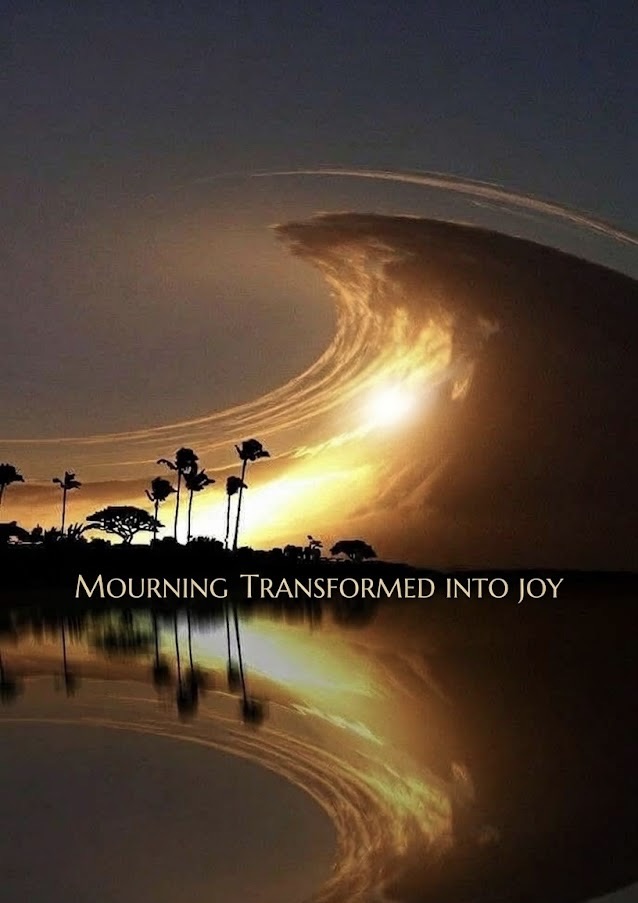
The mourning Jesus blesses is never a dead end. It is the doorway through which grace ushers us into the Kingdom, where sublime contentment flows from the presence of God and where our abject misery gives way to the fullness of God’s joy.
Prequel: “They shall be comforted”
The Bliss of a Broken Heart https://wp.me/p22zu5-cs
Next time: The Liberation of Transparency (The Bliss of the Meek)
So far:
The Be-Attitiudes of Conetentment
Contents:


Leave a Reply