The Logic of the BeAttitudes
“Beatitude” is a strange word to modern ears. It actually describes a person who is flourishing.
“Beatitude” comes from beati, the Latin word Jerome used around 400 A.D. when he translated the Greek word makarios in the Vulgate, his translation of the Gospels. Later, English speakers turned it into “Beatitudes,” naming the sayings as a group. Jesus himself never used this word.
Makarios itself is a translation of an older Hebrew word, ashrei: thriving, fortunate, enviable. This is not the English “blessed” as we usually interpret it, a happy feeling reliant on circumstances. It describes something deeper: a state of well-being, of profound contentment.
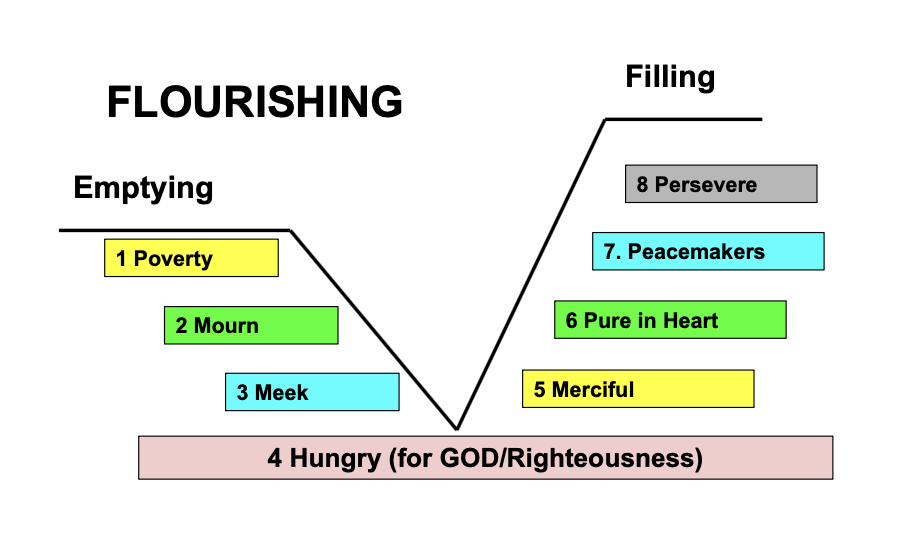
“Flourishing” better captures the essence of these sayings. And Jesus maps it out. These sayings are a journey of discovery: first of our emptiness and then of God’s provision. They are not a tapestry for framing as a static display, they are an exciting adventure of transformation. They point more towards the attitudes that shape life than to specific actions. I like to call them Attitudes of Becoming.
The Map of the Journey
We Descend
The first three Attitudes of Becoming are counter-intuitive, appearing to humiliate rather than exalt. Yet this descent is essential because it unmasks the false, presentable self-important image we tend to project. Poverty of spirit surfaces that self-righteousness. Mourning laments the isolating and damaging alienation caused by our failures. Meekness refuses to let the ego dictate terms. It is how a human being stops managing appearances and as a result realize their full potential as human becomings: merciful, single minded peace makers.
We Meet God
In the fourth Attitude of Becoming we prepare for the ascent. The emptying of the first three now leads to a hunger and thirst for God, the Righteous One. We “see” God. The promise is extraordinary “they shall see God”; not simply understand him intellectually, but experience Him directly. That, as Paul explains, is life changing, “But we all, with unveiled face, beholding as in a mirror the glory of the Lord, are being transformed into the same image from glory to glory.” (2 Corinthians 3:18 NKJV)
We Ascend
The next three Attitudes of Becoming express the results of that transforming encounter, Each one corresponds directly to one of the first three, as the color coded diagram shows.
Poverty of Spirit makes us Mercful
Peter got up the nerve to ask, “Master, how many times do I forgive a brother or sister who hurts me? Seven?” Jesus answers with a story about a servant (forgiven an impossible debt, who then had a debtor thrown in jail for a trivial amount), then tells the disciples: “Seven! Hardly. Try seventy times seven.” . . . I forgave your entire debt when you begged me for mercy. Shouldn’t you be compelled to be merciful to your fellow servant who asked for mercy?’ (Matthew 21:21-35 The Message)
Mourning Creates a Craving for Purity of Heart
We mourn because our sin has causes alienation: from God, from people and from ourselves. Therefore the effect of sin is to isolate us. The grieving is not pointless; which results in the longing for purity. Purity of heart, as Kierkegaard said, is to will one thing, to be single minded. Jesus said, “The light of the body is the eye: if therefore thine eye be single, thy whole body shall be full of light. (KJV)” We pursue God with single mindedness.
Meekness is the Prerequisite for a Peacemaker
You cannot make peace between others, or absorb conflict without retaliating, until you have first been broken of your own need to assert and defend yourself.
The Big Surprise
Genuine inner transformation challenges the status quo and often draws resistance. Although this final Attitude of Becoming sounds sobering, it offers a realistic assessment of living counter-culturally and provides the resolve needed to persevere.
Why This Matters
Christianity is not merely an intellectual exercise, an emotional state, or a set of moral actions. The Attitudes of Becoming are not prescriptive, they are descriptive. This changes the pilgrimage: it is not demanding that we grit our teeth, roll up our sleeves, and dig deep. Because they are descriptive rather than prescriptive, they engage the whole person, the biblical “heart”: the mind, will, emotions, and desires, the real person rather than the fake one we would prefer to project. They describe the attitudes that develop from seeing God.
They begin with an honest reckoning of the heart’s condition, move through a real encounter with God that satisfies that condition, and end in a transformed character that visibly bears the fruit of that encounter.
Some follow and others surrender. Followers admire from a distance; the surrendered experience the transformation. For them, these are not Beatitudes to imitate but Attitudes of Becoming. Of flourishing!
Next up: Purity of Heart is Singleness of Mind
Previously: https://wp.me/p22zu5-ce
 Progressing People
Leave a comment