I once had the terrifying experience of getting lost in Minsk, Belorussia.. With rising panic, I tried to retrace my steps, but nothing registered. No one spoke English and people shrugged then ignored me when I asked for help, the signs were all in Cyrillic, the phone booths were stripped of equipment, bare wires protruding and smelling of urine. I felt doomed until, in entirely the wrong direction according to my perceptions, I saw the monument outside the metro station where I disembarked every morning on my way to teaching at The International Leadership Academy. The recognition of that landmark was the critical turning point that allowed me to reorient myself.Habakkuk 1:12–17 presents a crisis that every pilgrim eventually faces. It isn’t just that God is silent; it’s that His actions feel hostile—even evil. Habakkuk looks at the brutal Babylonians and anguishes over the mystery. “Why do You stand idly by while the wicked swallow up those more righteous than they?”
Pilgrims are disoriented by the mysterious ways of God, impacting their mindset and the trajectory of their lives. Pull out of the flow of alarmed thought, and switch your bewildered focus from the circumstances to God.
Habakkuk 1:12–17 presents a crisis that every pilgrim eventually faces. It isn’t just that God is silent; it’s that His actions feel hostile—even evil. Habakkuk looks at the brutal Babylonians and anguishes over the mystery. “Why do You stand idly by while the wicked swallow up those more righteous than they?”
Pilgrims are disoriented by the mysterious ways of God, impacting their mindset and the trajectory of their lives. Pull out of the flow of alarmed thought, and switch your bewildered focus from the circumstances to God.
Stop! Look for a Landmark!

Notice Habakkuk’s focus on God as Holy. “Lord, are you not from everlasting? My God, my Holy One, you will never die.”
The “Sun-ness” of God: Holy means Distinct
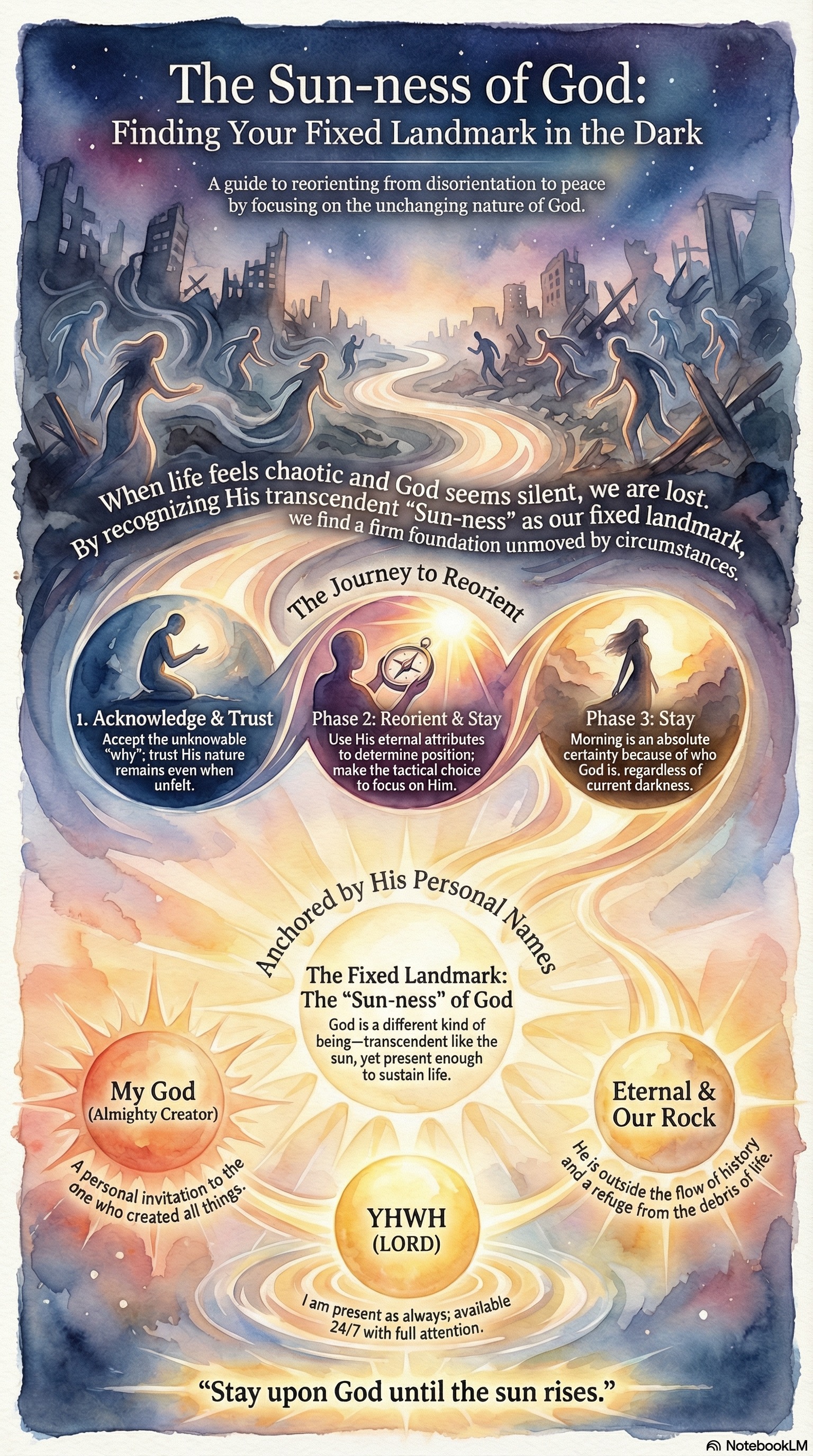
To reorient, we must understand God as our landmark, specifically His holiness. Think of the difference between a drawing of the sun and the actual sun. You can look at a sketch, touch the paper, and understand its shape. But you cannot “touch” the sun; its heat, power, and brilliance would vaporise you long before you made contact.
Holiness is God’s “sun-ness.” He is not just a better version of us; He is a different kind of being entirely. However, this “otherness” does not mean He is inaccessible. Like the sun, God is too great to be controlled, but He is also too present to be ignored. The sun is 93 million miles away, yet its “sun-ness” is exactly what allows it to reach across the vacuum of space to sustain life. His transcendence (being above us) is precisely what makes His immanence (being with us) possible.
When you are lost you must find a landmark that is fixed. Because God is “Holy”—the “Sun-ness” outside of our creation—He is the only truly fixed point. When Habakkuk stood on his watchtower, he didn’t look at the Babylonian army to find his peace; he looked at the “Sun-ness” of God.
To use this landmark:
- Acknowledge: Accept that you cannot understand the “why” of every event. God begins where our data collection ends.
- Trust: Even when you can’t feel the heat, the “Sun-ness” of God remains.
- Reorient: Use His attributes to determine your position. If God is eternal, this crisis is temporary.
Distinct not Distant – The Personal Name: YHWH
“O LORD,” says Habakkuk. That is the personal name that God revealed to Moses when he tried to dodge going to tell Pharaoh, an absolute despot with no accountability, to let “my people go.” LORD (YHWH) describes His activity: “I am present as always,” available 24/7 with full attention. Unlike a human gatekeeper who might deny access, God’s attention is always full because His holiness tells us He is different.
Affirm these personal landmarks:
- He is “LORD”. (YHWH)
- He is “MY God”: A personal pronoun; respond to the personal invitation.
- He is”my GOD“: The Hebrew word means “Almighty Creator”.
- He is “Eternal”: He is outside the ebb and flow of history.
- He is “Our Rock”: A firm foundation – a refuge outside of the debris flow.
The Voice That Sustains the Weary
Isaiah 50 addresses the darkness from the perspective of the Servant—the voice that sustains the weary. This is not the rehearsed art of an orator; it is a voice that carries weight because the speaker is literally nailed to a cross in the darkness.
During the unnatural night of the crucifixion, Jesus cries out in anguish: “My God, my God, why have you forsaken me?” Yet, after that cry of abandonment eventually comes the calm, trusting voice of faith: “Into Your hands I commend my spirit.”
Jesus acts as the bridge between the “Sun-ness” of God and our human frailty. Just as the atmosphere allows us to experience the sun’s light without being consumed by its raw heat, He is the “radiance of God’s glory”—the brilliance of the sun brought down to eye level. He absorbed the darkness so that we might walk in the light.
When you find yourself in the “pitch-black room” of a personal crisis, the natural instinct is to scramble for a flashlight—to fix the problem, find an answer, or force a resolution. But Isaiah offers a different strategy for the pilgrim: Stay.
Staying Upon YHWH – Leaning against a Rock
Staying is not a sign of defeat; it is a tactical choice of focus. It is the refusal to let the chaos of the immediate “alarmed thoughts” drown out the reality of the fixed landmarks. By orienting yourself toward the “Sun-ness” of God, you recognize that while you are currently in the shadow, the Sun itself has not moved, dimmed, or changed.
You are leaning against a Rock that is higher than the debris flow. You are listening to a Voice that has already navigated the deepest darkness and emerged with a calm, commendatory faith.
If you are walking in darkness, stay upon God until the sun rises. For the pilgrim, the morning is not just a possibility; because of who God is, it is an absolute certainty, the one and only sure thing in a changing world.
The Babylonians still invade. Jerusalem was sacked. Captivity lasted seventy years.
But Habakkuk, as we shall see, was not sighing anymore, after seeing, he began singing.
Stay tuned!


Leave a Reply