lasting peace and spiritual revival.
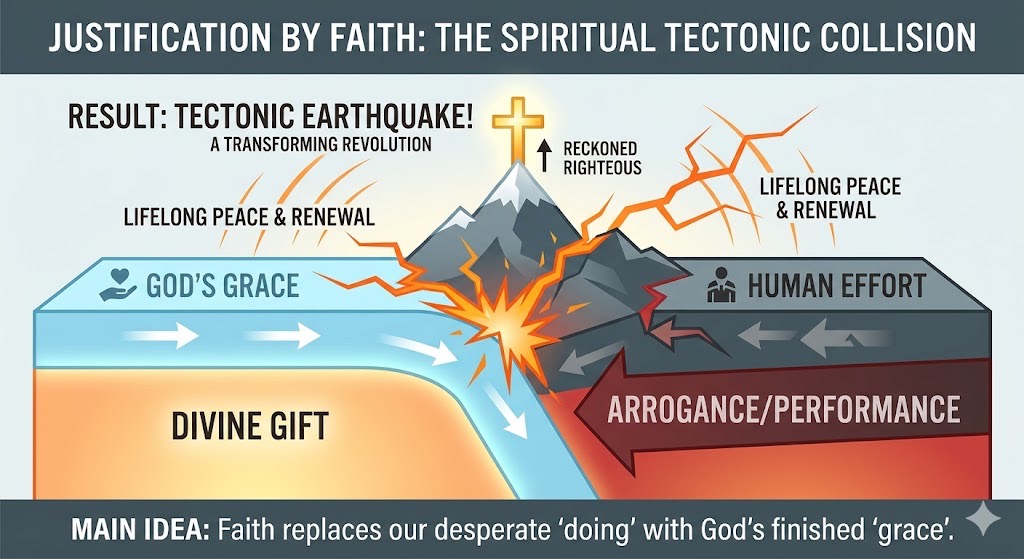
Mount Everest continues to rise about ¼ inch (5 mm) a year due to a massive, ongoing “tectonic smashup” between two tectonic plates: the Indian Plate and the Eurasian Plate. The region is prone toJustification by faith is more than a doctrine; it is a seismic event. It is the moment human effort is swallowed up by divine grace. continuing earthquakes. https://www.youtube.com/watch?v=z4WLHIUU2uU&t=7s
Justification by faith is a tectonic smashup between the grace of God and human arrogance. This contrast is clearly surfaced in the difficulties in prayer: unanswered as well as answers not to my agenda. (Habakkuk:1-2:5) Human arrogance demands God do what an arrogant human desires. (The many who testify they tested God and he failed them highlight the matter.) Specifically 2:4 “Look at that man, bloated by self-importance— full of himself but soul-empty. But the person in right standing before God through loyal and steady believing is fully alive, really alive.” (The Message)
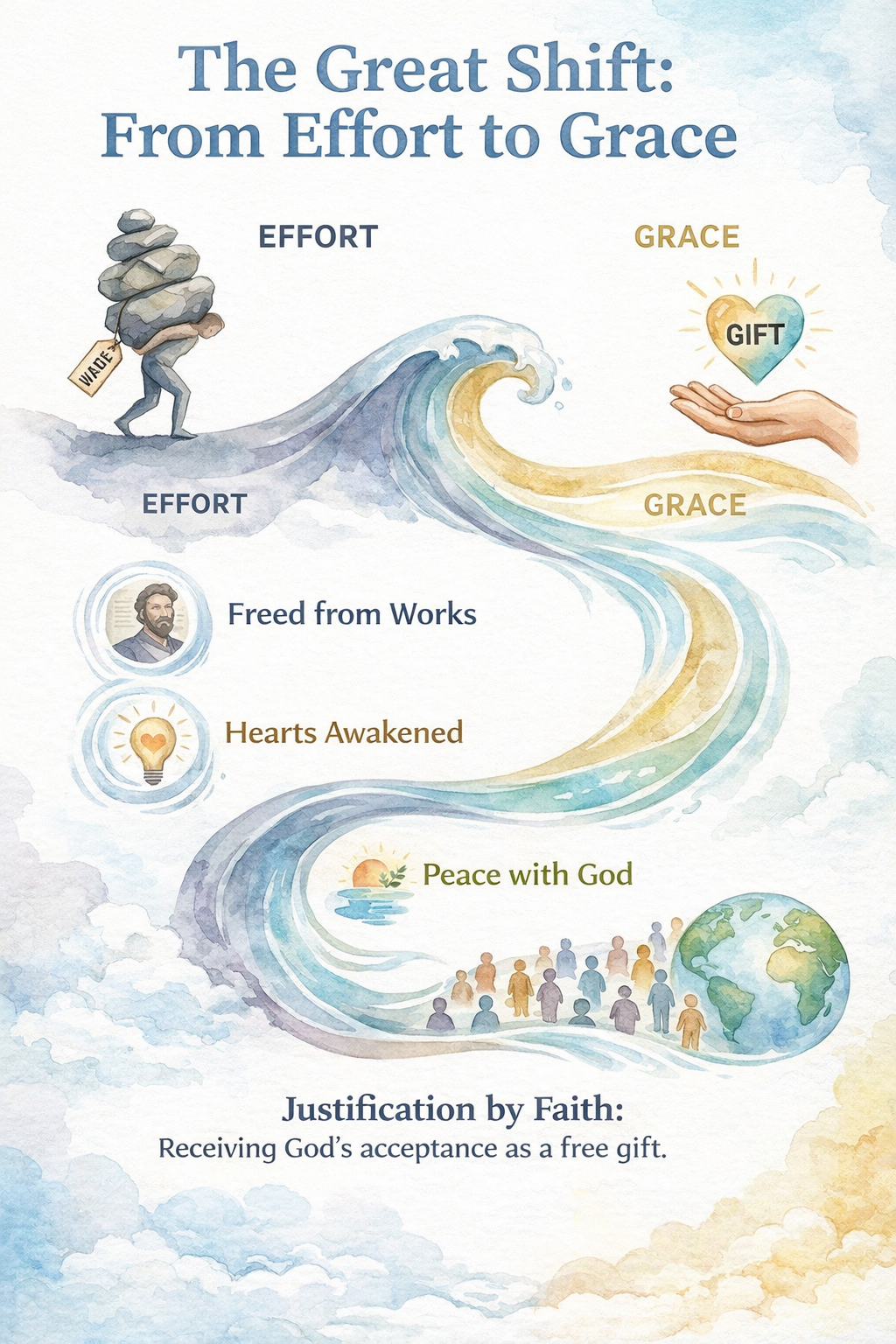
Paul and the Shock Within Judaism
Paul was a Pharisee of the Pharisees, indicating a brand of fussy obedience that was all enveloping. Friendship with God cannot be earned. It is offered as a gift to be accepted. The obverse side to this coin is a pernicious human perception that God requires performance for acceptance. Here is an historical trajectory of the performance model: The Torah, the five books attributed to Moses, were analyzed to contain 613 commandments. The Talmud (which came after Paul) demonstrates where this led: a 63-volume “instruction manual” that explains the 613 details in depth. It is like the tax code of the USA” The “page count” of the U.S. tax code is a moving target because it depends entirely on whether you are looking at the literal laws passed by Congress or the massive library of regulations required to actually follow those laws.As of 2026, here is the breakdown of the length of the tax code:If you only count the actual Internal Revenue Code (Title 26 of the U.S. Code) as published by the government, it is approximately 6,800 to 7,000 pages.
Paul recognized that it was impossible to be scrupulous enough. His discovery that God declared a person righteous, or justified, based on faith in the doing and dying of Jesus in his place, was a tectonic shift with continuing impact. Harking back to the revelation made to Habakkuk, he found that accepting the gift of God, offered freely, was pivotal in friendship with God. Mount Everest, after all, is still rising!
Luther and the Shock Within the Church
More than a thousand years later, the same idea shook Europe.
The medieval church had developed a complex system of penance, sacramental participation, and religious effort. Many believers lived with deep anxiety about whether they had done enough to satisfy God’s perfection. All who were sincere in seeking God lived with quiet anxiety: had they done enough to satisfy God’s perfection?
Martin Luther certainly tried. Reflecting on his years as a monk, he wrote, “If ever a monk got to heaven by monkery, I should have been that monk.”
Despite his scrupulous observance, he was wracked by doubt. He thought a pilgrimage to The Holy City would resolve his crisis of faith. Luther ascended the 28 marble steps (which tradition says were the steps Jesus climbed to face Pontius Pilate) on his knees. On each individual step, he stopped to recite the “Our Father” (Pater Noster) and, according to some accounts, kissed the steps where he believed he saw stains of Christ’s blood. Instead of feeling the spiritual peace or “certainty” he expected, he reportedly stood up and thought (or whispered), “Who knows if it is true?” Maybe God requires a 100 steps, and/or a Pater Noster and a Hail Mary on each step? How do we satisfy perfection?
While teaching the Epistle to the Romans, Luther came to understand that righteousness before God was not something earned but something given through faith. This realization became the shock that led to the Protestant Reformation. The chain from Habakkuk to Paul gained another link,
The discovery of “justification by faith” brought profound personal relief to Luther and soon spread across Europe. This shift was a geopolitical seismic event: when the established Church in Rome collided with these simplified Biblical truths, the resulting “shockwaves” permanently fractured the monolithic religious landscape, forcing a complete reordering of the map of Europe.
Wesley and the Shock of Methodism
Two centuries later, the same truth again changed a life—with far-reaching consequences.
John Wesley devoted himself to rigorous discipline and the pursuit of holiness. Yet he lacked assurance about his standing with God. That insecurity was exposed during his 1735 voyage to Georgia.
Mid-Atlantic, a storm so violent struck, that even the experienced sailors were terrified.. Waves crashed over the deck, sails tore apart, and passengers panicked, certain they would die. Wesley, though a devout Anglican priest, found himself afraid—without the calm confidence he thought he possessed.
In stark contrast, a group of Moravians calmly sang hymns through the chaos. When Wesley later asked if they had been afraid, their answer was simple: they were not—even their children faced death without fear.
The moment unsettled him deeply. Wesley realized he had religion, but not assurance. His faith was disciplined and sincere, yet lacked the settled trust he saw in them.
The storm did not convert him, but it destabilized him in the best way. It forced a question he could no longer avoid: did he truly trust God, or merely practice religion?
On May 24, 1738, while listening to Luther’s commentary on Romans, Wesley felt his “heart strangely warmed.” He came to trust in Christ alone for salvation.
That shift transformed his preaching. Its impact spread rapidly, helping spark a national awakening. Some historians even suggest it played a role in England avoiding a revolution like France’s.
The Shock in America
The same doctrine ignited the First Great Awakening in eighteenth-century America.
Preachers like George Whitefield and Jonathan Edwards confronted a comfortable assumption: that being right with God came through birth, baptism, or respectable behavior. For many, religion had become little more than inherited custom. Justification, they insisted, comes by faith alone—not by family background, moral effort, or outward religion. A person is made right with God only through a personal, inward trust in Jesus Christ.
Whitefield called people to the “new birth,” pressing for inner transformation rather than external reform. Edwards argued that true religion consists of “holy affections”—a heart genuinely reshaped by love for God. Faith, in their preaching, was not mere agreement, but deep reliance.
This shifted Christianity from cultural assumption to personal encounter. It unsettled the self-assured, yet opened the door to all: anyone could be reconciled to God through faith.
Removing the Bottleneck
The Awakening didn’t just change the message—it changed how it spread.
Before the revivals, preaching was largely confined to ordained clergy, creating a natural bottleneck. Growth was slow, limited by how many ministers could be trained and installed.
But if faith is personal, then testimony becomes universal. Those who experienced new life began to speak of it. The result was explosive: the rise of lay preaching.
Methodists and Circuit Riders
John Wesley’s decision to authorize lay preachers multiplied the movement overnight. Circuit riders carried the message across vast distances—on horseback, in fields, homes, and frontier settlements—spreading Methodism far beyond the reach of traditional structures.
The Baptist Grassroots Model
The Baptists, with their emphasis on local leadership and personal testimony, were already positioned for this shift. Lay preaching fit naturally. Ordinary people with a clear conversion and a gift for speaking could lead, enabling rapid growth across the South and West.
Lay preaching didn’t just support the revival—it fueled it. The message created transformed people; lay preaching turned them into messengers. Together, they reshaped the American religious landscape.
The Personal Shock
The impact of justification by faith is not only historical; it is deeply personal.
In the Epistle to the Romans, Paul writes: “Therefore, since we have been justified by faith, we have peace with God through our Lord Jesus Christ.”
The passage continues through Romans 5:1–12, describing the remarkable results of justification: peace with God, access to God, hope, and glory in suffering, and the assurance of reconciliation, all made real in the power of the Holy Spirit.
For countless individuals throughout history, these words have brought profound relief. The fear of never being good enough is replaced with the confidence that acceptance with God rests on Christ’s work rather than human effort.
A Message That Continues to Change Lives
From the revelation to Habakkuk, Paul’s proclamation in the first century, Luther’s rediscovery in the Reformation, to Wesley’s awakening of heart, the doctrine of justification by faith has repeatedly brought renewal.
It reminds us that the foundation of the Christian life is not human achievement but divine grace.
And whenever that message is rediscovered, it has the power to transform both history and the human heart.
What’s In It For Me?
“Revived” medically speaking, is a miracle – a dead body is brought back to life. That, in a spiritual sense, is what happens when someone trusts in Christ. Baptism mirrors this miracle. We are baptized or initiated into His death and Resurrection. It can be compared to a marriage ceremony where the parties say“I do”. “I do” must not be construed as “I did it!” -as if the ceremony was the conclusion. it IS a done deed, but with the promise to keep up at it, loving, honoring, tending,
And that is a description of revival. It begins when you say “I do” to Jesus. That “first love” needs constant renewal, or revival. Each time we feel distant, the way back is to say “I do” in response to God’s question
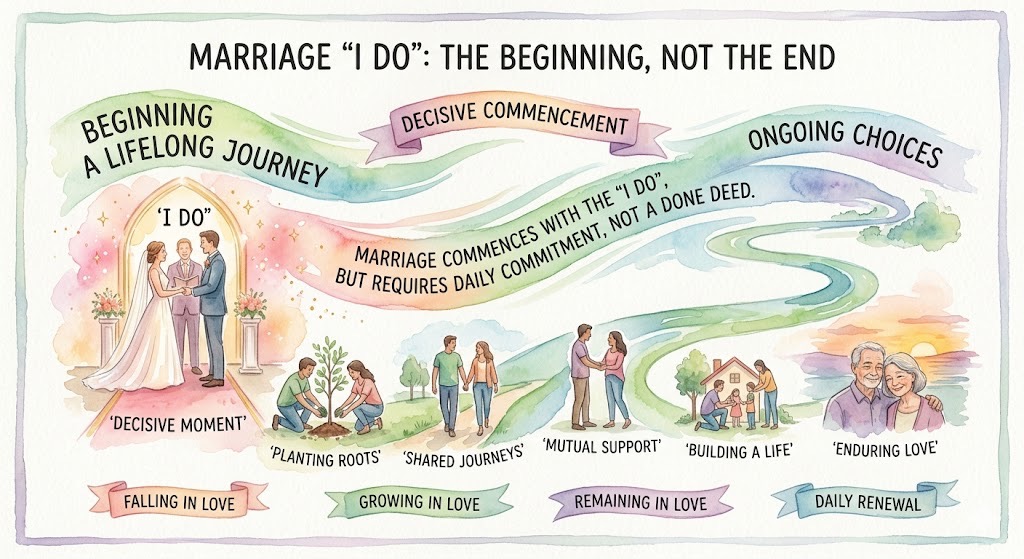
Say “I do” now! Maybe for the first time. Maybe for the hundredth time. It is a process of falling in love, growing in love and staying in love.


Leave a Reply