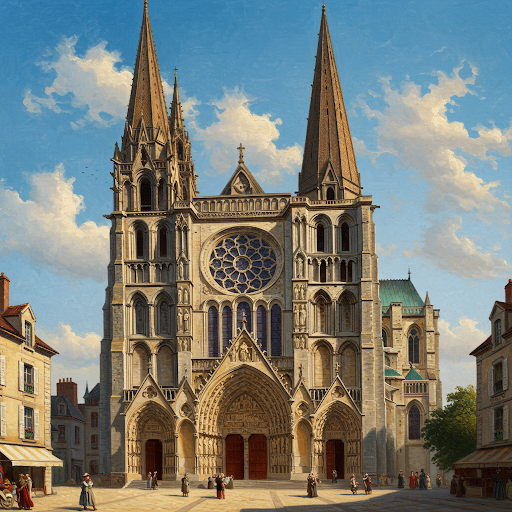
While shaving this morning, I was anticipating with great joy the prospect of going to church. I like to prepare myself so that I get the full benefit.
The thought came to me forcibly, “STOP USING THAT PHRASE!”
In biblical context, you cannot “go to church.” The Greek word that the bible uses for church is “kuriakes.” It appears twice in the New Testament. It literally means “of the Lord”, describing people as “belonging to the Lord.” (See Gemini answer in ENDNOTE) You can trace the English word back to the Greek word: the krk in “K u r ia k es” became “kirche” in German, was abbreviated to “kerk” in Dutch, Scotland added brogue and it became “kirk”, and since England is slightly (considerably?) an island unto itself, it is “church” in English – the hard k starting and ending the word in the other languages was changed and softened to ch, as it chat, in English.
When Jesus spoke of what is now called “church”, he used a different Greek word “ekklesia”. Its secular use was political, “to call out citizens to a public meeting”. The antecedent to it is found in the Old Testament. The Hebrew word “qahal” describes people gathering for public meetings, including legal proceedings, military call up, and worship.
So how did the switch happen? It was illegal to translate the bible into English, and early translators were in peril. Wycliffe translated the Latin Vulgate into English, and hand copied versions circulated. He escaped execution, but was declared a heretic after he died, and his body was exhumed and burned at the stake. (really!)
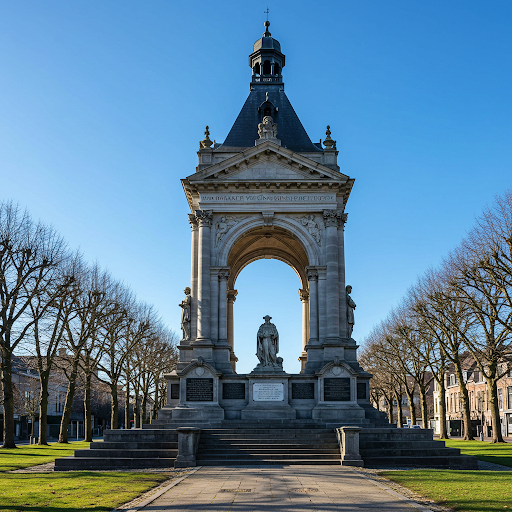
Tyndale translated the original Hebrew and Greek texts into English, working from Belgium to escape persecution. He was captured, however, and executed by strangling and then his body was burnt at the stake as a heretic in Vilvoorde, Belgium. There is a park, impressive memorial and museum there now. (Picture generated by Gemini AI)
Why such opposition? To distill a complex issue to one implication; both the Roman Church and Kings (who were Roman Catholics) feared any challenge to their absolute power and authority. Church and state were so intertwined that those who did not baptize their infants were considered treasonous. Heresy and treason were somewhat of a synonym. Any gathering of believers not sanctioned by “The Church” could well lead to unintended consequences.
However, when it became apparent in England that due to popular demand a translation was inevitable, King James authorized a translation so that he could control it. Some 47 scholars appointed by King James, worked under the constraint of 15 rules set by the King. One rule was that the word ekklesia, translated by Tyndale as “congregation” (and In some cases as “assembly”), must be translated as “church”. This choice was deliberate – a new meaning was threatening to the institution of church and state. Church was an entity with the King (or the Pope) in charge, a congregation was a loose cannon on the ship of state. Since it became the only standard translation, it enshrined “church” as a politically controlled entity, the very thing Jesus refused. He refused to acknowledge either the Sanhedrin or Caesar and this was the human cause of His public execution.
Ekklesia is a composite noun made up of the preposition “ek”, meaning “out of”, and the verb “kaleo”, “to call”. So the ekklesia is the mustering of those who have been called to gather to worship.
What should I anticipate and what will the eyes of my understanding grasp as I gather? Hear these magnificent words! “… you have come to Mount Zion, to the city of the living God, the heavenly Jerusalem, and to countless thousands of angels in a joyful gathering. You have come to the assembly of God’s firstborn children, whose names are written in heaven. You have come to God himself, who is the judge over all things. You have come to the spirits of the righteous ones in heaven who have now been made perfect.” (Hebrews 12:22-23 NLT)
Going to church? Nah! Could be, has been, very boring. I sit as a critic, evaluating people, performances and practices, all have self at the center. Worship has God at the center.
Fanny Crosby went blind at an early age. Her secretary, knowing she was alone in her office, once heard her talking, and crept up to hear if help was needed. She heard the hymn writer exclaiming in prayer, “O Lord! If only those poor sighted people could see what I see now!” The experience was captured in the great hymn, “Blessed assurance, Jesus is mine, O what a foretaste of heaven divine . . . Perfect submission, perfect delight, Visions of rapture now burst on my sight; Angels descending bring from above, Echoes of mercy, whispers of love.”

Reflecting on the gathering: the choir sang a piece beyond their capabilities, I was in a “dead space” in the auditorium and missed some things, the liturgy was wordy and rushed but magnificent, the sermon was outstanding and short, I sat – inadvertently – where families with small children were constantly and delightfully on the bustle. I am only aware of it retrospect, my spirit was soaring, glued in worship and wonder to the Lord of Glory.
Open the eyes of your heart.
Go to Worship!
ENDNOTE:
The Greek word “kuriakos” (κυριακός) appears twice in the New Testament:
- 1 Corinthians 11:20:
- Here, it’s used in the phrase “kuriakon deipnon” (κυριακὸν δεῖπνον), which translates to “Lord’s supper.”
- Revelation 1:10:
- In this verse, it’s found in the phrase “kuriake hemera” (κυριακῇ ἡμέρᾳ), meaning “Lord’s day.”
Essentially, “kuriakos” signifies something “belonging to the Lord.” So, in these instances, it specifies that the supper and the day are associated with or belong to the Lord (Jesus Christ).
 progressingpeople